Urinary tumor DNA testing predicts recurrence-free survival in patients treated for bladder cancer
Minimal Residual Disease Detection with Urine-derived DNA Is Prognostic for Recurrence-free Survival in Bacillus Calmette-Guérin-unresponsive Non-muscle-invasive Bladder Cancer Treated with Nadofaragene Firadenovec
Parallel-arm, phase 2 studyBenefit found
Is urine-derived DNA profiling prognostic for recurrence-free survival in bladder cancer patients?
Who
32
Bacillus Calmette-Guérin-unresponsive high-grade non-muscle-invasive bladder cancer patients
Compared
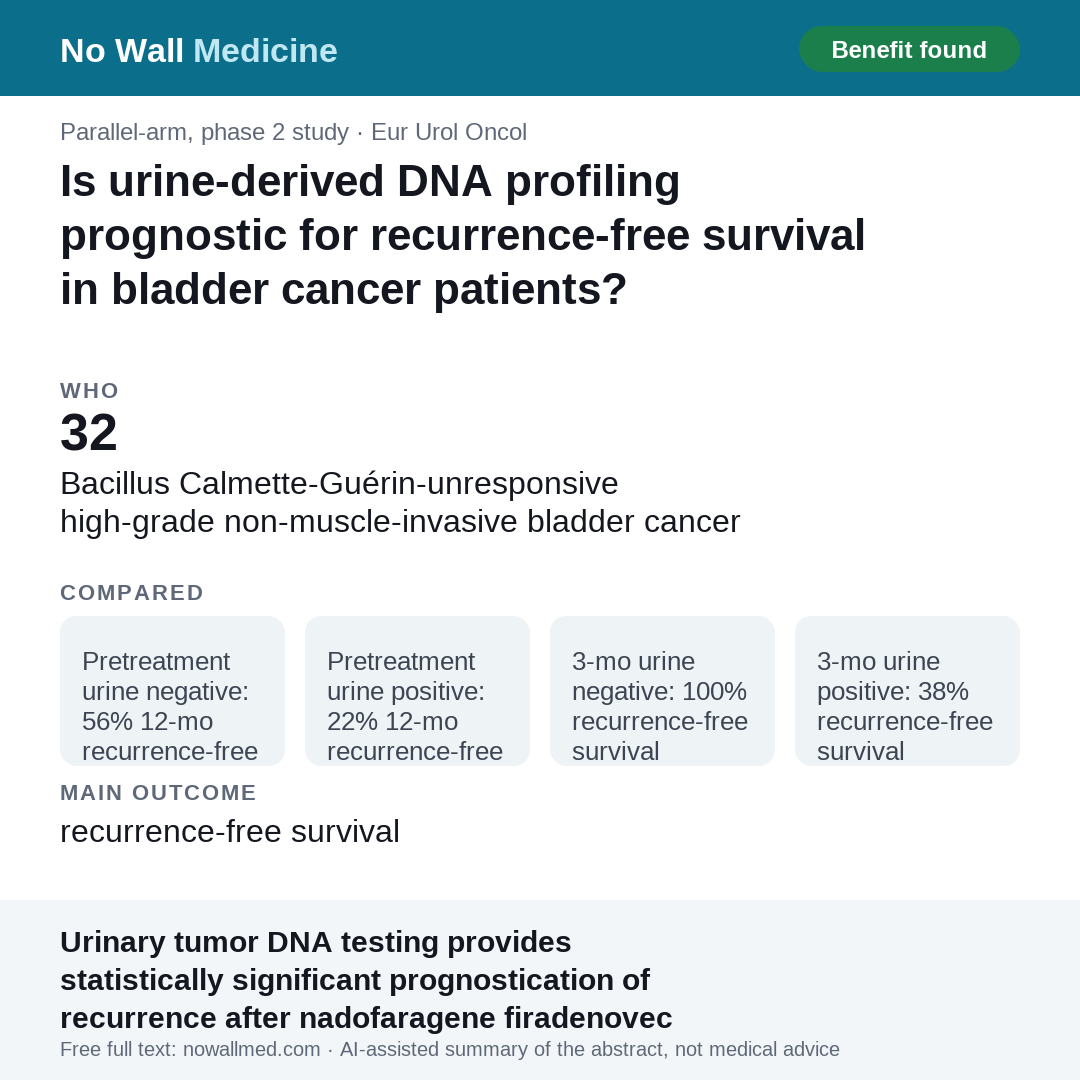
Pretreatment urine negative: 56% 12-mo recurrence-free survival
Pretreatment urine positive: 22% 12-mo recurrence-free survival
3-mo urine negative: 100% recurrence-free survival
3-mo urine positive: 38% recurrence-free survival
Main outcome
recurrence-free survival
Bottom line: Urinary tumor DNA testing provides statistically significant prognostication of recurrence after nadofaragene firadenovec induction.
Eur Urol Oncol · 2024-10-15Download image
Clinical question: Is urine-derived DNA profiling prognostic for recurrence-free survival in bladder cancer patients?
Why it matters: It is unknown if detecting minimal residual disease through urinary tumor DNA can predict treatment failure in patients with bladder cancer unresponsive to Bacillus Calmette-Guérin.
Key points
- Researchers studied patients with high-grade non-muscle-invasive bladder cancer who were unresponsive to Bacillus Calmette-Guérin and treated with nadofaragene firadenovec.
- Using 3-month urine samples, an experimental algorithm showed a 100% recurrence-free survival rate for negative patients compared to 38% for positive patients.
- Pretreatment urine testing with an enhanced algorithm showed a 71% recurrence-free survival rate for negative patients and 20% for positive patients.
Headline and key points written with AI from the paper’s abstract, with every number checked against it. Read the paper before relying on them.
Was this summary helpful?
Subject terms
Cite this article
Narayan VM, Tholomier C, Mokkapati S, Martini A, Caruso VM, Goudarzi M. Minimal Residual Disease Detection with Urine-derived DNA Is Prognostic for Recurrence-free Survival in Bacillus Calmette-Guérin-unresponsive Non-muscle-invasive Bladder Cancer Treated with Nadofaragene Firadenovec. Eur Urol Oncol. 2024. doi:10.1016/j.euo.2024.09.016
Spotted a mistake? Suggest a correction
Top studies every Monday
The week’s key trials and guidelines in your specialties, plus any topics you follow. By email, free.
Get the weekly digest