Minimal Residual Disease Status in Multiple Myeloma 1 Year After Autologous Hematopoietic Cell Transplantation and Lenalidomide Maintenance Are Associated With Long-Term Overall Survival
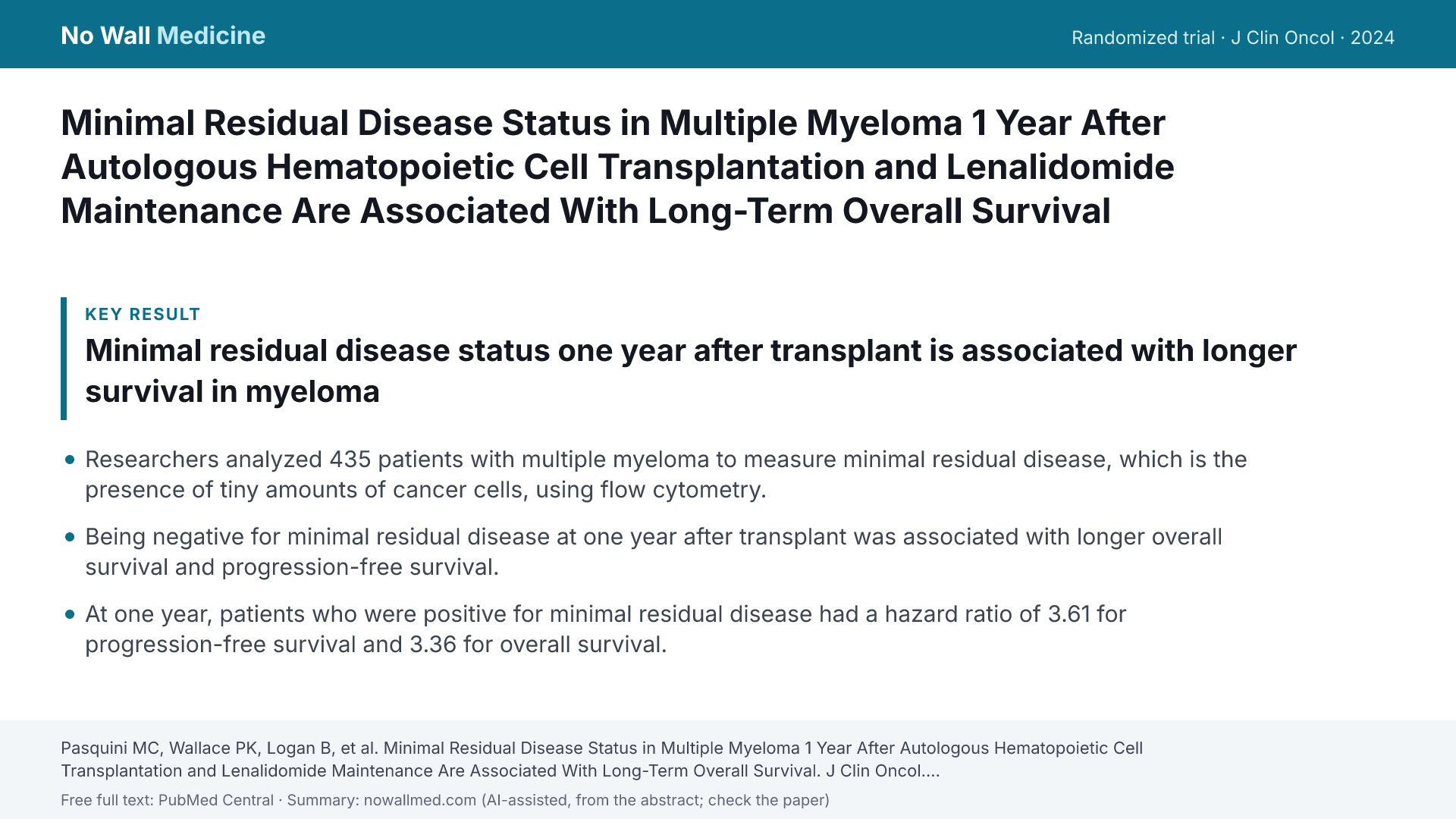
Key result: Minimal residual disease status one year after transplant is associated with longer survival in myeloma
Key points
- Researchers analyzed 435 patients with multiple myeloma to measure minimal residual disease, which is the presence of tiny amounts of cancer cells, using flow cytometry.
- Being negative for minimal residual disease at one year after transplant was associated with longer overall survival and progression-free survival.
- At one year, patients who were positive for minimal residual disease had a hazard ratio of 3.61 for progression-free survival and 3.36 for overall survival.
Discussion prompts
- Would these patients look like yours? Who was left out?
- Is the main outcome one that matters to patients?
- Is the difference large enough to change what you do?
Cite: Pasquini MC, Wallace PK, Logan B, et al. Minimal Residual Disease Status in Multiple Myeloma 1 Year After Autologous Hematopoietic Cell Transplantation and Lenalidomide Maintenance Are Associated With Long-Term Overall Survival. J Clin Oncol. 2024;42(23):2757-2768. doi:10.1200/JCO.23.00934
Free full text: PubMed Central · Summary and visual abstract: nowallmed.com/a/minimal-residual-disease-status-in-multiple-myeloma-1-year-after-91shnd/ (AI-assisted from the abstract; check the paper before relying on it).