Minimally invasive surgeries improved functional outcomes compared to craniotomy for spontaneous brain bleeds
Minimally invasive surgeries for spontaneous hypertensive intracerebral hemorrhage (MISICH): a multicenter randomized controlled trial
Multicenter randomized controlled trialBenefit found
Do minimally invasive surgeries improve functional outcomes in supratentorial hypertensive intracerebral hemorrhage?
Who
721
Patients with supratentorial hypertensive intracerebral hemorrhage · 16 centers
Compared
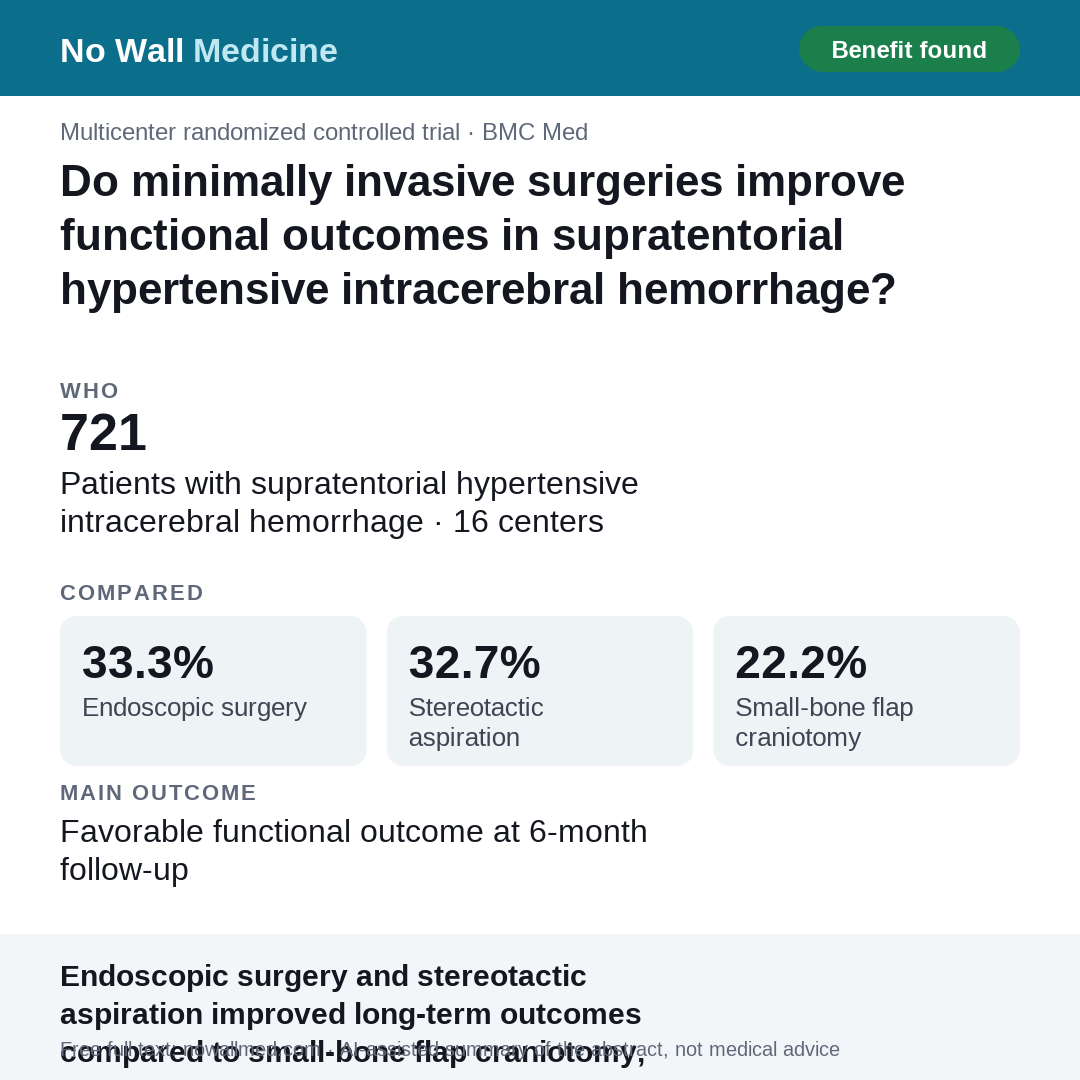
33.3%Endoscopic surgery (73 of 219)
32.7%Stereotactic aspiration (72 of 220)
22.2%Small-bone flap craniotomy (47 of 212)
Main outcome
Favorable functional outcome at 6-month follow-up
Bottom line: Endoscopic surgery and stereotactic aspiration improved long-term outcomes compared to small-bone flap craniotomy, especially for deep hemorrhages.
BMC Med · 2024-06-13Download image
Clinical question: Do minimally invasive surgeries improve functional outcomes in supratentorial hypertensive intracerebral hemorrhage?
Why it matters: It was unknown which surgical method is most effective for treating supratentorial hypertensive intracerebral hemorrhage.
Key points
- Researchers studied 721 patients with supratentorial hypertensive intracerebral hemorrhage, comparing endoscopic surgery, stereotactic aspiration, and small-bone flap craniotomy.
- At 6 months, 33.3% of the endoscopy group and 32.7% of the aspiration group achieved favorable functional outcomes compared to 22.2% in the craniotomy group.
- Mean hospitalization expenses were ¥92,420 for endoscopy, ¥77,351 for aspiration, and ¥100,947 for craniotomy.
Headline and key points written with AI from the paper’s abstract, with every number checked against it. Read the paper before relying on them.
Topics
Cite this article
Xu X, Zhang H, Zhang J, Luo M, Wang Q, Zhao Y. Minimally invasive surgeries for spontaneous hypertensive intracerebral hemorrhage (MISICH): a multicenter randomized controlled trial. BMC Med. 2024. doi:10.1186/s12916-024-03468-y
Spotted a mistake? Suggest a correction
Top studies every Monday
The week’s key trials and guidelines in your specialties, plus any topics you follow. By email, free.
Get the weekly digest