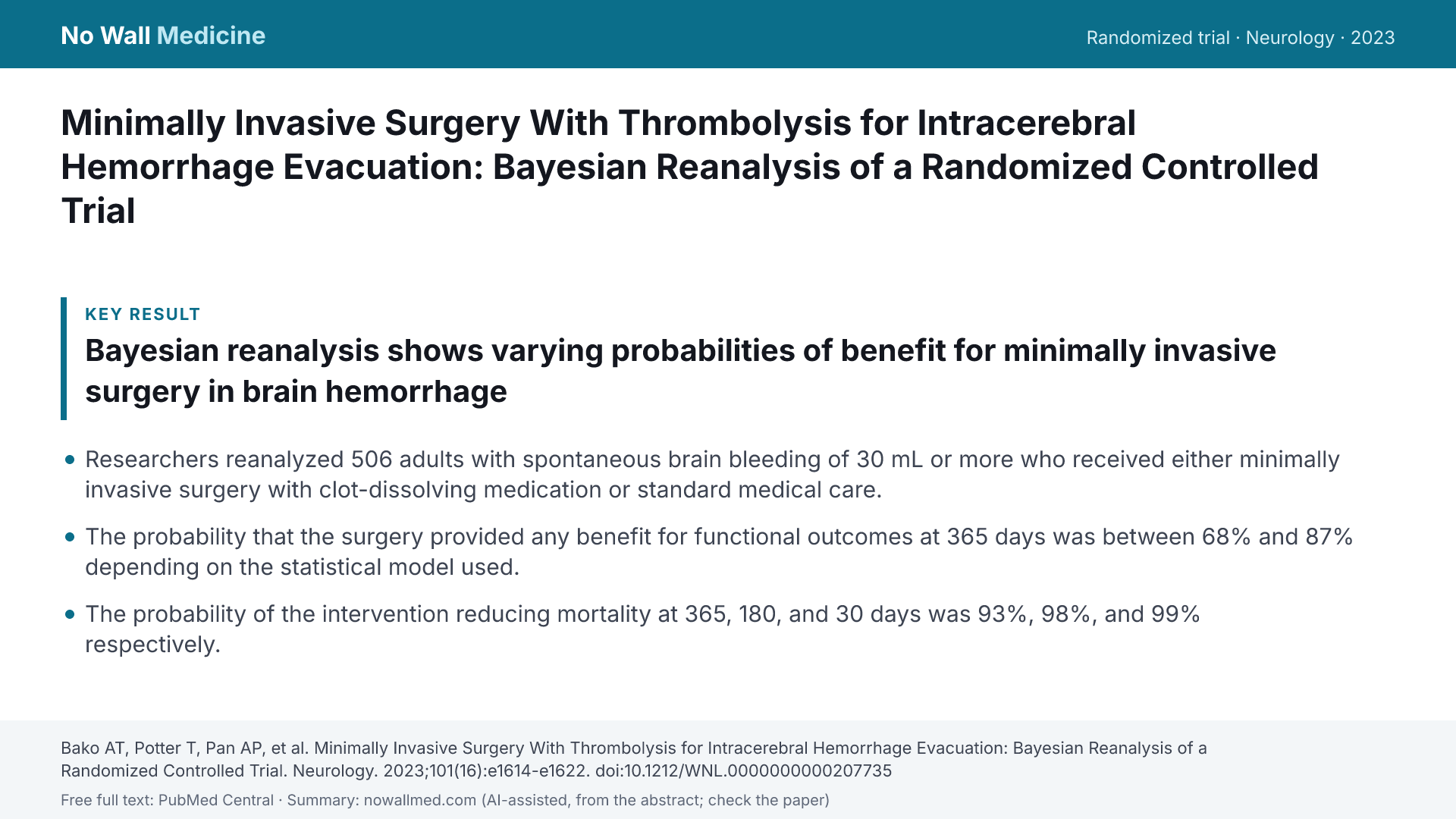
Bayesian reanalysis shows varying probabilities of benefit for minimally invasive surgery in brain hemorrhage
Minimally Invasive Surgery With Thrombolysis for Intracerebral Hemorrhage Evacuation: Bayesian Reanalysis of a Randomized Controlled Trial
Same trial (NCT01827046)
Papers we list that report this registered trial, oldest first. Read a secondary analysis alongside the main results.
- Main results
This paper Neurology 2023-09 - Secondary analysis Mixed results
Minimally invasive surgery with alteplase was associated with greater reduction in intraventricular hemorrhage volume J Neurol Neurosurg Psychiatry 2024-09
Key points
- Researchers reanalyzed 506 adults with spontaneous brain bleeding of 30 mL or more who received either minimally invasive surgery with clot-dissolving medication or standard medical care.
- The probability that the surgery provided any benefit for functional outcomes at 365 days was between 68% and 87% depending on the statistical model used.
- The probability of the intervention reducing mortality at 365, 180, and 30 days was 93%, 98%, and 99% respectively.
Headline and key points written with AI from the paper’s abstract, with every number checked against it. Read the paper before relying on them.
Was this summary helpful?
Subject terms
Headline, design, result, key points, caveat and citation as plain text.
Cite this article
Bako AT, Potter T, Pan AP, et al. Minimally Invasive Surgery With Thrombolysis for Intracerebral Hemorrhage Evacuation: Bayesian Reanalysis of a Randomized Controlled Trial. Neurology. 2023;101(16):e1614-e1622. doi:10.1212/WNL.0000000000207735
Spotted a mistake? Suggest a correction