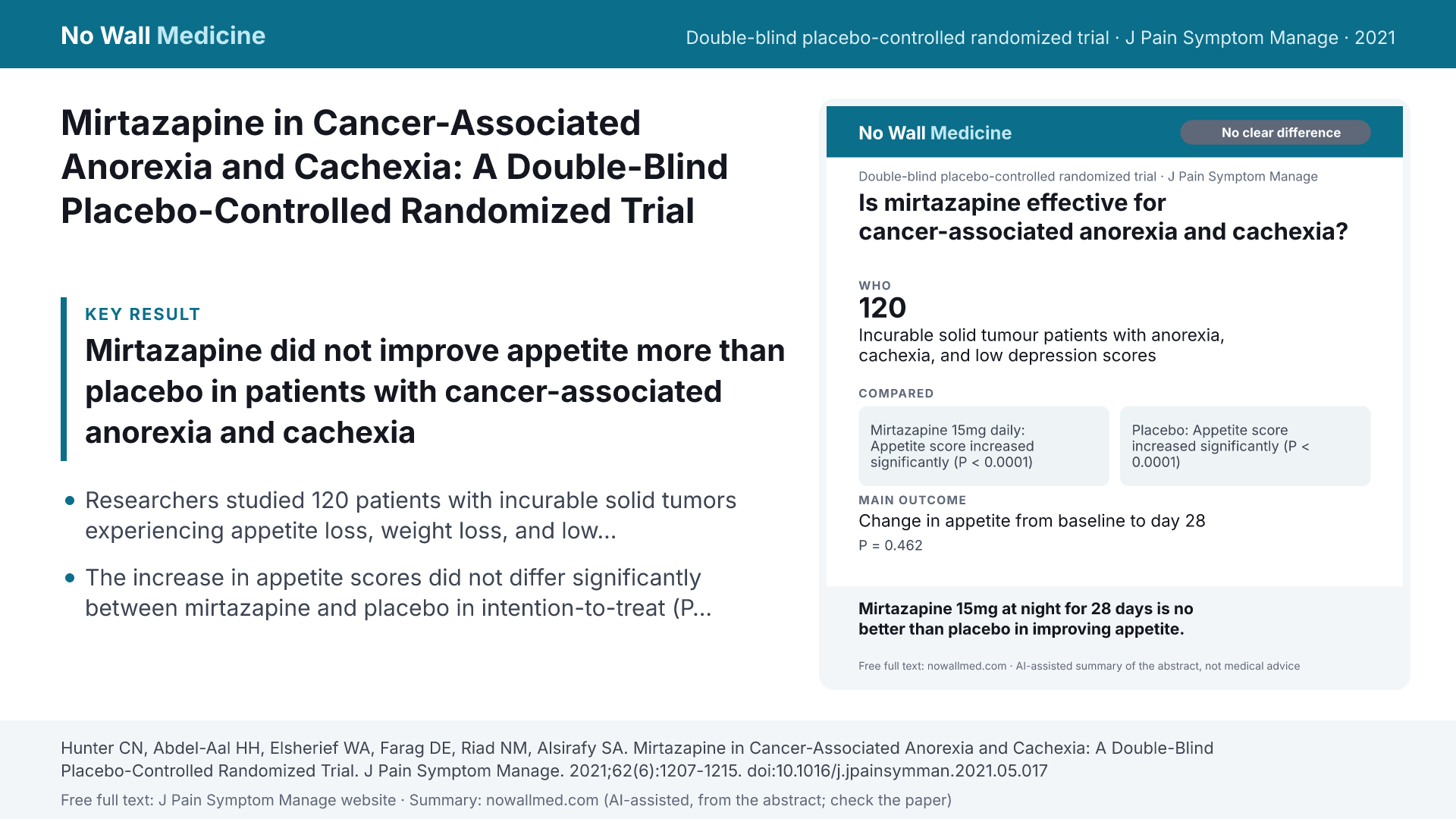
Mirtazapine did not improve appetite more than placebo in patients with cancer-associated anorexia and cachexia
Mirtazapine in Cancer-Associated Anorexia and Cachexia: A Double-Blind Placebo-Controlled Randomized Trial
Double-blind placebo-controlled randomized trialNo clear difference
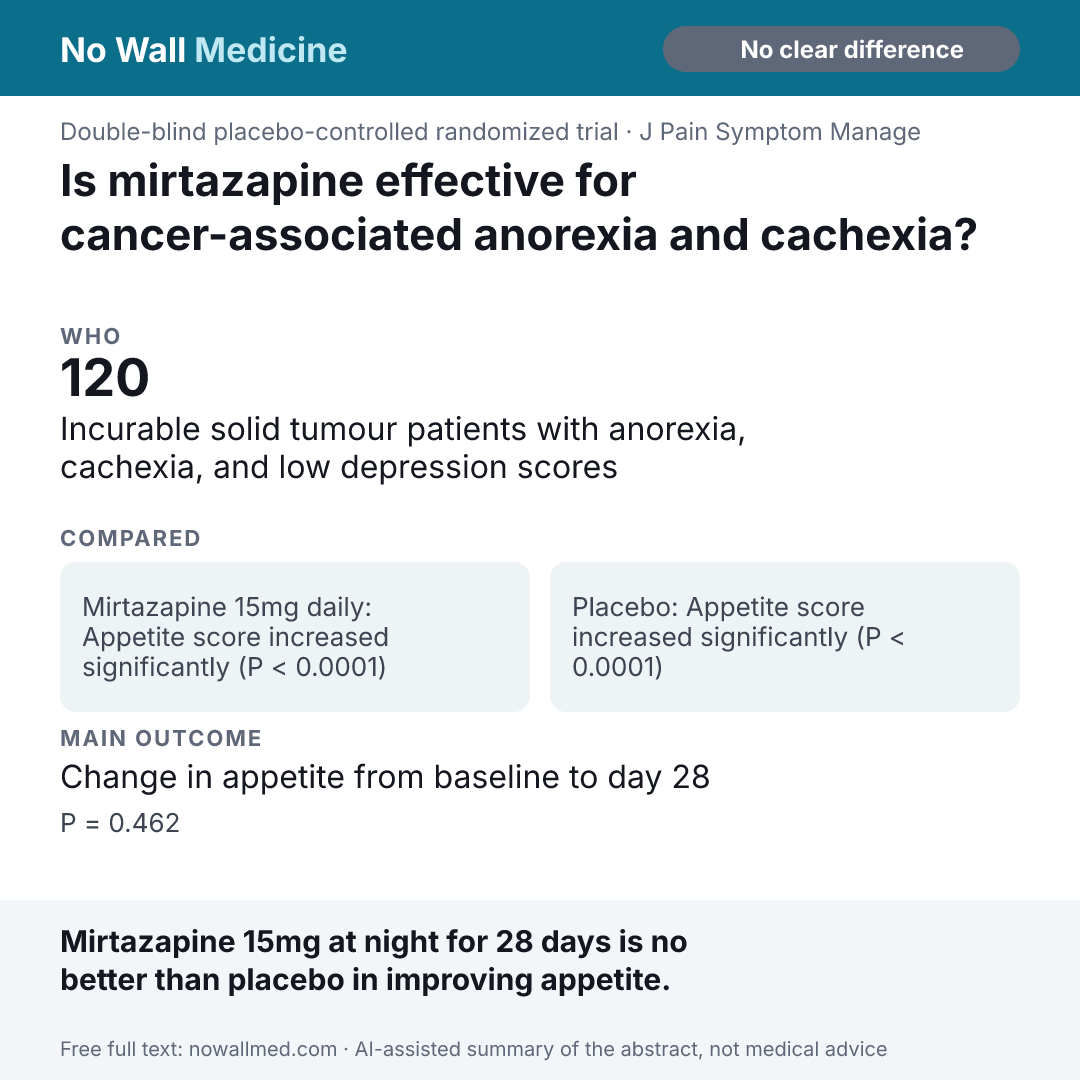
Is mirtazapine effective for cancer-associated anorexia and cachexia?
Who
120
Incurable solid tumour patients with anorexia, cachexia, and low depression scores
Compared
Mirtazapine 15mg daily: Appetite score increased significantly (P < 0.0001)
Placebo: Appetite score increased significantly (P < 0.0001)
Main outcome
Change in appetite from baseline to day 28
Result: P = 0.462
Bottom line: Mirtazapine 15mg at night for 28 days is no better than placebo in improving appetite.
J Pain Symptom Manage · 2021-05-26 · Save PNG
Clinical question: Is mirtazapine effective for cancer-associated anorexia and cachexia?
Why it matters: Few pharmacological interventions are available for managing appetite loss and muscle wasting in patients with cancer.
Key points
- Researchers studied 120 patients with incurable solid tumors experiencing appetite loss, weight loss, and low depression scores.
- The increase in appetite scores did not differ significantly between mirtazapine and placebo in intention-to-treat (P = 0.462) or per-protocol (P = 0.472) analyses.
- Mirtazapine was associated with a significantly smaller increase in depressive symptoms and a higher prevalence of somnolence, which is excessive sleepiness.
Headline and key points written with AI from the paper’s abstract, with every number checked against it. Read the paper before relying on them.
Was this summary helpful?
Subject terms
Headline, design, result, key points, caveat and citation as plain text.
Cite this article
Hunter CN, Abdel-Aal HH, Elsherief WA, Farag DE, Riad NM, Alsirafy SA. Mirtazapine in Cancer-Associated Anorexia and Cachexia: A Double-Blind Placebo-Controlled Randomized Trial. J Pain Symptom Manage. 2021;62(6):1207-1215. doi:10.1016/j.jpainsymman.2021.05.017
Spotted a mistake? Suggest a correction