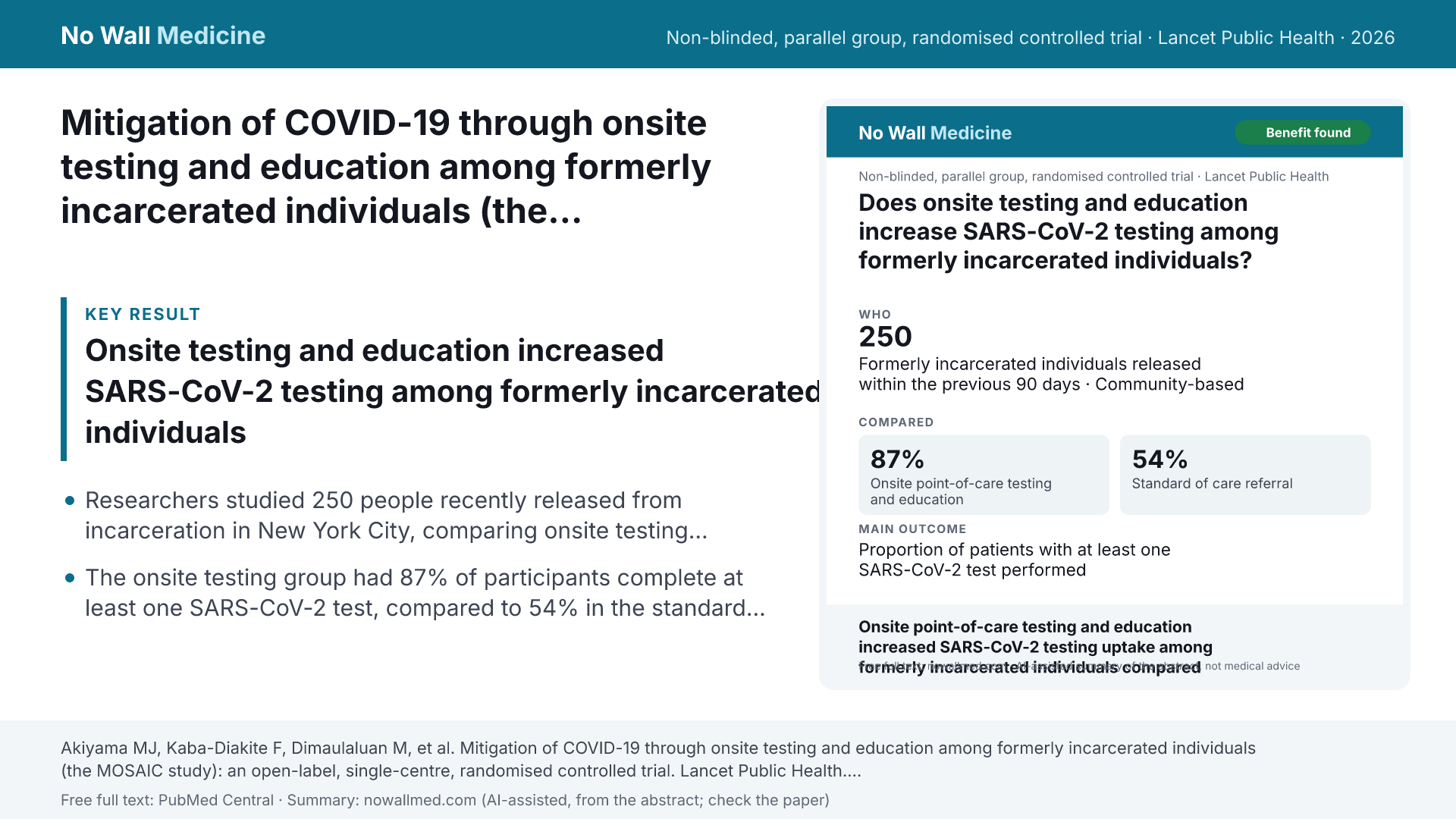
Onsite testing and education increased SARS-CoV-2 testing among formerly incarcerated individuals
Mitigation of COVID-19 through onsite testing and education among formerly incarcerated individuals (the MOSAIC study): an open-label, single-centre, randomised controlled trial
Non-blinded, parallel group, randomised controlled trialBenefit found
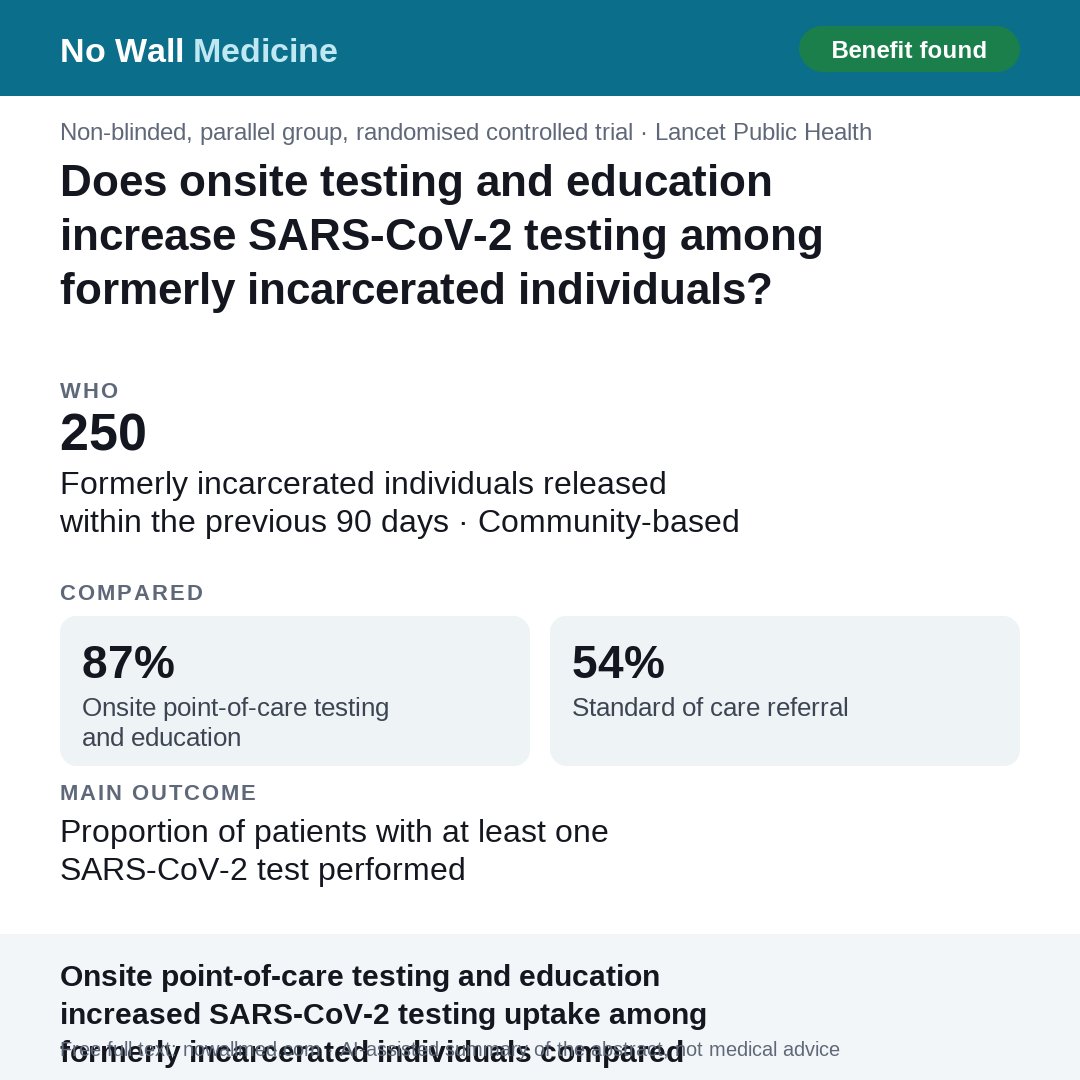
Does onsite testing and education increase SARS-CoV-2 testing among formerly incarcerated individuals?
Who
250
Formerly incarcerated individuals released within the previous 90 days · Community-based organisation in New York City, USA
Compared
87%Onsite point-of-care testing and education
54%Standard of care referral
Main outcome
Proportion of patients with at least one SARS-CoV-2 test performed
Result: odds ratio 5·9 (95% CI 3·1-11·1)
Bottom line: Onsite point-of-care testing and education increased SARS-CoV-2 testing uptake among formerly incarcerated individuals compared to standard referrals.
Funded by: US National Institutes of Health
Lancet Public Health · 2026-06-24Download image
Clinical question: Does onsite testing and education increase SARS-CoV-2 testing among formerly incarcerated individuals?
Why it matters: Individuals released from incarceration face barriers to care and increased risks for respiratory viral infections due to living in congregate settings.
In absolute numbers
Onsite point-of-care testing and education: 87% · Standard of care referral: 54% → a difference of 33 percentage points, so about 4 people would need the treatment for 1 more to benefit (number needed to treat) over the trial’s follow-up.
Worked out by us from the two group results above, not reported by the authors. Check the paper for the exact outcome and timing.
Key points
- Researchers studied 250 people recently released from incarceration in New York City, comparing onsite testing and education to standard referrals for offsite testing.
- The onsite testing group had 87% of participants complete at least one SARS-CoV-2 test, compared to 54% in the standard care group.
- The incidence rate of complete SARS-CoV-2 tests was 2.4 times as high in the onsite testing and education group.
Headline and key points written with AI from the paper’s abstract, with every number checked against it. Read the paper before relying on them.
Was this summary helpful?
Abstract
Background
Criminal legal system-involved individuals face barriers to care after release from carceral settings. Elevated SARS-CoV-2 risk while incarcerated, together with living in congregate settings post-incarceration, increase the risk of respiratory viral infection transmission. This study evaluated a community health worker-led point-of-care SARS-CoV-2 testing and education intervention in a re-entry-focused community-based organisation compared with standard referrals. Methods
This non-blinded, parallel group, randomised controlled trial, conducted in partnership with a community-based organisation in New York City (NYC), NY, USA, enrolled clients who were released from incarceration in the previous 90 days, fluent in English or Spanish, and residing within NYC for the study duration. Participants were randomly assigned (1:1) via computer-generated randomisation to onsite point-of-care testing and education or standard of care referral to offsite testing sites over 12 months. All participants were advised to test every 3 months. The study was not masked due to the nature of the intervention. The primary outcome was the proportion of patients with at least one SARS-CoV-2 test performed with results received during the 12-month period. Primary analyses were done by intention-to-treat using logistic or Poisson regression modelling. This trial was registered with ClinicalTrials.gov, NCT04878328, and is completed. Findings
Between April 14, 2022, and May 22, 2024, 572 formerly incarcerated individuals were assessed for study eligibility. After the exclusion of 247 individuals, and a further 75 who did not attend enrolment, 250 participants were randomly assigned to the two study groups (125 to onsite point-of-care testing and education and 125 to standard of care). 216 (86%) participants were cisgender men, 30 (12%) were cisgender women, two (1%) were transgender women, and two (1%) were non-binary; 120 (48%) were Black and 82 (33%) were Hispanic; mean age was 42·0 years (SD 11·8). 109 (87%) of the 125 participants in the onsite point-of-care testing and education group and 67 (54%) of 125 participants in the standard of care group had at least one complete SARS-CoV-2 test (odds ratio 5·9 [95% CI 3·1-11·1]; p<0·0001). The absolute difference was 34 percentage points (95% CI 23-44; p<0·0001). The incidence rate ratio of complete SARS-CoV-2 tests was 2·4 times (95% CI 1·9-3·0, p<0·0001) as high among participants in the intervention group versus those in the standard of care group. No serious adverse events occurred. Interpretation
Community-health worker-led testing and education at a re-entry-focused community-based organisation could potentially increase uptake of SARS-CoV-2 testing among formerly incarcerated individuals. Although further, larger trials are required, trusted community health workers can provide onsite point-of-care testing and health education, which has relevance for respiratory viral infections such as SARS-CoV-2 and might potentially be applicable to other infectious diseases such as HIV and hepatitis C virus. Funding
US National Institutes of Health.
Abstract reproduced under the article’s CC BY licence.
Subject terms
Cite this article
Akiyama MJ, Kaba-Diakite F, Dimaulaluan M, et al. Mitigation of COVID-19 through onsite testing and education among formerly incarcerated individuals (the MOSAIC study): an open-label, single-centre, randomised controlled trial. Lancet Public Health. 2026. doi:10.1016/S2468-2667(26)00093-9
Spotted a mistake? Suggest a correction