Systematic review finds diverse hearing loss characteristics in children with mitochondrial disease
Mitochondrial Disease and Hearing Loss in Children: A Systematic Review
Systematic reviewUnclear result
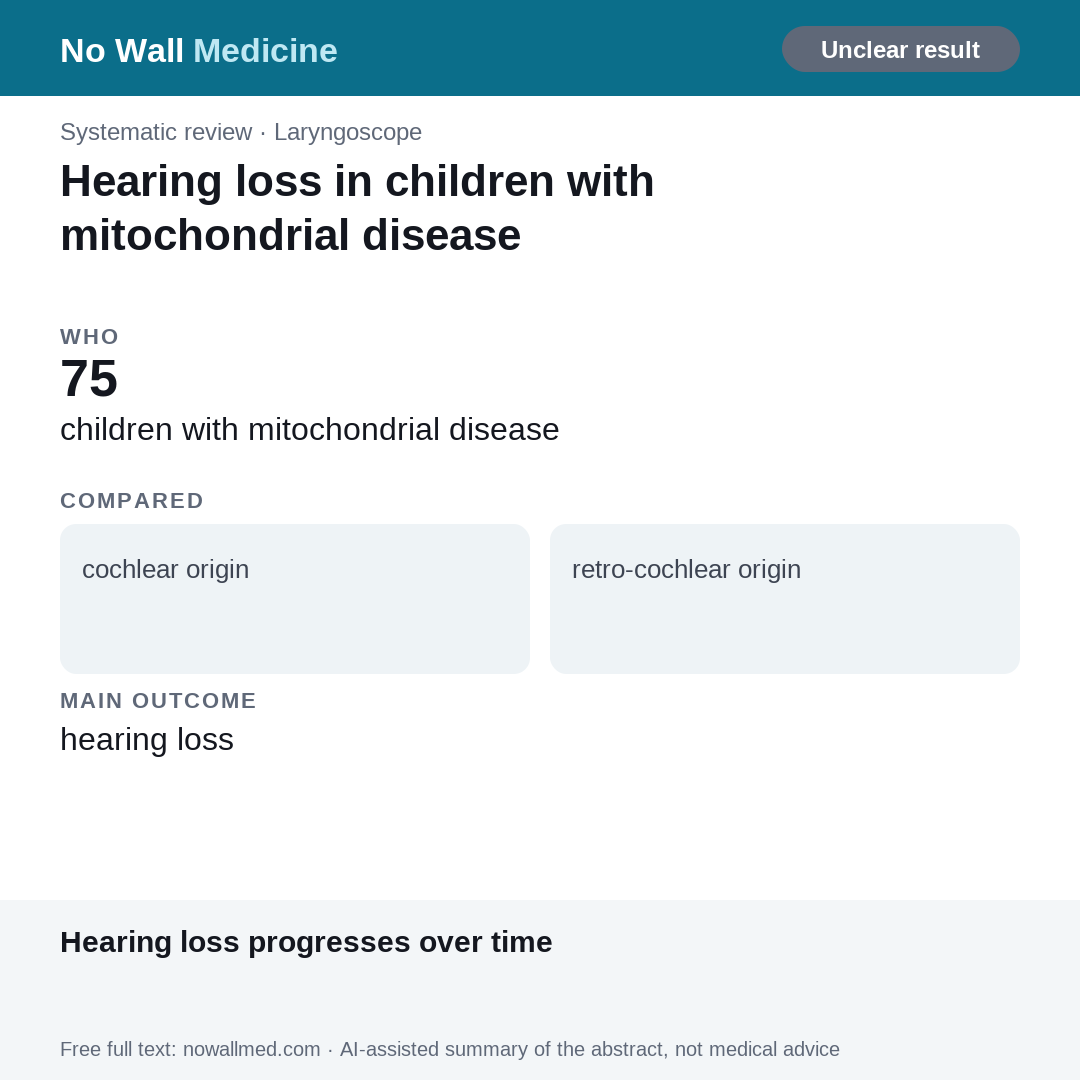
Hearing loss in children with mitochondrial disease
Who
75
children with mitochondrial disease
Compared
cochlear origin
retro-cochlear origin
Main outcome
hearing loss
Bottom line: Hearing loss progresses over time
Limitation: inhomogeneous reporting
Laryngoscope · 2022-02-21Download image
Why it matters: The specific characteristics and patterns of hearing loss in children with genetically proven mitochondrial disease were not clearly summarized in existing literature.
Key points
- Researchers reviewed 23 articles involving 75 individuals with childhood onset hearing loss and genetically proven mitochondrial disease.
- The review found that both cochlear and retro-cochlear hearing loss—where the issue is in the inner ear or the nerve pathways—occur in different mitochondrial diseases.
- Hearing loss in these patients showed manifold characteristics, though progression over time appeared to be a common feature.
Headline and key points written with AI from the paper’s abstract, with every number checked against it. Read the paper before relying on them.
Was this summary helpful?
Abstract
Objectives
Hearing loss is a clinical symptom, frequently mentioned in the context of mitochondrial disease. With no cure available for mitochondrial disease, supportive treatment of clinical symptoms like hearing loss is of the utmost importance. The aim of this study was to summarize current knowledge on hearing loss in genetically proven mitochondrial disease in children and deduce possible and necessary consequences in patient care. Methods
Systematic literature review, including Medline, Embase, and Cochrane library. Review protocol was established and registered prior to conduction (International prospective register of systematic reviews-PROSPERO: CRD42020165356). Conduction of this review was done in accordance with MOOSE criteria. Results
A total of 23 articles, meeting predefined criteria and providing sufficient information on 75 individuals with childhood onset hearing loss was included for analysis. Both cochlear and retro-cochlear origin of hearing loss can be identified among different types of mitochondrial disease. Analysis was hindered by inhomogeneous reporting and methodical limitations. Conclusion
Overall, the findings do not allow for a general statement on hearing loss in children with mitochondrial disease. Retro-cochlear hearing loss seems to be found more often than expected. A common feature appears to be progression of hearing loss over time. However, hearing loss in these patients shows manifold characteristics. Therefore, awareness of mitochondrial disease as a possible causative background is important for otolaryngologists. Future attempts rely on standardized reporting and long-term follow-up. Level of evidence
NA Laryngoscope, 132:2459-2472, 2022.
Abstract reproduced under the article’s CC BY-NC-ND licence.
Subject terms
Cite this article
Roesch S, O'Sullivan A, Zimmermann G, Mair A, Lipuš C, Mayr JA. Mitochondrial Disease and Hearing Loss in Children: A Systematic Review. Laryngoscope. 2022. doi:10.1002/lary.30067
Spotted a mistake? Suggest a correction
Top studies every Monday
The week’s key trials and guidelines in your specialties, plus any topics you follow. By email, free.
Get the weekly digest