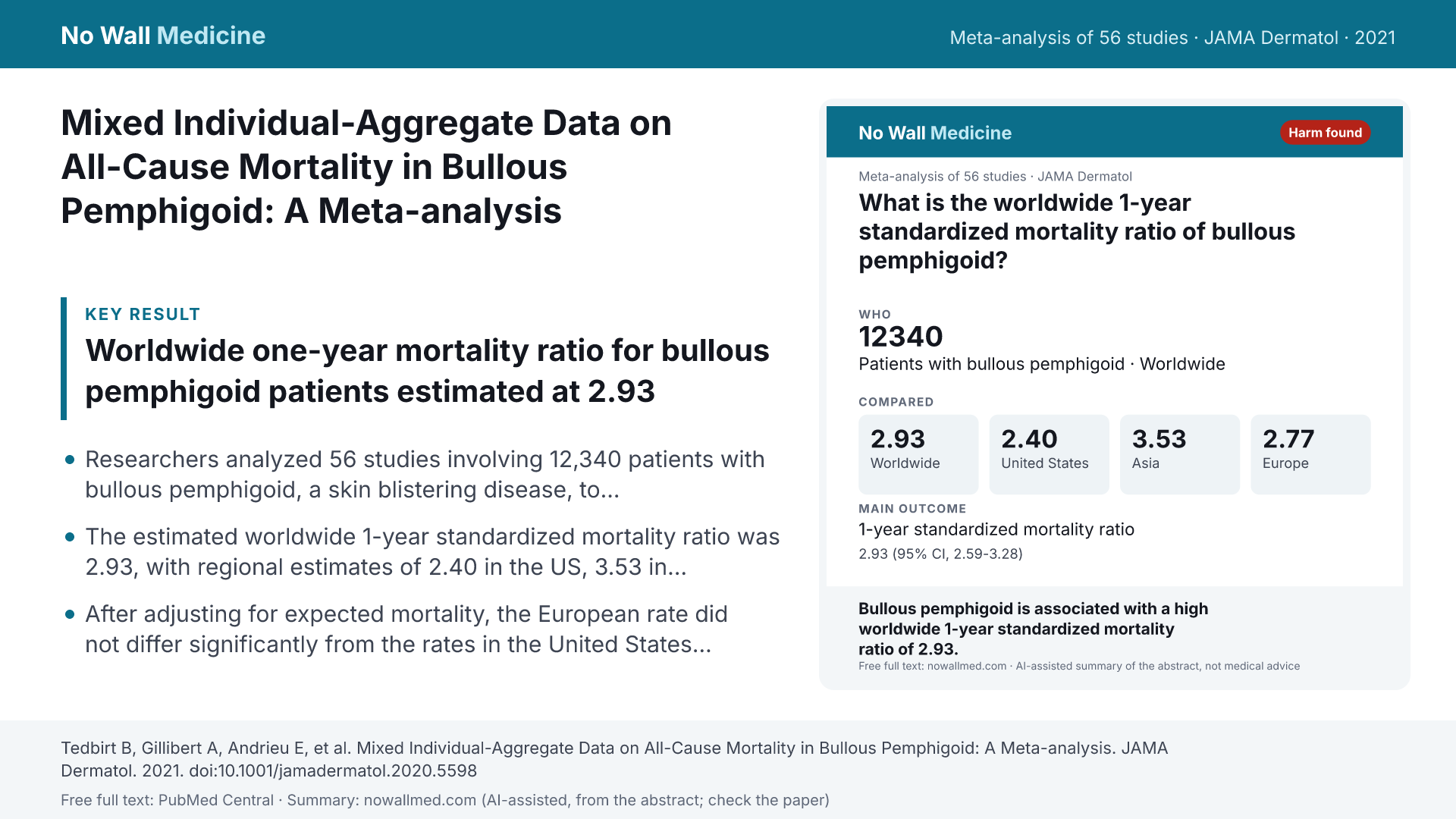
Worldwide one-year mortality ratio for bullous pemphigoid patients estimated at 2.93
Mixed Individual-Aggregate Data on All-Cause Mortality in Bullous Pemphigoid: A Meta-analysis
Meta-analysis of 56 studiesHarm found
What is the worldwide 1-year standardized mortality ratio of bullous pemphigoid?
Who
12340
Patients with bullous pemphigoid · Worldwide
Compared
2.93Worldwide (95% CI, 2.59-3.28)
2.40United States (95% CI, 0.89-3.90)
3.53Asia (95% CI, 2.85-4.20)
2.77Europe (95% CI, 2.35-3.19)
Main outcome
1-year standardized mortality ratio
Result: 2.93 (95% CI, 2.59-3.28)
Bottom line: Bullous pemphigoid is associated with a high worldwide 1-year standardized mortality ratio of 2.93.
Limitation: High heterogeneity, poor follow-up quality, and low representativity in most studies.
JAMA Dermatol · 2021-03-18 · Save PNG
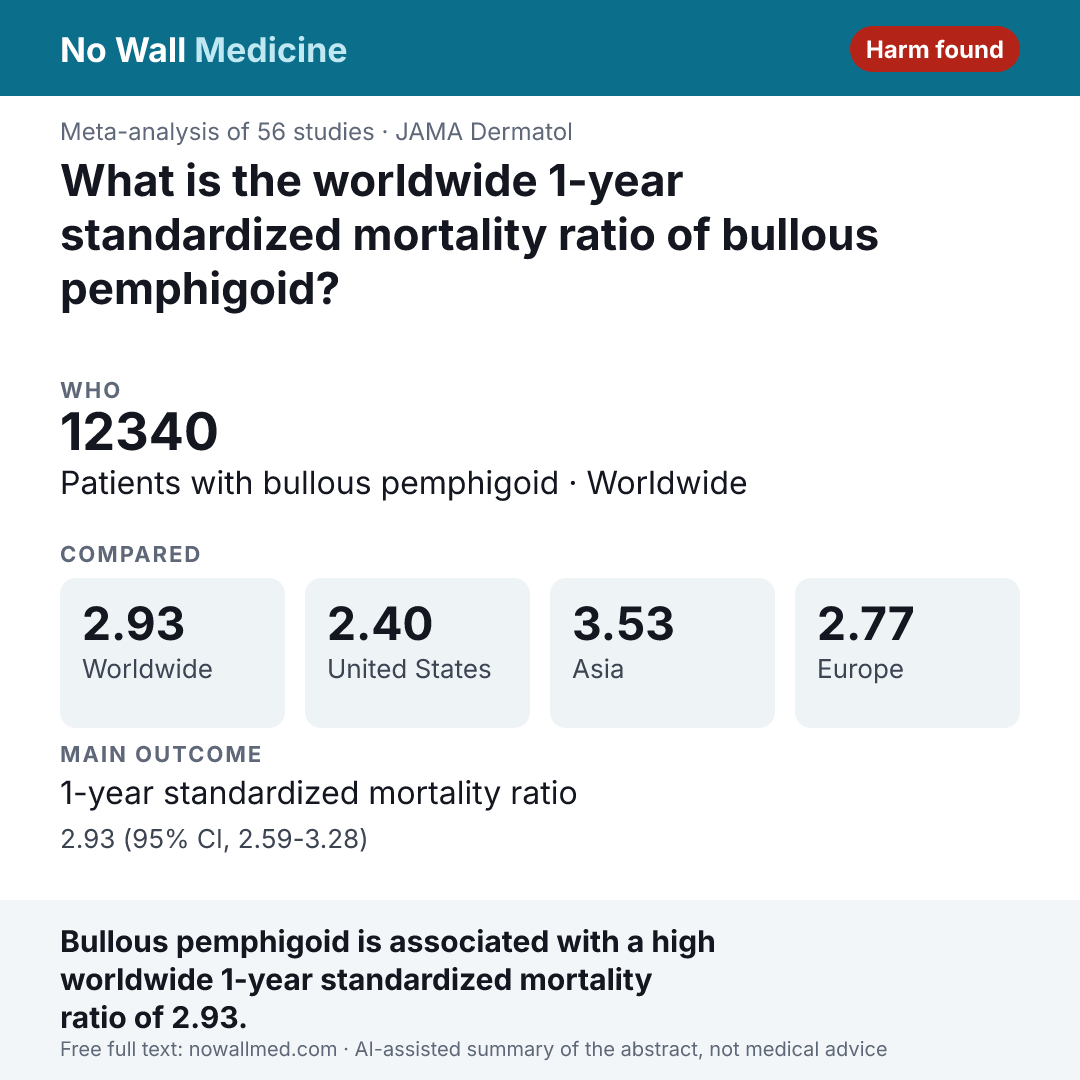
Clinical question: What is the worldwide 1-year standardized mortality ratio of bullous pemphigoid?
Why it matters: The 1-year standardized mortality ratio for bullous pemphigoid has been reported with varying ranges and differences between the US and Europe.
Key points
- Researchers analyzed 56 studies involving 12,340 patients with bullous pemphigoid, a skin blistering disease, to estimate global mortality rates.
- The estimated worldwide 1-year standardized mortality ratio was 2.93, with regional estimates of 2.40 in the US, 3.53 in Asia, and 2.77 in Europe.
- After adjusting for expected mortality, the European rate did not differ significantly from the rates in the United States or Asia.
Limitation the authors note: The authors noted high heterogeneity, poor follow-up quality, and that only 7.1% of studies used sampling methods guaranteeing representativity of cases.
Headline and key points written with AI from the paper’s abstract, with every number checked against it. Read the paper before relying on them.
Was this summary helpful?
Subject terms
Headline, design, result, key points, caveat and citation as plain text.
Cite this article
Tedbirt B, Gillibert A, Andrieu E, et al. Mixed Individual-Aggregate Data on All-Cause Mortality in Bullous Pemphigoid: A Meta-analysis. JAMA Dermatol. 2021. doi:10.1001/jamadermatol.2020.5598
Spotted a mistake? Suggest a correction