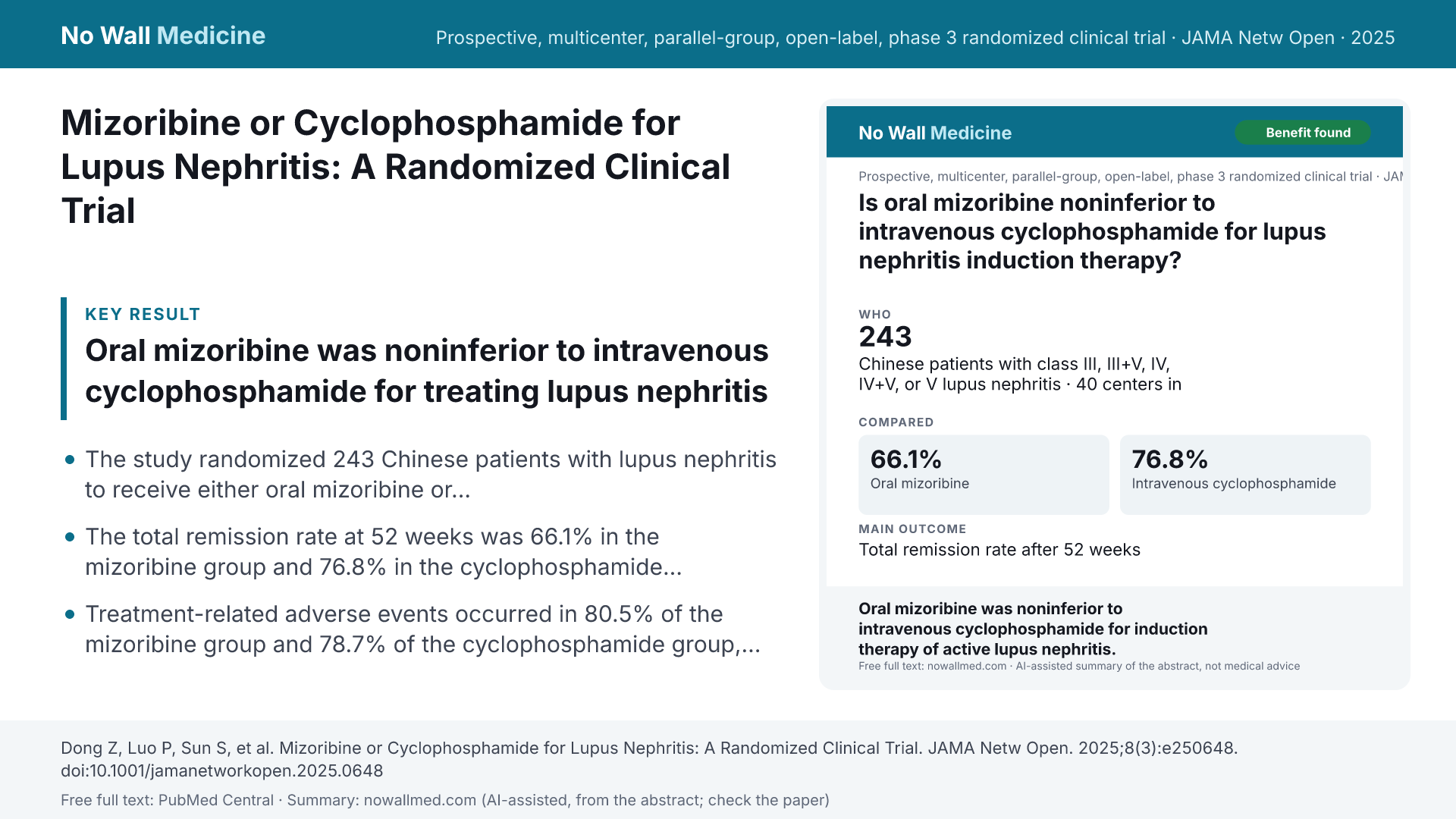
Oral mizoribine was noninferior to intravenous cyclophosphamide for treating lupus nephritis
Mizoribine or Cyclophosphamide for Lupus Nephritis: A Randomized Clinical Trial
Prospective, multicenter, parallel-group, open-label, phase 3 randomized clinical trialBenefit found
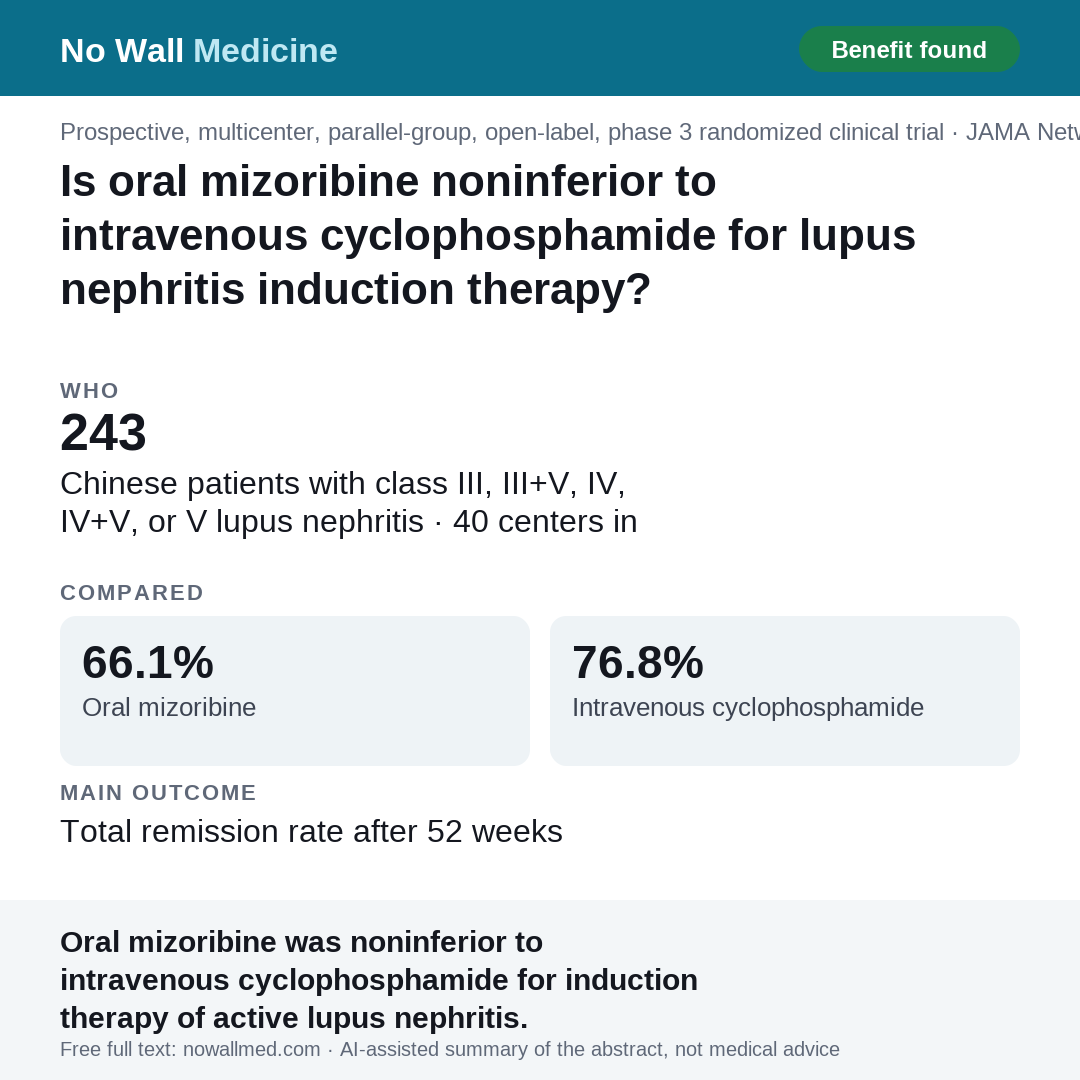
Is oral mizoribine noninferior to intravenous cyclophosphamide for lupus nephritis induction therapy?
Who
243
Chinese patients with class III, III+V, IV, IV+V, or V lupus nephritis · 40 centers in China
Compared
66.1%Oral mizoribine (76 of 115 patients)
76.8%Intravenous cyclophosphamide (86 of 112 patients)
Main outcome
Total remission rate after 52 weeks
Result: relative risk ratio 0.861 (95% CI 0.729-1.016)
Bottom line: Oral mizoribine was noninferior to intravenous cyclophosphamide for induction therapy of active lupus nephritis.
JAMA Netw Open · 2025-03-03Download image
Clinical question: Is oral mizoribine noninferior to intravenous cyclophosphamide for lupus nephritis induction therapy?
Why it matters: It is unknown if oral mizoribine is a safe and effective alternative to intravenous cyclophosphamide, which is associated with serious adverse effects, for induction therapy in lupus nephritis.
Key points
- The study randomized 243 Chinese patients with lupus nephritis to receive either oral mizoribine or intravenous cyclophosphamide plus oral glucocorticoids for 52 weeks.
- The total remission rate at 52 weeks was 66.1% in the mizoribine group and 76.8% in the cyclophosphamide group, showing mizoribine was noninferior.
- Treatment-related adverse events occurred in 80.5% of the mizoribine group and 78.7% of the cyclophosphamide group, with upper respiratory tract infections being the most frequent.
Headline and key points written with AI from the paper’s abstract, with every number checked against it. Read the paper before relying on them.
Was this summary helpful?
Subject terms
Cite this article
Dong Z, Luo P, Sun S, Ni Z, He Y, Huang X. Mizoribine or Cyclophosphamide for Lupus Nephritis: A Randomized Clinical Trial. JAMA Netw Open. 2025. doi:10.1001/jamanetworkopen.2025.0648
Spotted a mistake? Suggest a correction
Top studies every Monday
The week’s key trials and guidelines in your specialties, plus any topics you follow. By email, free.
Get the weekly digest