Automated bidirectional text messages were associated with higher COVID-19 testing rates in school communities
Mobile Intervention for Increasing COVID-19 Testing in K-12 Schools Serving Disadvantaged Communities: Randomized Controlled Trial of SCALE-UP Counts
Randomized trialBenefit found
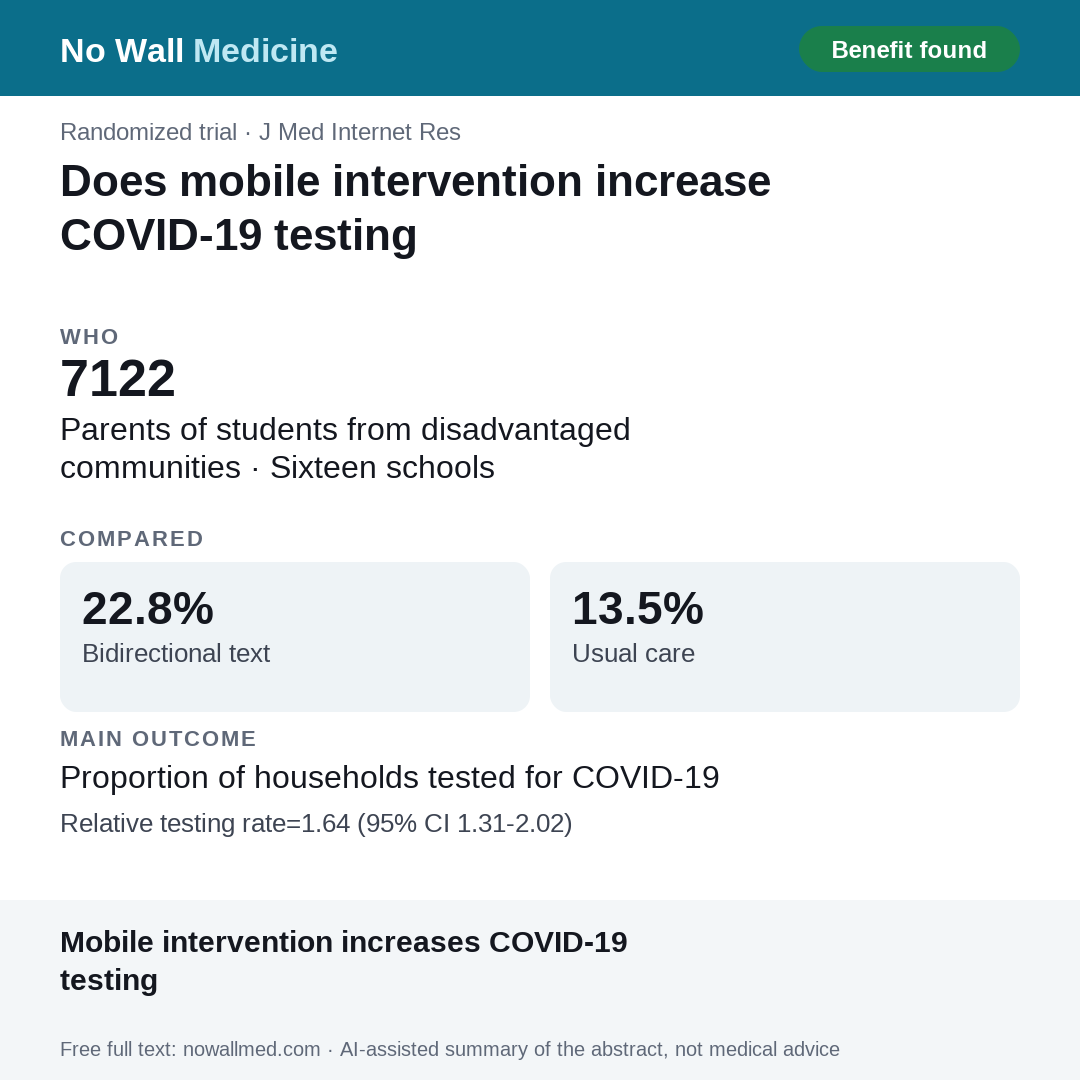
Does mobile intervention increase COVID-19 testing
Who
7122
Parents of students from disadvantaged communities · Sixteen schools
Compared
22.8%Bidirectional text
13.5%Usual care
Main outcome
Proportion of households tested for COVID-19
Result: Relative testing rate=1.64 (95% CI 1.31-2.02)
Bottom line: Mobile intervention increases COVID-19 testing
J Med Internet Res · 2025-11-11Download image
Why it matters: Schools often lack the information technology infrastructure needed to monitor COVID-19 cases and connect families to testing resources.
In absolute numbers
Bidirectional text: 22.8% · Usual care: 13.5% → a difference of 9.3 percentage points, so about 11 people would need the treatment for 1 more to benefit (number needed to treat) over the trial’s follow-up.
Worked out by us from the two group results above, not reported by the authors. Check the paper for the exact outcome and timing.
Key points
- Researchers studied 7122 parents from 16 schools to compare intensive bidirectional text messaging with usual unidirectional text messaging.
- The bidirectional messaging group had a higher self-reported testing rate of 22.8% compared to 13.5% in the control group.
- There was no observed difference in the number of missed school days between the two study arms.
Headline and key points written with AI from the paper’s abstract, with every number checked against it. Read the paper before relying on them.
Topics
Cite this article
Wu YP, Chipman JJ, Kolp L, Stump TK, Kuzmenko TV, Del Fiol G. Mobile Intervention for Increasing COVID-19 Testing in K-12 Schools Serving Disadvantaged Communities: Randomized Controlled Trial of SCALE-UP Counts. J Med Internet Res. 2025. doi:10.2196/79775
Spotted a mistake? Suggest a correction
Top studies every Monday
The week’s key trials and guidelines in your specialties, plus any topics you follow. By email, free.
Get the weekly digest