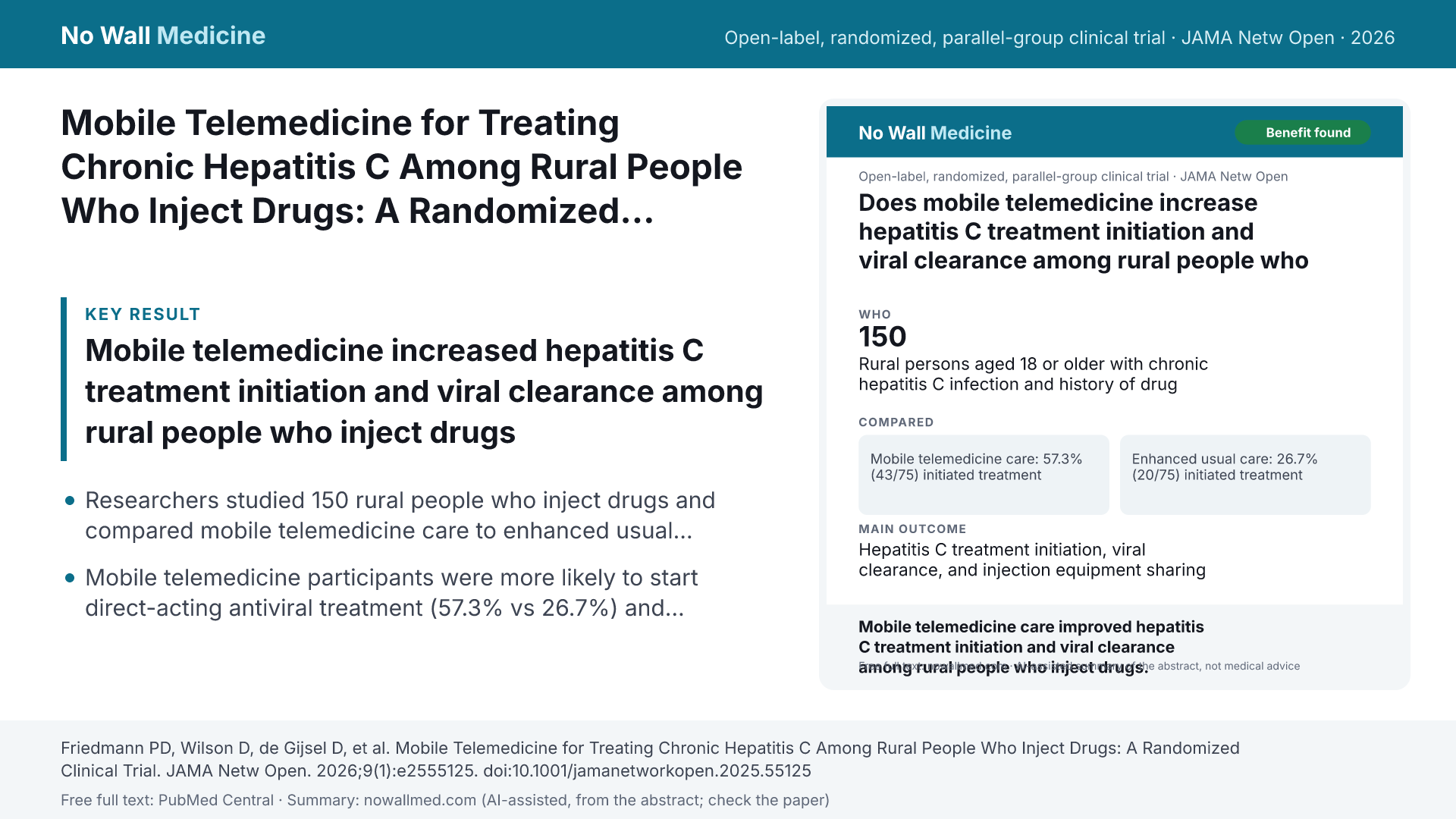
Mobile telemedicine increased hepatitis C treatment initiation and viral clearance among rural people who inject drugs
Mobile Telemedicine for Treating Chronic Hepatitis C Among Rural People Who Inject Drugs: A Randomized Clinical Trial
Open-label, randomized, parallel-group clinical trialBenefit found
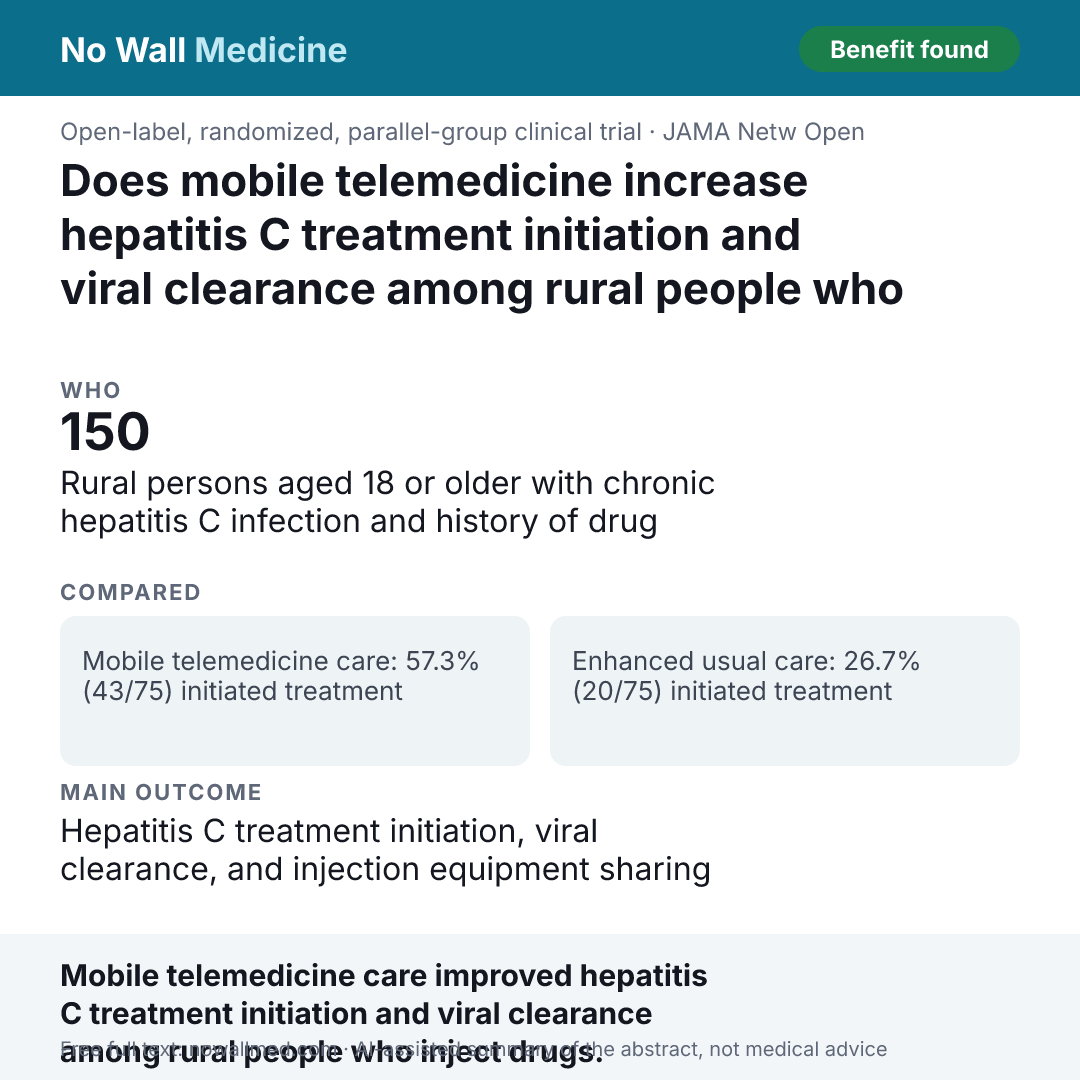
Does mobile telemedicine increase hepatitis C treatment initiation and viral clearance among rural people who inject drugs?
Who
150
Rural persons aged 18 or older with chronic hepatitis C infection and history of drug injection · 3 rural counties in New Hampshire and Vermont
Compared
Mobile telemedicine care: 57.3% (43/75) initiated treatment
Enhanced usual care: 26.7% (20/75) initiated treatment
Main outcome
Hepatitis C treatment initiation, viral clearance, and injection equipment sharing
Result: relative risk 2.15 (95% CI, 1.41-3.28) for treatment initiation
Bottom line: Mobile telemedicine care improved hepatitis C treatment initiation and viral clearance among rural people who inject drugs.
JAMA Netw Open · 2026-01-02 · Save PNG
Clinical question: Does mobile telemedicine increase hepatitis C treatment initiation and viral clearance among rural people who inject drugs?
Why it matters: People who inject drugs in rural areas face high rates of chronic hepatitis C and poor access to testing, treatment, and syringe services.
In absolute numbers
Mobile telemedicine care: 57.3% · Enhanced usual care: 26.7% → a difference of 30.6 percentage points, so about 4 people would need the treatment for 1 more to benefit (number needed to treat) over the trial’s follow-up.
Worked out by us from the two group results above, not reported by the authors. Check the paper for the exact outcome and timing.
Key points
- Researchers studied 150 rural people who inject drugs and compared mobile telemedicine care to enhanced usual care integrated with van-based syringe services.
- Mobile telemedicine participants were more likely to start direct-acting antiviral treatment (57.3% vs 26.7%) and achieve viral clearance (37.3% vs 18.7%).
- The mobile telemedicine intervention had no effect on whether participants reported abstaining from sharing injection equipment at follow-up.
Headline and key points written with AI from the paper’s abstract, with every number checked against it. Read the paper before relying on them.
Was this summary helpful?
Subject terms
Headline, design, result, key points, caveat and citation as plain text.
Cite this article
Friedmann PD, Wilson D, de Gijsel D, et al. Mobile Telemedicine for Treating Chronic Hepatitis C Among Rural People Who Inject Drugs: A Randomized Clinical Trial. JAMA Netw Open. 2026;9(1):e2555125. doi:10.1001/jamanetworkopen.2025.55125
Spotted a mistake? Suggest a correction