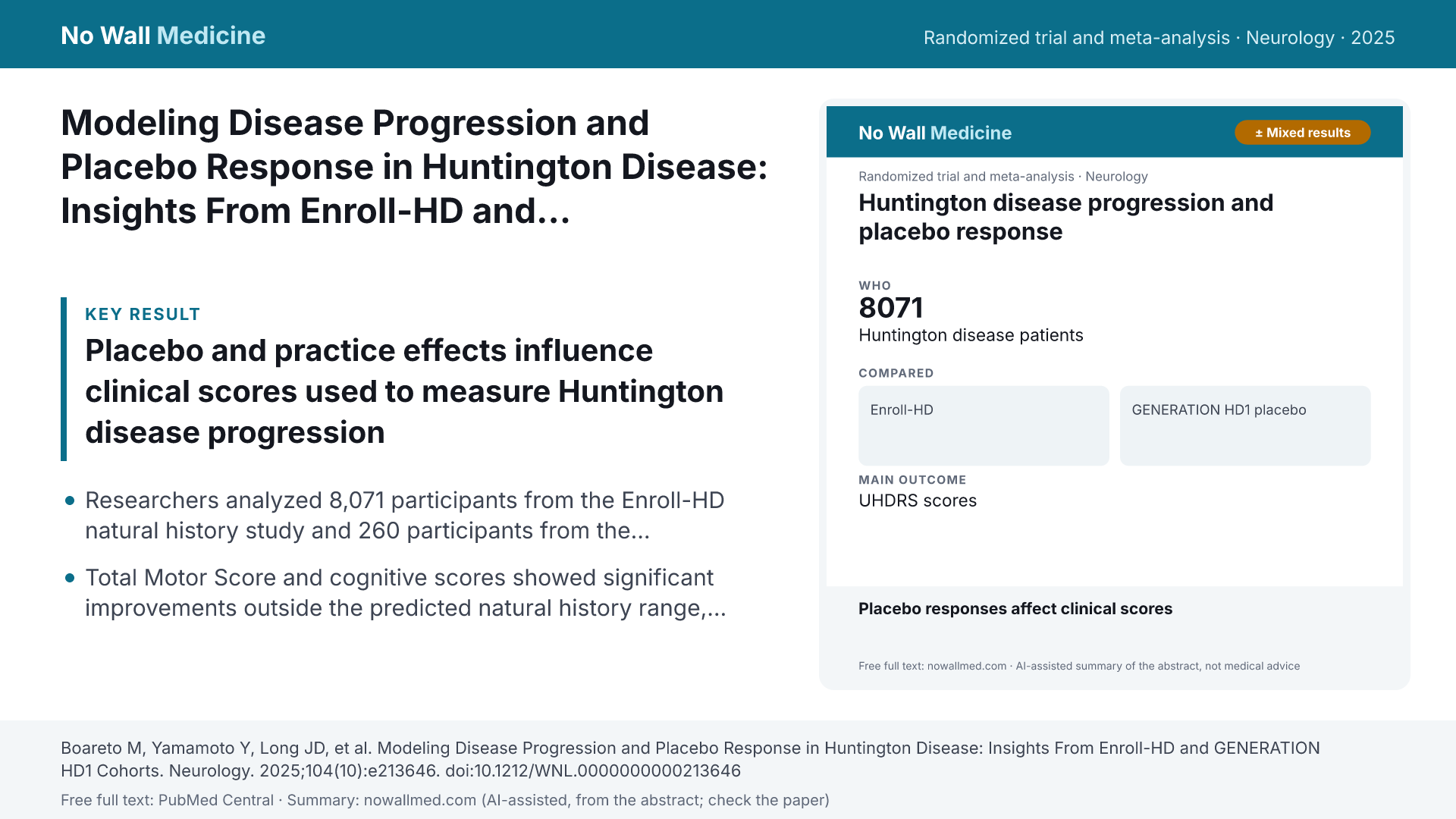
Placebo and practice effects influence clinical scores used to measure Huntington disease progression
Modeling Disease Progression and Placebo Response in Huntington Disease: Insights From Enroll-HD and GENERATION HD1 Cohorts
Randomized trial and meta-analysisMixed results
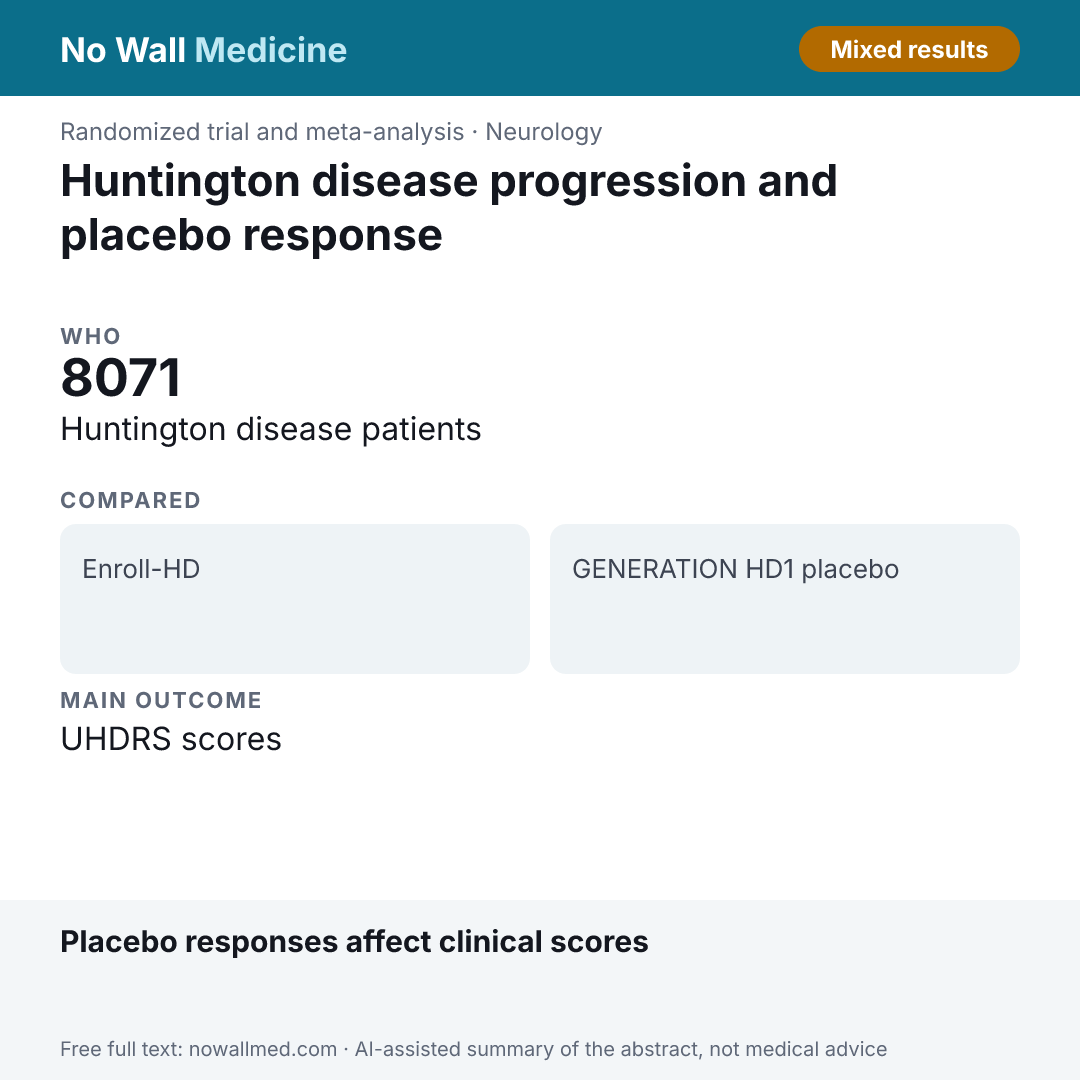
Huntington disease progression and placebo response
Who
8071
Huntington disease patients
Compared
Enroll-HD
GENERATION HD1 placebo
Main outcome
UHDRS scores
Bottom line: Placebo responses affect clinical scores
Limitation: limited placebo data
Neurology · 2025-05-02 · Save PNG
Same trial (NCT01574053, NCT03761849)
Papers we list that report this registered trial, oldest first. Read a secondary analysis alongside the main results.
- Secondary analysis Mixed results
This paper Neurology 2025-05 - Related report
Longitudinal assessment of chorea in Huntington's disease using digital passive monitoring NPJ Digit Med 2026-04
Why it matters: Clinical trials for Huntington disease need to account for how placebo responses and frequent testing can influence the Unified Huntington's Disease Rating Scale scores.
Key points
- Researchers analyzed 8,071 participants from the Enroll-HD natural history study and 260 participants from the GENERATION HD1 placebo group to model disease progression.
- Total Motor Score and cognitive scores showed significant improvements outside the predicted natural history range, while Total Functional Capacity aligned with predicted progression.
- Improvements in cognitive scores like the Symbol Digit Modalities Test were likely due to practice effects from more frequent testing in the clinical trial.
Limitation the authors note: The results rely on limited placebo data and may not generalize to other trials with different populations, treatments, and designs.
Headline and key points written with AI from the paper’s abstract, with every number checked against it. Read the paper before relying on them.
Was this summary helpful?
Subject terms
Headline, design, result, key points, caveat and citation as plain text.
Cite this article
Boareto M, Yamamoto Y, Long JD, et al. Modeling Disease Progression and Placebo Response in Huntington Disease: Insights From Enroll-HD and GENERATION HD1 Cohorts. Neurology. 2025;104(10):e213646. doi:10.1212/WNL.0000000000213646
Spotted a mistake? Suggest a correction