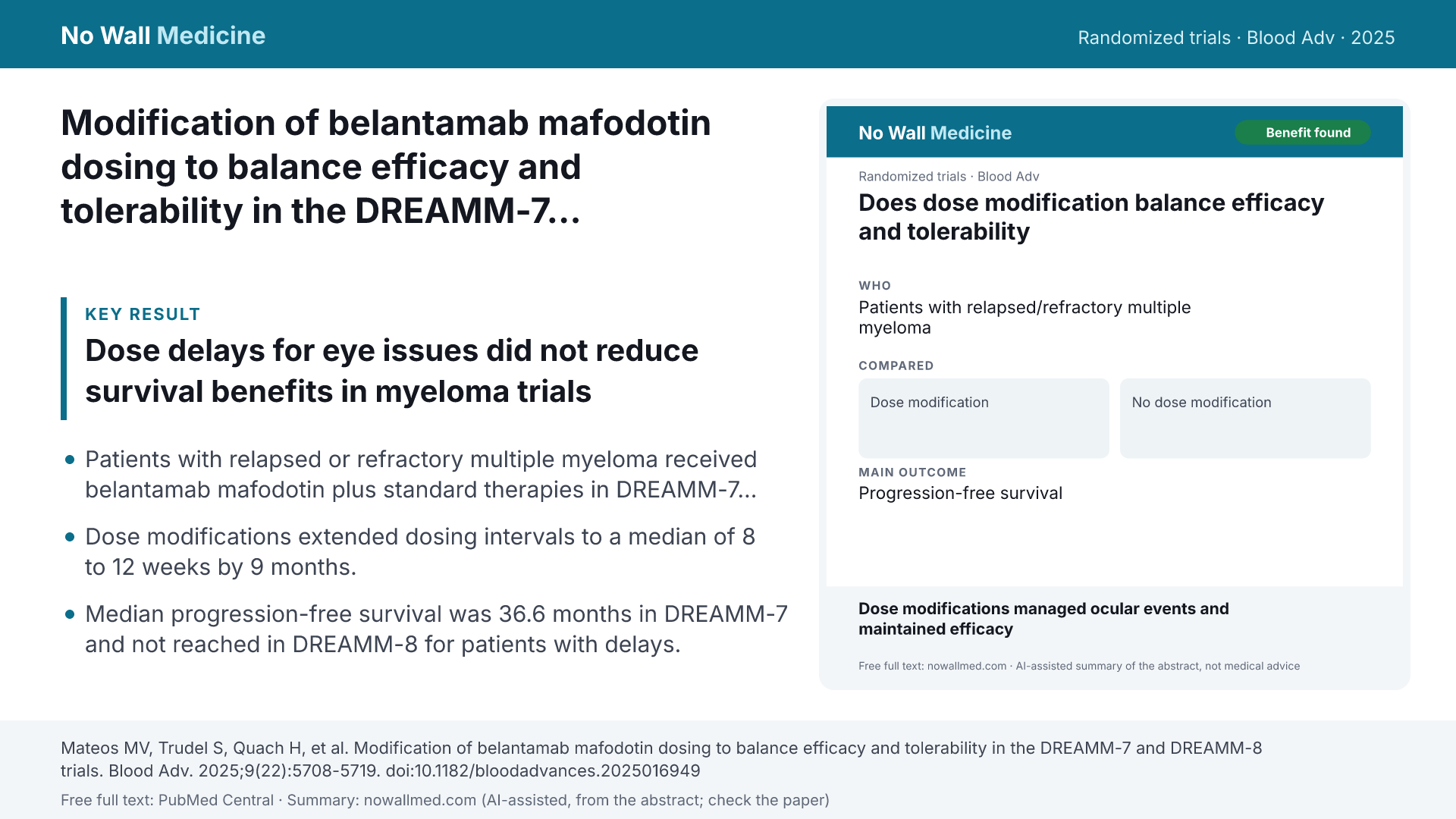
Dose delays for eye issues did not reduce survival benefits in myeloma trials
Modification of belantamab mafodotin dosing to balance efficacy and tolerability in the DREAMM-7 and DREAMM-8 trials
Randomized trialsBenefit found
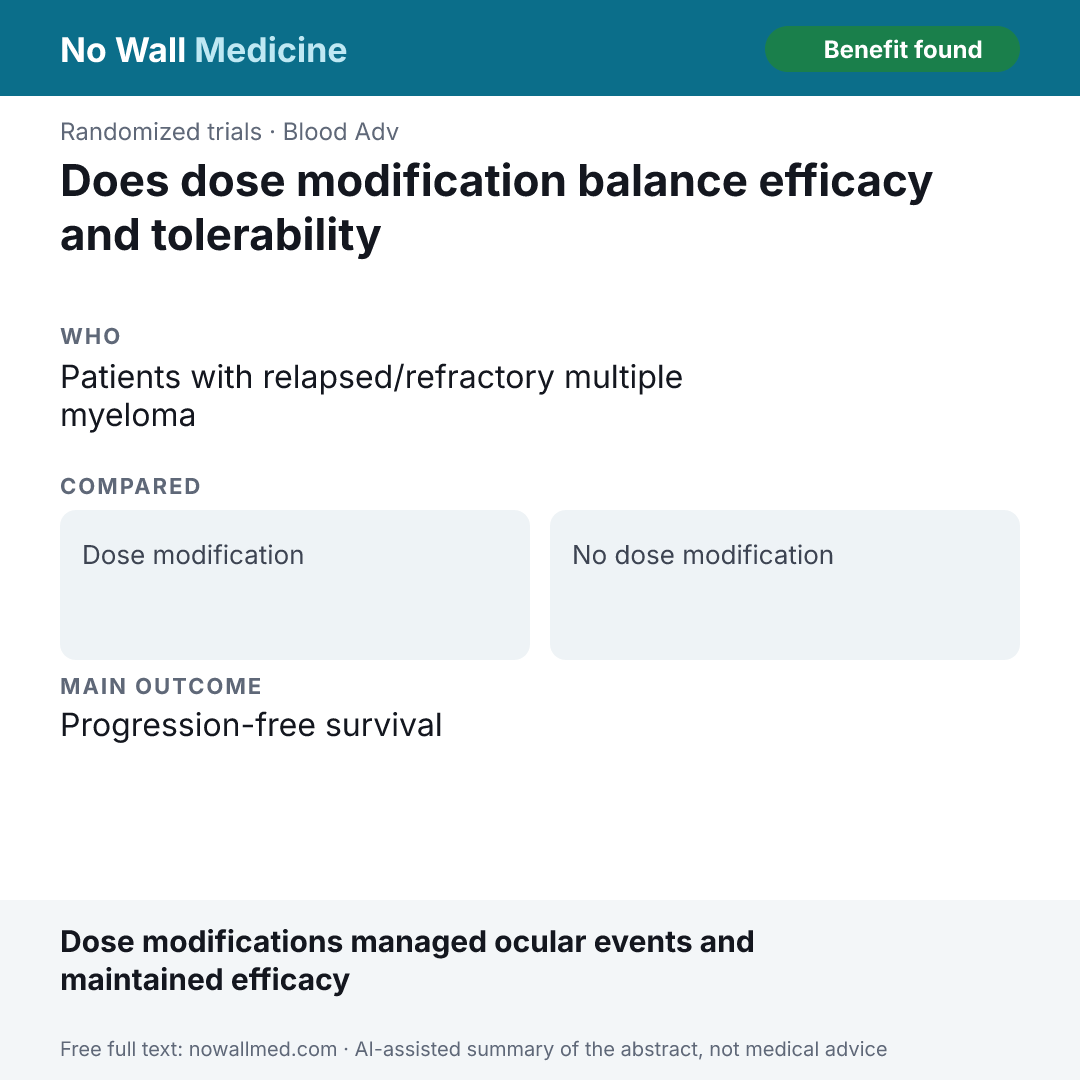
Does dose modification balance efficacy and tolerability
Who
Patients with relapsed/refractory multiple myeloma
Compared
Dose modification
No dose modification
Main outcome
Progression-free survival
Bottom line: Dose modifications managed ocular events and maintained efficacy
Blood Adv · 2025-08-05 · Save PNG
Key points
- Patients with relapsed or refractory multiple myeloma received belantamab mafodotin plus standard therapies in DREAMM-7 and DREAMM-8.
- Dose modifications extended dosing intervals to a median of 8 to 12 weeks by 9 months.
- Median progression-free survival was 36.6 months in DREAMM-7 and not reached in DREAMM-8 for patients with delays.
Headline and key points written with AI from the paper’s abstract, with every number checked against it. Read the paper before relying on them.
Was this summary helpful?
Abstract
Belantamab mafodotin (belamaf) combined with standard therapies demonstrated significant progression-free survival (PFS) and overall survival benefits in DREAMM-7 and PFS benefit in DREAMM-8 in relapsed/refractory multiple myeloma. Belamaf dose modifications managed adverse events, including belamaf-related ocular events. Ocular events included ocular adverse reactions (eg, dry eyes, photophobia, eye irritation) and protocol-mandated ophthalmic examination findings. Protocol-recommended dose modifications for ocular events were driven by ophthalmic examination findings and included belamaf dose delays until resolution and reductions. We used descriptive analyses to evaluate the impact of dose modifications on managing ocular events and treatment efficacy. In patients with normal baseline vision who were receiving treatment, dose modifications extended belamaf dosing intervals to a median of 8 to 12 weeks by 9 months; the prevalences of reduced vision to bilateral 20/50 or worse and ocular adverse reactions were highest in the first 3 months and remained low at later time points. The median time to resolution after grade ≥2 ophthalmic examination findings was 12 weeks. Rates of belamaf discontinuations due to ocular events were low. Almost all responders (partial response or better) required dose modifications. Most patients achieved a response before an extended (>2 cycles) dose delay; most who had not, subsequently achieved or deepened their response. In DREAMM-7 and DREAMM-8, the median PFS in patients with ≥1 dose delay of ≥12 weeks was 36.6 months and not reached, respectively. Ocular events were common but effectively managed with dose modifications, allowing for patients to remain on treatment and derive robust efficacy benefit. The trials were registered at www.clinicaltrials.gov as #NCT04246047 (DREAMM-7) and #NCT04484623 (DREAMM-8).
Abstract reproduced under the article’s CC BY NC ND licence.
Subject terms
Headline, design, result, key points, caveat and citation as plain text.
Cite this article
Mateos MV, Trudel S, Quach H, et al. Modification of belantamab mafodotin dosing to balance efficacy and tolerability in the DREAMM-7 and DREAMM-8 trials. Blood Adv. 2025;9(22):5708-5719. doi:10.1182/bloodadvances.2025016949
Spotted a mistake? Suggest a correction