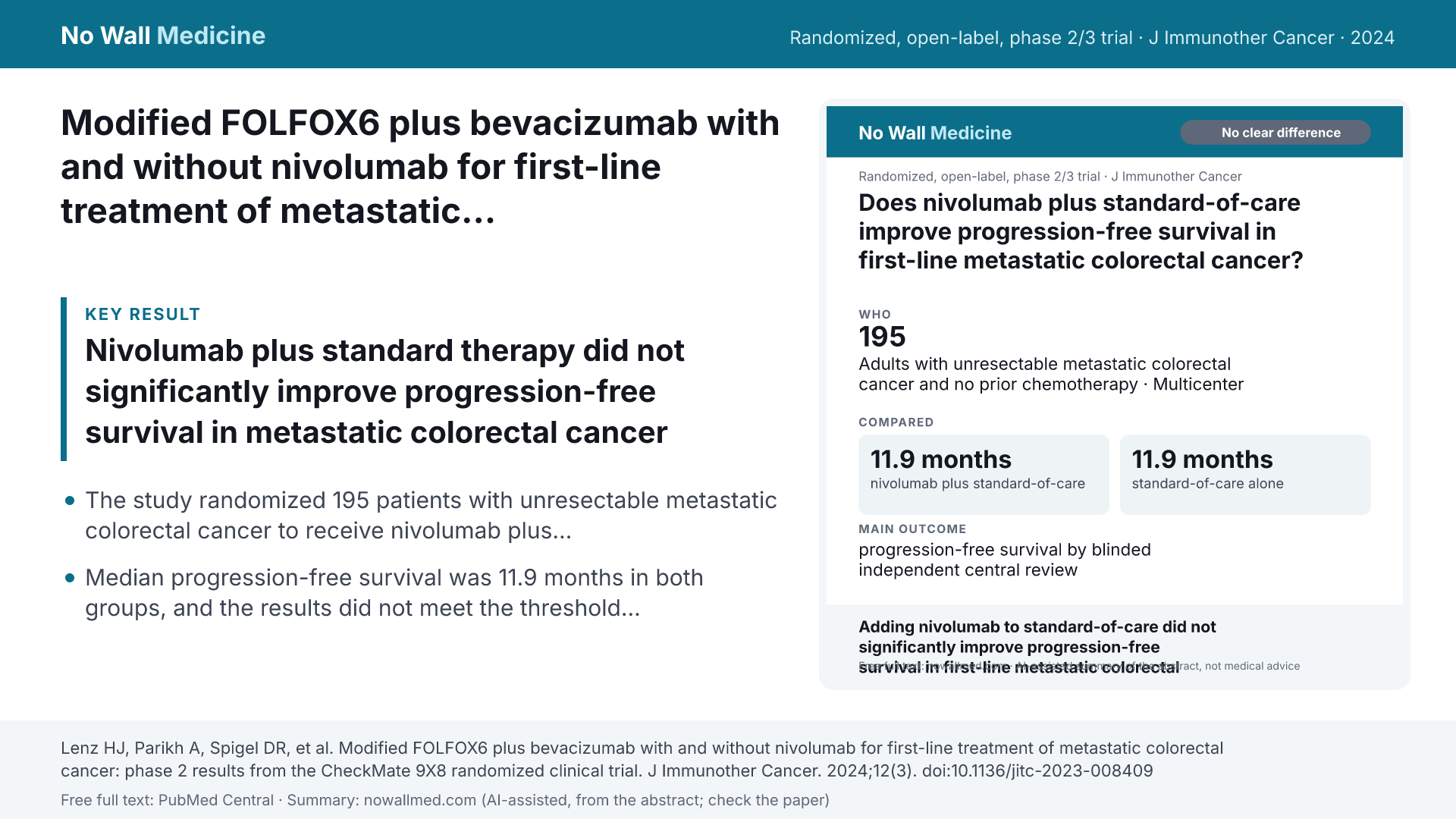
Nivolumab plus standard therapy did not significantly improve progression-free survival in metastatic colorectal cancer
Modified FOLFOX6 plus bevacizumab with and without nivolumab for first-line treatment of metastatic colorectal cancer: phase 2 results from the CheckMate 9X8 randomized clinical trial
Randomized, open-label, phase 2/3 trialNo clear difference
Does nivolumab plus standard-of-care improve progression-free survival in first-line metastatic colorectal cancer?
Who
195
Adults with unresectable metastatic colorectal cancer and no prior chemotherapy · Multicenter
Compared
11.9 monthsnivolumab plus standard-of-care
11.9 monthsstandard-of-care alone
Main outcome
progression-free survival by blinded independent central review
Result: hazard ratio 0.81 (95% CI 0.53 to 1.23)
Bottom line: Adding nivolumab to standard-of-care did not significantly improve progression-free survival in first-line metastatic colorectal cancer.
J Immunother Cancer · 2024-03-13Download image
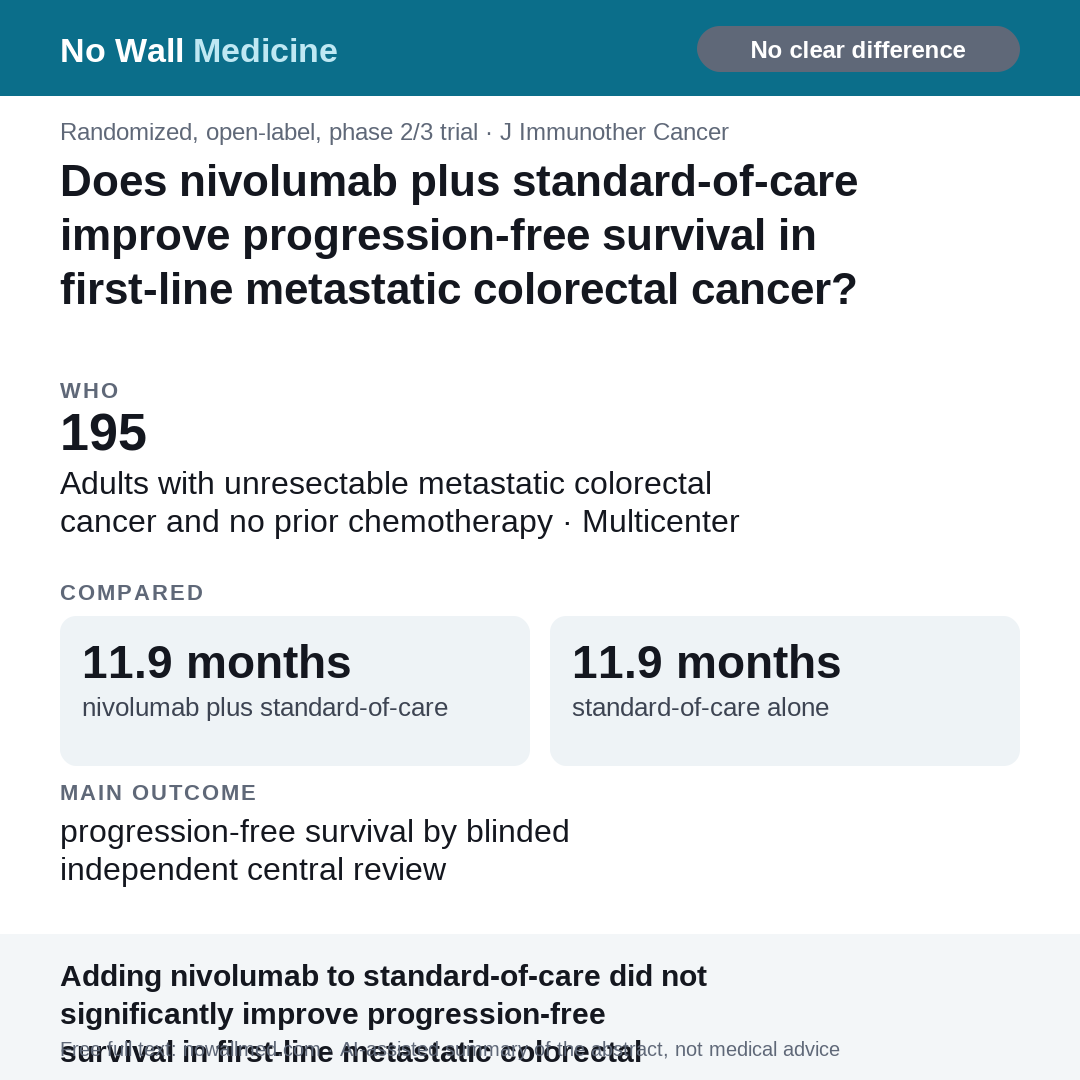
Clinical question: Does nivolumab plus standard-of-care improve progression-free survival in first-line metastatic colorectal cancer?
Why it matters: It was unknown if adding the immunotherapy drug nivolumab to standard chemotherapy and bevacizumab would improve outcomes for patients with metastatic colorectal cancer.
Key points
- The study randomized 195 patients with unresectable metastatic colorectal cancer to receive nivolumab plus standard-of-care therapy or standard-of-care alone.
- Median progression-free survival was 11.9 months in both groups, and the results did not meet the threshold for statistical significance.
- Grade 3-4 treatment-related adverse events occurred in 75% of the nivolumab group compared to 48% in the standard-of-care group.
Headline and key points written with AI from the paper’s abstract, with every number checked against it. Read the paper before relying on them.
Was this summary helpful?
Abstract
Background
Standard first-line therapies for metastatic colorectal cancer (mCRC) include fluoropyrimidine-containing regimens with oxaliplatin and/or irinotecan and a biologic agent. Immunotherapy may enhance antitumor activity in combination with standard therapies in patients with mCRC. Here, we present phase 2 results of nivolumab plus standard-of-care therapy (SOC; 5-fluorouracil/leucovorin/oxaliplatin/bevacizumab) versus SOC in the first-line treatment of patients with mCRC (CheckMate 9X8). Methods
CheckMate 9X8 was a multicenter, open-label, randomized, phase 2/3 trial. Eligible patients were at least 18 years of age with unresectable mCRC and no prior chemotherapy for metastatic disease. Patients were randomized 2:1 to receive nivolumab 240 mg plus SOC or SOC alone every 2 weeks. The primary endpoint was progression-free survival (PFS) by blinded independent central review (BICR) per Response Evaluation Criteria in Solid Tumors V.1.1. Secondary endpoints included PFS by investigator assessment; objective response rate (ORR), disease control rate, duration of response, and time to response, all by BICR and investigator assessments; overall survival; and safety. Preplanned exploratory biomarker analyses were also performed. Results
From February 2018 through April 2019, 310 patients were enrolled, of which 195 patients were randomized to nivolumab plus SOC (n=127) or SOC (n=68). At 21.5-month minimum follow-up, PFS with nivolumab plus SOC versus SOC did not meet the prespecified threshold for statistical significance; median PFS by BICR was 11.9 months in both arms (HR, 0.81 (95% CI, 0.53 to 1.23); p=0.30). Higher PFS rates after 12 months (18 months: 28% vs 9%), higher ORR (60% vs 46%), and durable responses (median 12.9 vs 9.3 months) were observed with nivolumab plus SOC versus SOC. Grade 3-4 treatment-related adverse events were reported in 75% versus 48% of patients; no new safety signals were identified. Conclusions
The CheckMate 9X8 trial investigating first-line nivolumab plus SOC versus SOC in patients with mCRC did not meet its primary endpoint of PFS by BICR. Nivolumab plus SOC showed numerically higher PFS rates after 12 months, a higher response rate, and more durable responses compared with SOC alone, with acceptable safety. Further investigation to identify subgroups of patients with mCRC that may benefit from nivolumab plus SOC versus SOC in the first-line setting is warranted. Trial registration number
NCT03414983.
Abstract reproduced under the article’s CC BY NC licence.
Subject terms
Cite this article
Lenz HJ, Parikh A, Spigel DR, et al. Modified FOLFOX6 plus bevacizumab with and without nivolumab for first-line treatment of metastatic colorectal cancer: phase 2 results from the CheckMate 9X8 randomized clinical trial. J Immunother Cancer. 2024. doi:10.1136/jitc-2023-008409
Spotted a mistake? Suggest a correction