Olfactory nerve stimulation changed brain connectivity patterns associated with depression in healthy individuals
Modulating salience network connectivity through olfactory nerve stimulation
Randomized, blinded within-subject designBenefit found
Does olfactory nerve stimulation modulate salience network connectivity?
Who
45
Healthy individuals
Compared
Olfactory stimulation: increased functional connectivity within the salience network
Trigeminal nerve stimulation
Main outcome
Functional connectivity within and between brain networks
Bottom line: Olfactory stimulation increases salience network connectivity and weakens connectivity with the default mode network.
Limitation: Results were obtained from a healthy cohort, requiring further studies in individuals with depression.
Transl Psychiatry · 2025-08-21Download image
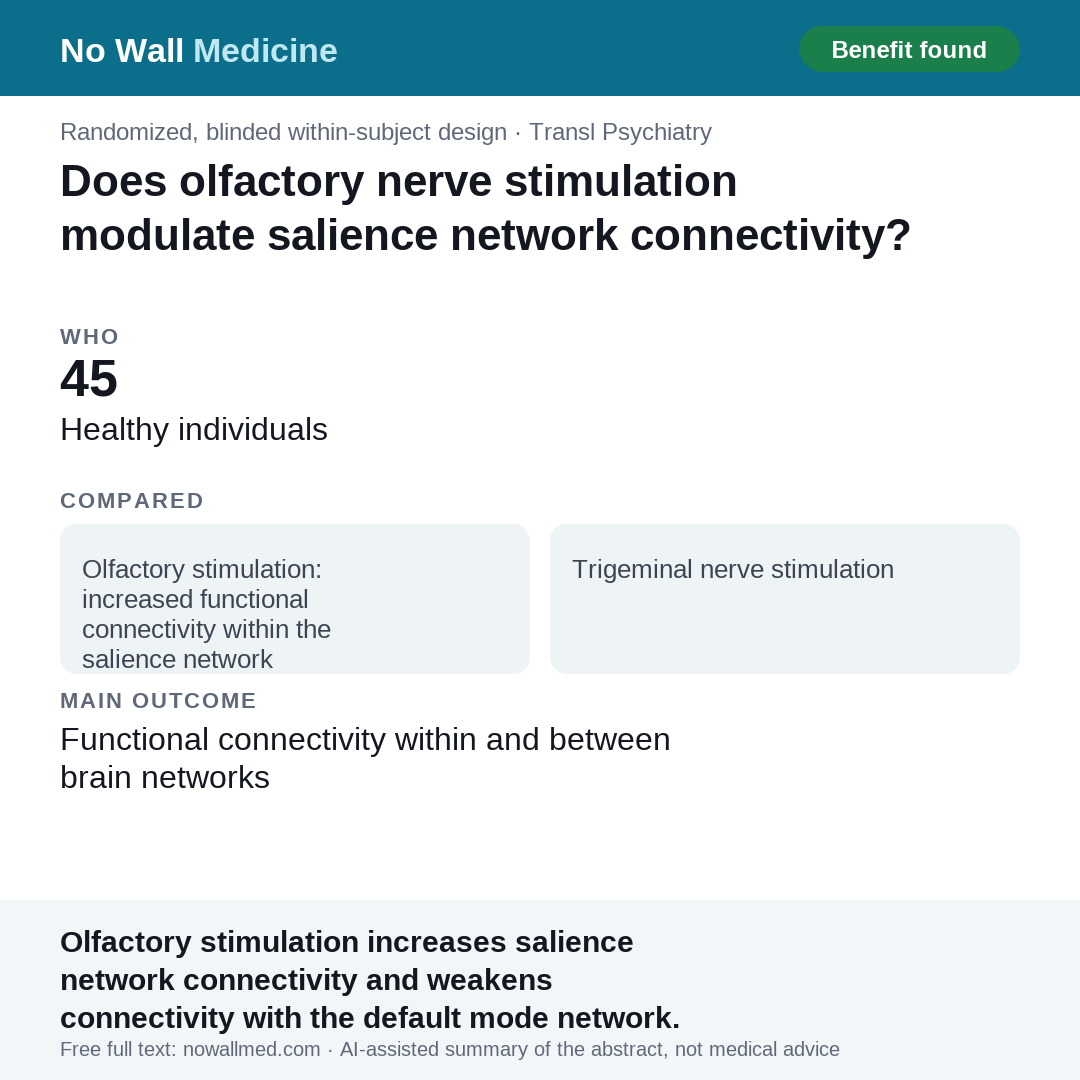
Clinical question: Does olfactory nerve stimulation modulate salience network connectivity?
Why it matters: Modifying the brain connectivity patterns associated with depression, such as reduced salience network connectivity, is currently a clinical challenge.
Key points
- Researchers conducted a randomized, blinded within-subject study involving 45 healthy individuals to measure brain connectivity changes using functional magnetic resonance imaging.
- Olfactory stimulation increased functional connectivity within the salience network and between the salience network and the piriform cortex, which is a primary olfactory structure.
- The stimulation was associated with weakened connectivity between the salience network and the default mode network, a pattern often seen in depression.
Headline and key points written with AI from the paper’s abstract, with every number checked against it. Read the paper before relying on them.
Topics
Cite this article
Heller C, Geisler M, Mayer NL, Thierfelder A, Walter M, Hummel T. Modulating salience network connectivity through olfactory nerve stimulation. Transl Psychiatry. 2025. doi:10.1038/s41398-025-03500-6
Spotted a mistake? Suggest a correction