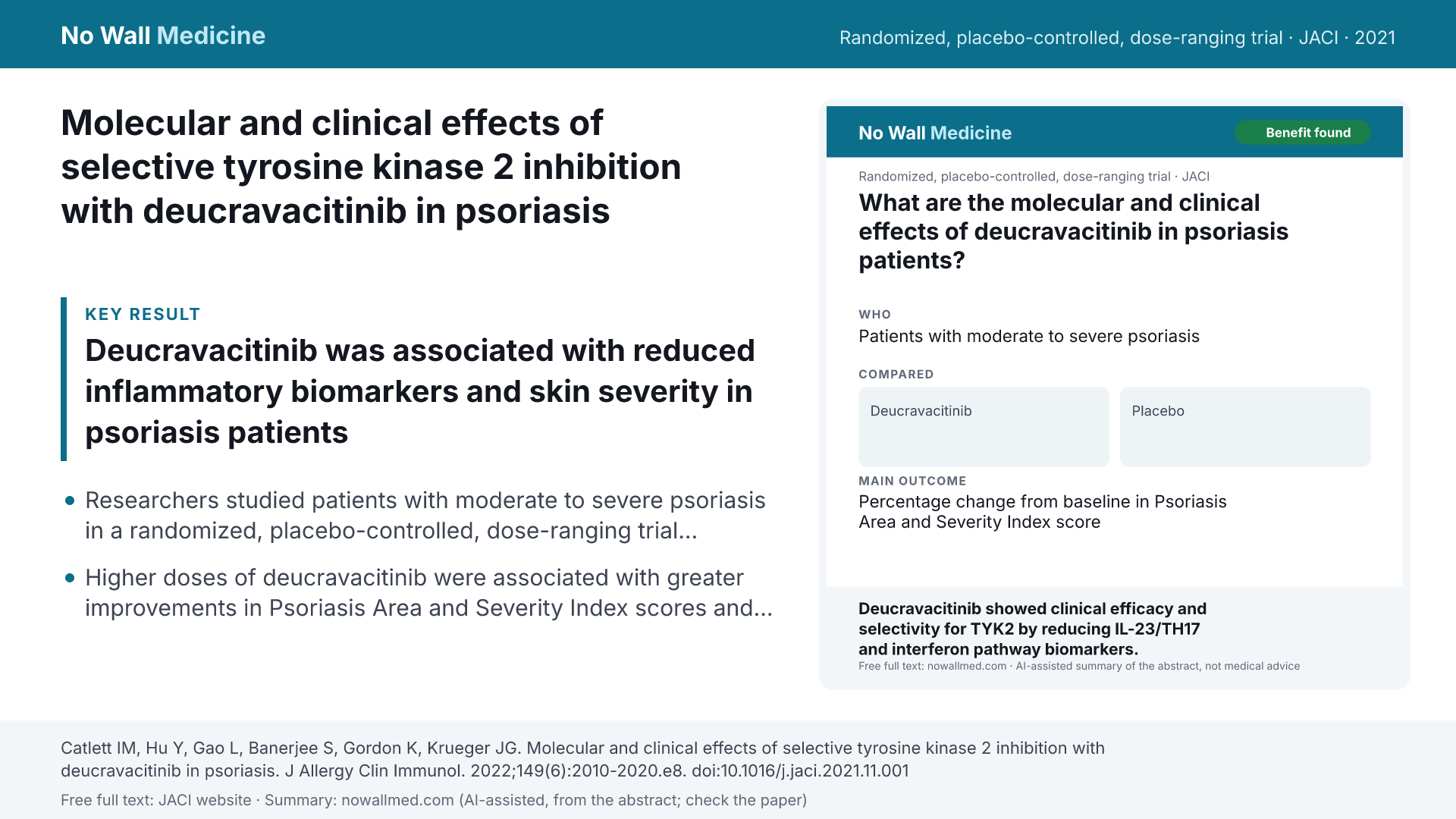
Deucravacitinib was associated with reduced inflammatory biomarkers and skin severity in psoriasis patients
Molecular and clinical effects of selective tyrosine kinase 2 inhibition with deucravacitinib in psoriasis
Randomized, placebo-controlled, dose-ranging trialBenefit found
What are the molecular and clinical effects of deucravacitinib in psoriasis patients?
Who
Patients with moderate to severe psoriasis
Compared
Deucravacitinib
Placebo
Main outcome
Percentage change from baseline in Psoriasis Area and Severity Index score
Bottom line: Deucravacitinib showed clinical efficacy and selectivity for TYK2 by reducing IL-23/TH17 and interferon pathway biomarkers.
JACI · 2021-11-10 · Save PNG
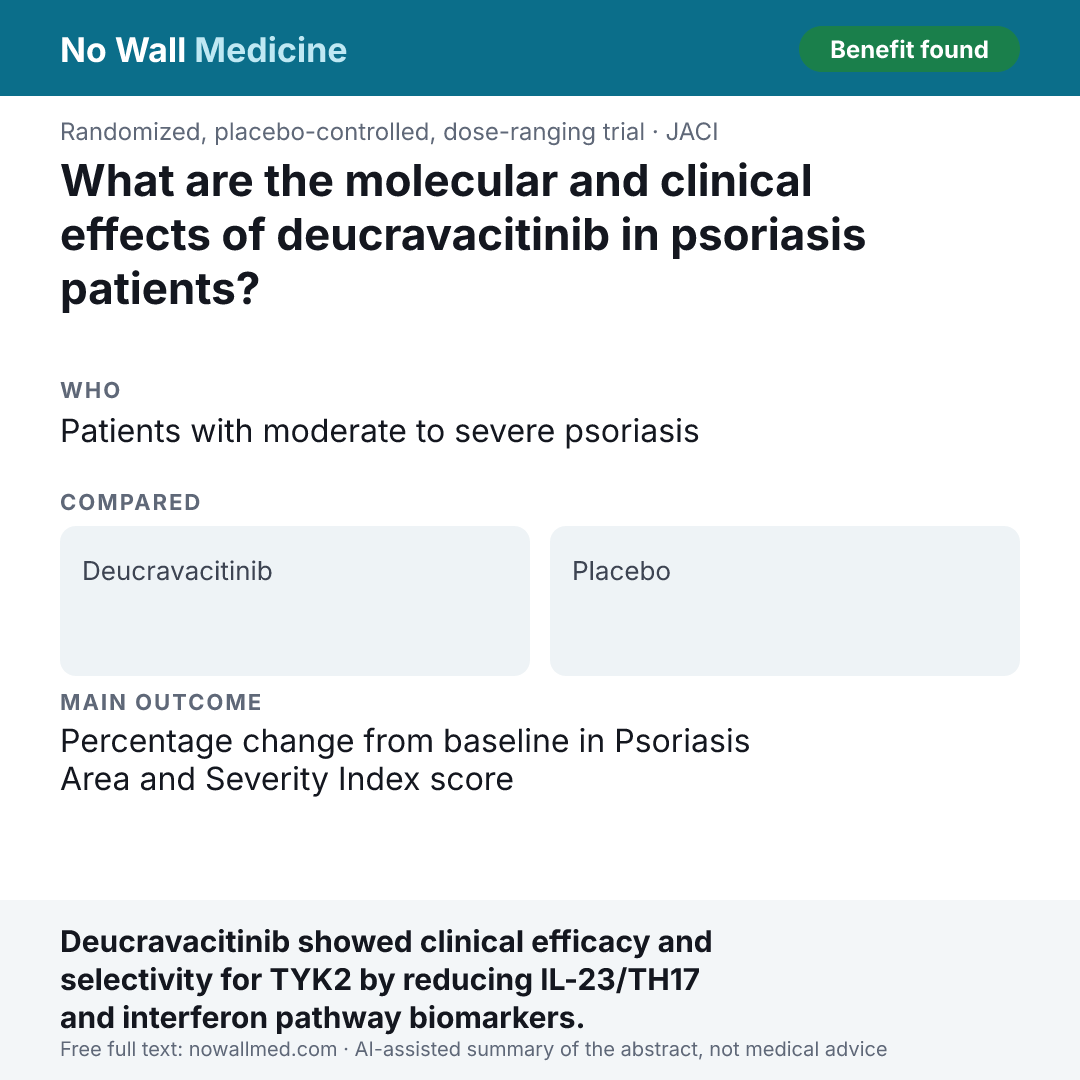
Clinical question: What are the molecular and clinical effects of deucravacitinib in psoriasis patients?
Key points
- Researchers studied patients with moderate to severe psoriasis in a randomized, placebo-controlled, dose-ranging trial using skin biopsies and blood markers.
- Higher doses of deucravacitinib were associated with greater improvements in Psoriasis Area and Severity Index scores and a dose-dependent return of IL-23 pathway biomarkers toward nonlesional levels.
- The drug was not associated with changes in laboratory parameters typically affected by Janus kinase 1-3 inhibition, supporting its selectivity for tyrosine kinase 2.
Headline and key points written with AI from the paper’s abstract, with every number checked against it. Read the paper before relying on them.
Was this summary helpful?
Subject terms
Headline, design, result, key points, caveat and citation as plain text.
Cite this article
Catlett IM, Hu Y, Gao L, Banerjee S, Gordon K, Krueger JG. Molecular and clinical effects of selective tyrosine kinase 2 inhibition with deucravacitinib in psoriasis. J Allergy Clin Immunol. 2022;149(6):2010-2020.e8. doi:10.1016/j.jaci.2021.11.001
Spotted a mistake? Suggest a correction