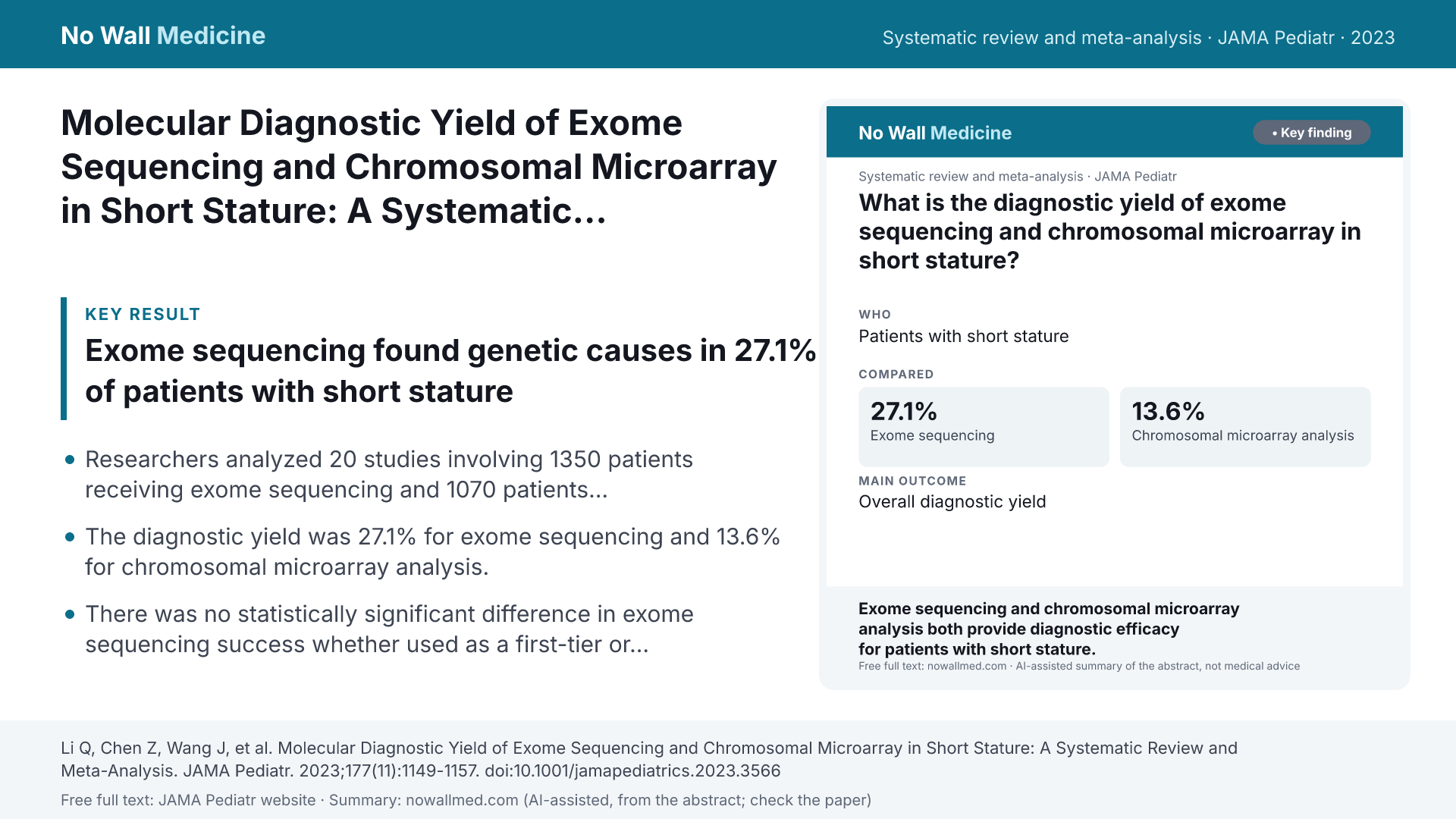
Molecular Diagnostic Yield of Exome Sequencing and Chromosomal Microarray in Short Stature: A Systematic Review and Meta-Analysis
Key result: Exome sequencing found genetic causes in 27.1% of patients with short stature
Systematic review and meta-analysisKey finding
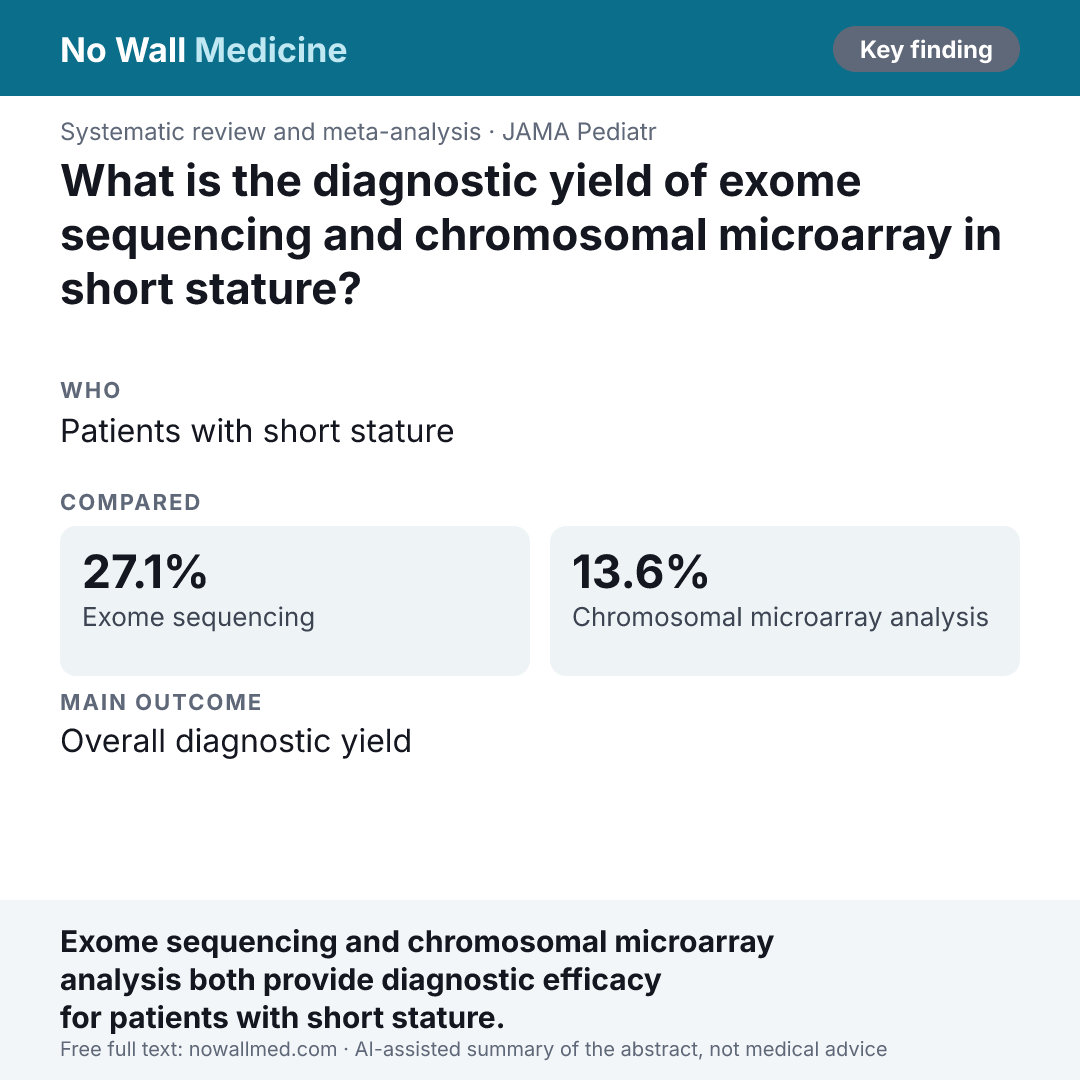
What is the diagnostic yield of exome sequencing and chromosomal microarray in short stature?
Who
Patients with short stature
Compared
27.1%Exome sequencing (95% CI, 18.1%-37.2%)
13.6%Chromosomal microarray analysis (95% CI, 9.2%-18.7%)
Main outcome
Overall diagnostic yield
Bottom line: Exome sequencing and chromosomal microarray analysis both provide diagnostic efficacy for patients with short stature.
JAMA Pediatr · 2023-09-11 · Save PNG
Key points
- Researchers analyzed 20 studies involving 1350 patients receiving exome sequencing and 1070 patients receiving chromosomal microarray analysis.
- The diagnostic yield was 27.1% for exome sequencing and 13.6% for chromosomal microarray analysis.
- There was no statistically significant difference in exome sequencing success whether used as a first-tier or last-resort test.
Why it matters: The definitive diagnostic yield of exome sequencing and chromosomal microarray analysis for patients with short stature has not been established.
Discussion prompts
- Would these patients look like yours? Who was left out?
- Is the main outcome one that matters to patients?
- Is the difference large enough to change what you do?
Cite: Li Q, Chen Z, Wang J, et al. Molecular Diagnostic Yield of Exome Sequencing and Chromosomal Microarray in Short Stature: A Systematic Review and Meta-Analysis. JAMA Pediatr. 2023;177(11):1149-1157. doi:10.1001/jamapediatrics.2023.3566
Free full text: JAMA Pediatr website · Summary and visual abstract: nowallmed.com/a/molecular-diagnostic-yield-of-exome-sequencing-and-chromosomal-u15qcv/ (AI-assisted from the abstract; check the paper before relying on it).