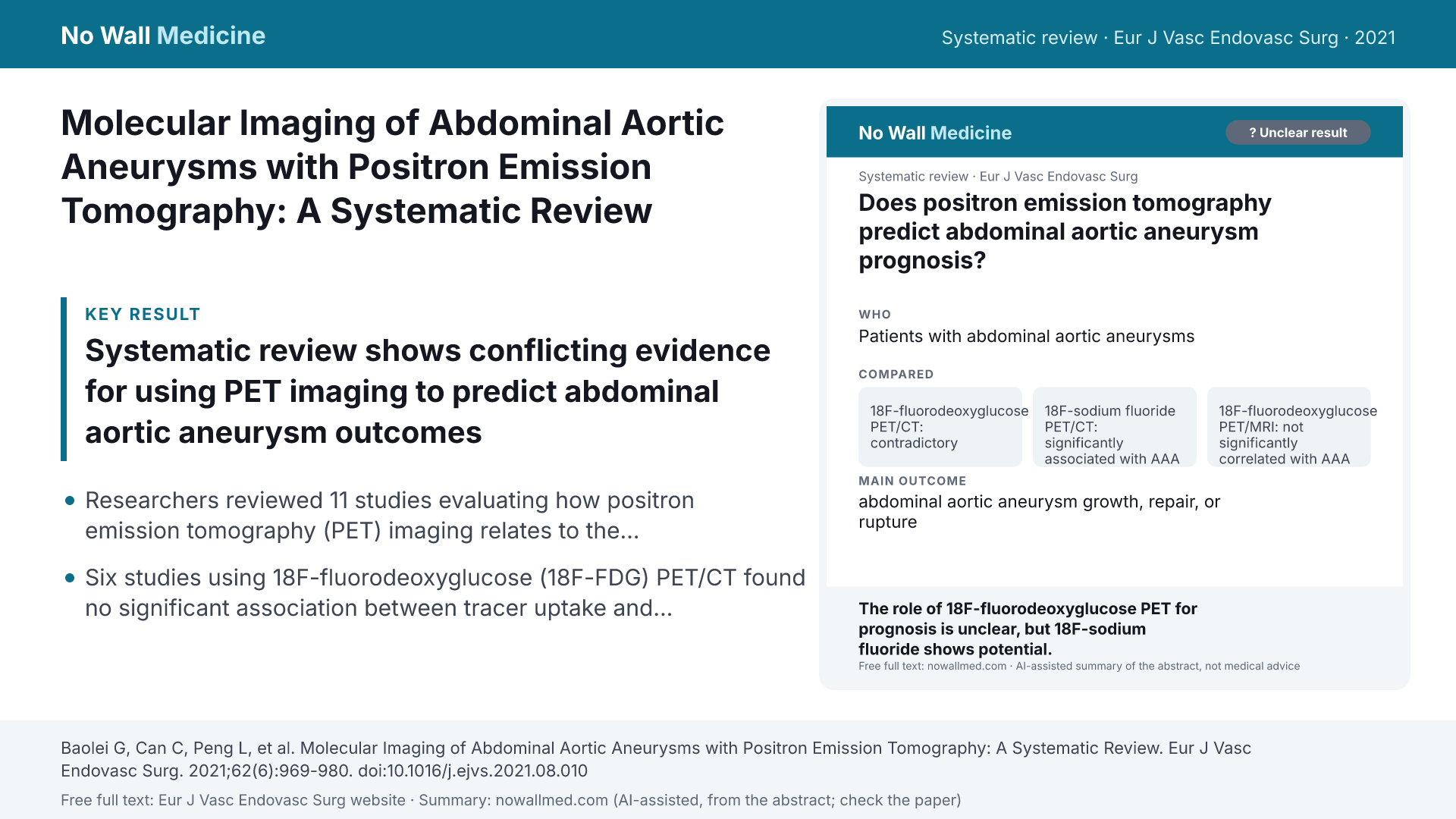
Molecular Imaging of Abdominal Aortic Aneurysms with Positron Emission Tomography: A Systematic Review
Key result: Systematic review shows conflicting evidence for using PET imaging to predict abdominal aortic aneurysm outcomes
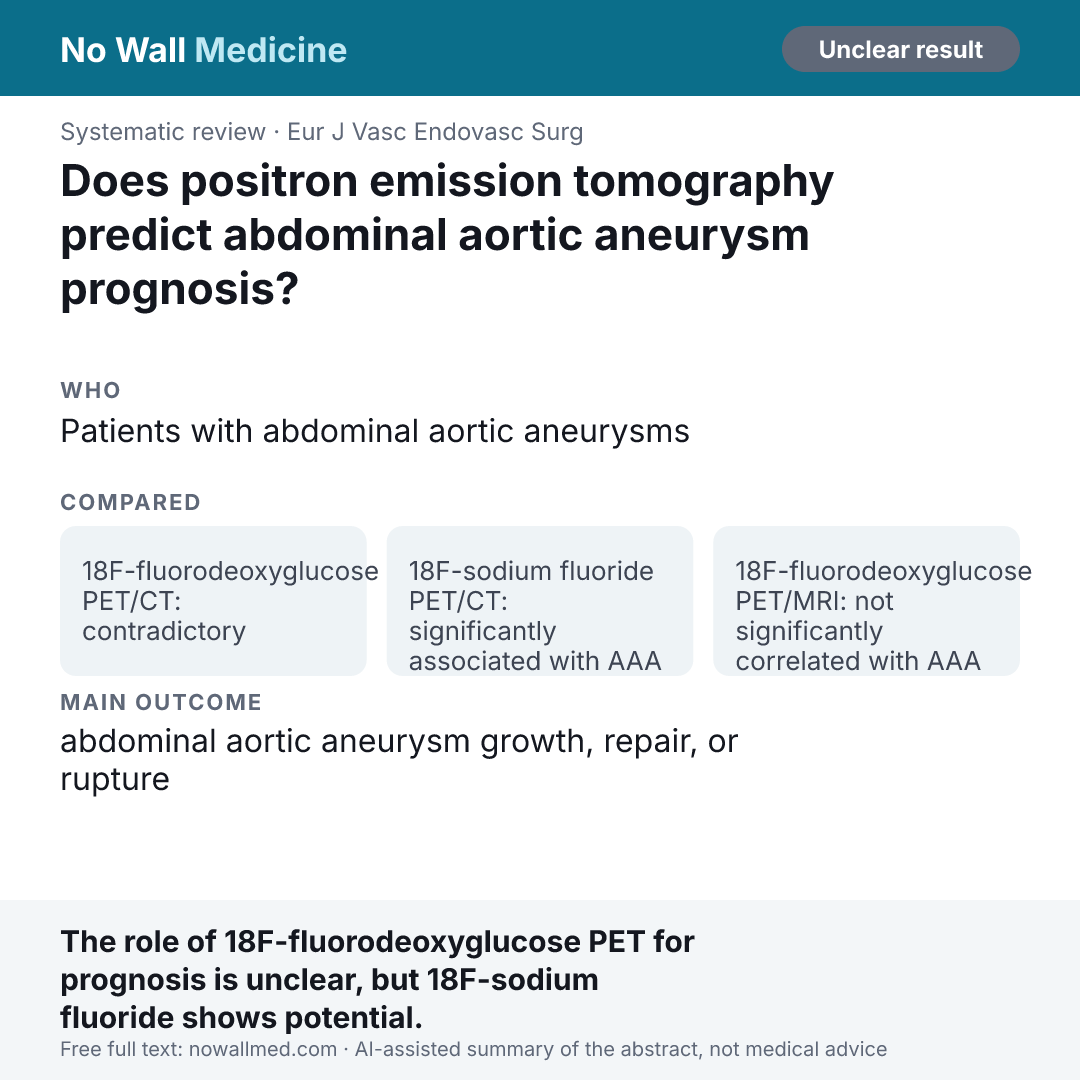
Systematic reviewUnclear result
Does positron emission tomography predict abdominal aortic aneurysm prognosis?
Who
Patients with abdominal aortic aneurysms
Compared
18F-fluorodeoxyglucose PET/CT: contradictory
18F-sodium fluoride PET/CT: significantly associated with AAA growth and clinical events
18F-fluorodeoxyglucose PET/MRI: not significantly correlated with AAA expansion
Main outcome
abdominal aortic aneurysm growth, repair, or rupture
Bottom line: The role of 18F-fluorodeoxyglucose PET for prognosis is unclear, but 18F-sodium fluoride shows potential.
Eur J Vasc Endovasc Surg · 2021-10-22 · Save PNG
Key points
- Researchers reviewed 11 studies evaluating how positron emission tomography (PET) imaging relates to the growth, repair, or rupture of abdominal aortic aneurysms.
- Six studies using 18F-fluorodeoxyglucose (18F-FDG) PET/CT found no significant association between tracer uptake and aneurysm expansion.
- One study using 18F-sodium fluoride (18F-NaF) PET/CT showed that increased tracer uptake was significantly associated with aneurysm growth and clinical events.
Discussion prompts
- Would these patients look like yours? Who was left out?
- Is the main outcome one that matters to patients?
- Is the difference large enough to change what you do?
Cite: Baolei G, Can C, Peng L, et al. Molecular Imaging of Abdominal Aortic Aneurysms with Positron Emission Tomography: A Systematic Review. Eur J Vasc Endovasc Surg. 2021;62(6):969-980. doi:10.1016/j.ejvs.2021.08.010
Free full text: Eur J Vasc Endovasc Surg website · Summary and visual abstract: nowallmed.com/a/molecular-imaging-of-abdominal-aortic-aneurysms-with-positron-18ir1w3/ (AI-assisted from the abstract; check the paper before relying on it).