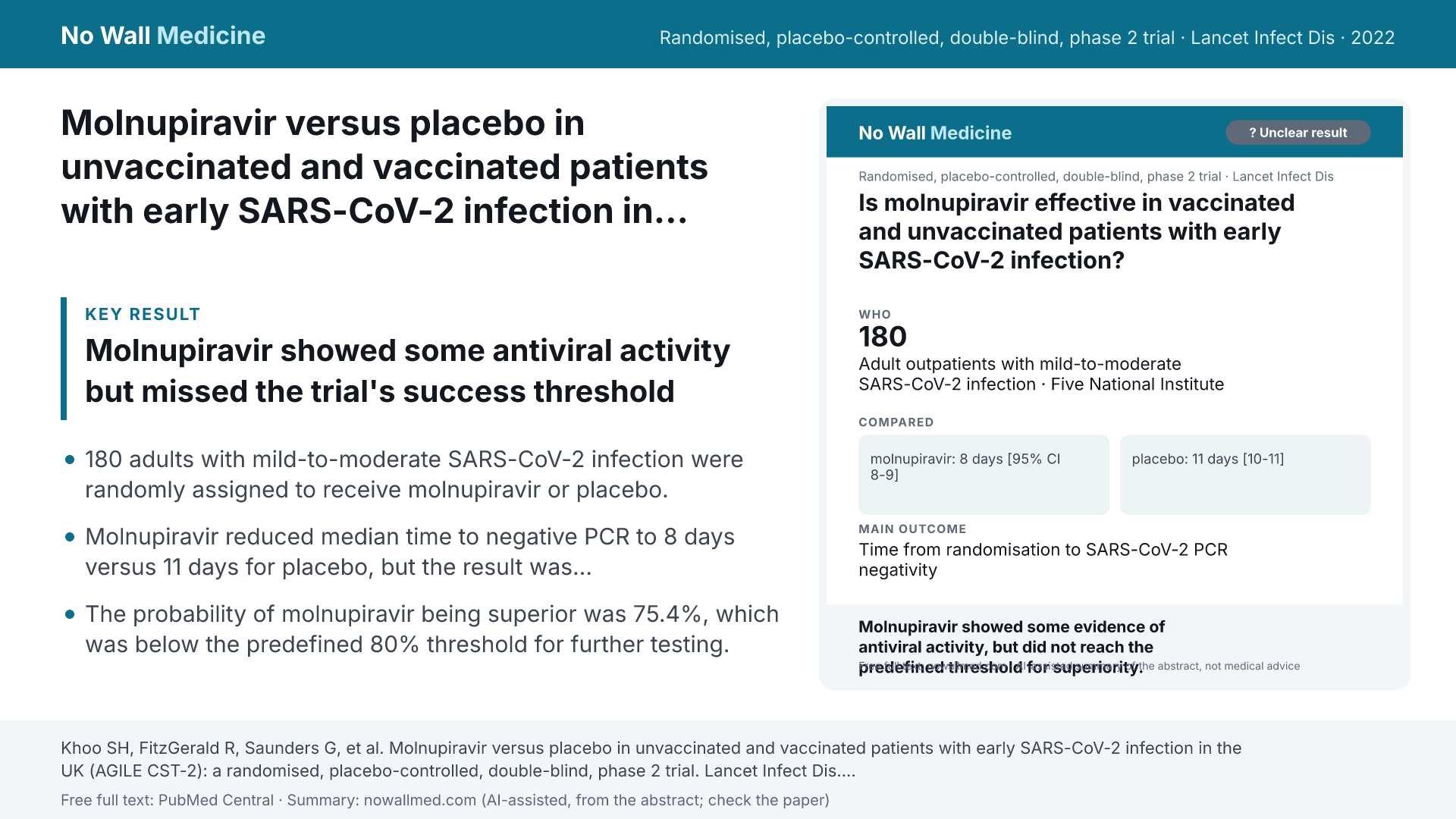
Molnupiravir showed some antiviral activity but missed the trial's success threshold
Molnupiravir versus placebo in unvaccinated and vaccinated patients with early SARS-CoV-2 infection in the UK (AGILE CST-2): a randomised, placebo-controlled, double-blind, phase 2 trial
Randomised, placebo-controlled, double-blind, phase 2 trialUnclear result
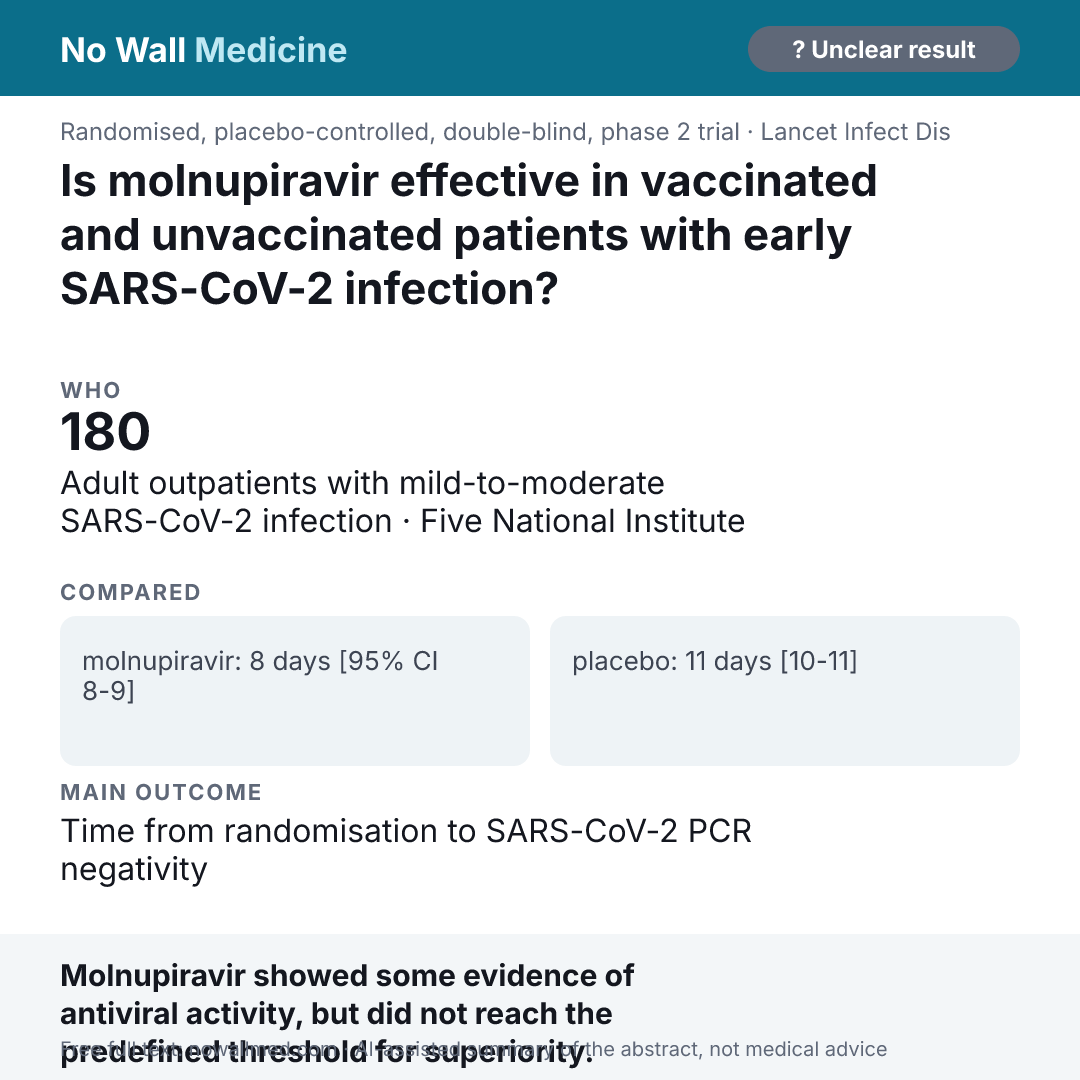
Is molnupiravir effective in vaccinated and unvaccinated patients with early SARS-CoV-2 infection?
Who
180
Adult outpatients with mild-to-moderate SARS-CoV-2 infection · Five National Institute for Health and Care Research sites in the UK
Compared
molnupiravir: 8 days [95% CI 8-9]
placebo: 11 days [10-11]
Main outcome
Time from randomisation to SARS-CoV-2 PCR negativity
Result: hazard ratio 1·30, 95% credible interval 0·92-1·71
Bottom line: Molnupiravir showed some evidence of antiviral activity, but did not reach the predefined threshold for superiority.
Funded by: Ridgeback Biotherapeutics, NIHR, Medical Research Council, and Wellcome Trust
Lancet Infect Dis · 2022-10-19 · Save PNG
Same trial (NCT04746183, ISRCTN27106947)
Papers we list that report this registered trial, oldest first. Read a secondary analysis alongside the main results.
- Main results Early signal
Molnupiravir was found to be safe at doses of 300, 600, and 800 mg J Antimicrob Chemother 2021-08 - Related analysis Unclear result
This paper Lancet Infect Dis 2022-10 - Related analysis
Combination of molnupiravir and nirmatrelvir/ritonavir was safe for mild-to-moderate COVID-19 infections J Antimicrob Chemother 2026-06
Clinical question: Is molnupiravir effective in vaccinated and unvaccinated patients with early SARS-CoV-2 infection?
Key points
- 180 adults with mild-to-moderate SARS-CoV-2 infection were randomly assigned to receive molnupiravir or placebo.
- Molnupiravir reduced median time to negative PCR to 8 days versus 11 days for placebo, but the result was not statistically significant.
- The probability of molnupiravir being superior was 75.4%, which was below the predefined 80% threshold for further testing.
Headline and key points written with AI from the paper’s abstract, with every number checked against it. Read the paper before relying on them.
Was this summary helpful?
Abstract
Background
The antiviral drug molnupiravir was licensed for treating at-risk patients with COVID-19 on the basis of data from unvaccinated adults. We aimed to evaluate the safety and virological efficacy of molnupiravir in vaccinated and unvaccinated individuals with COVID-19. Methods
This randomised, placebo-controlled, double-blind, phase 2 trial (AGILE CST-2) was done at five National Institute for Health and Care Research sites in the UK. Eligible participants were adult (aged ≥18 years) outpatients with PCR-confirmed, mild-to-moderate SARS-CoV-2 infection who were within 5 days of symptom onset. Using permuted blocks (block size 2 or 4) and stratifying by site, participants were randomly assigned (1:1) to receive either molnupiravir (orally; 800 mg twice daily for 5 days) plus standard of care or matching placebo plus standard of care. The primary outcome was the time from randomisation to SARS-CoV-2 PCR negativity on nasopharyngeal swabs and was analysed by use of a Bayesian Cox proportional hazards model for estimating the probability of a superior virological response (hazard ratio [HR]>1) for molnupiravir versus placebo. Our primary model used a two-point prior based on equal prior probabilities (50%) that the HR was 1·0 or 1·5. We defined a priori that if the probability of a HR of more than 1 was more than 80% molnupiravir would be recommended for further testing. The primary outcome was analysed in the intention-to-treat population and safety was analysed in the safety population, comprising participants who had received at least one dose of allocated treatment. This trial is registered in ClinicalTrials.gov, NCT04746183, and the ISRCTN registry, ISRCTN27106947, and is ongoing. Findings
Between Nov 18, 2020, and March 16, 2022, 1723 patients were assessed for eligibility, of whom 180 were randomly assigned to receive either molnupiravir (n=90) or placebo (n=90) and were included in the intention-to-treat analysis. 103 (57%) of 180 participants were female and 77 (43%) were male and 90 (50%) participants had received at least one dose of a COVID-19 vaccine. SARS-CoV-2 infections with the delta (B.1.617.2; 72 [40%] of 180), alpha (B.1.1.7; 37 [21%]), omicron (B.1.1.529; 38 [21%]), and EU1 (B.1.177; 28 [16%]) variants were represented. All 180 participants received at least one dose of treatment and four participants discontinued the study (one in the molnupiravir group and three in the placebo group). Participants in the molnupiravir group had a faster median time from randomisation to negative PCR (8 days [95% CI 8-9]) than participants in the placebo group (11 days [10-11]; HR 1·30, 95% credible interval 0·92-1·71; log-rank p=0·074). The probability of molnupiravir being superior to placebo (HR>1) was 75·4%, which was less than our threshold of 80%. 73 (81%) of 90 participants in the molnupiravir group and 68 (76%) of 90 participants in the placebo group had at least one adverse event by day 29. One participant in the molnupiravir group and three participants in the placebo group had an adverse event of a Common Terminology Criteria for Adverse Events grade 3 or higher severity. No participants died (due to any cause) during the trial. Interpretation
We found molnupiravir to be well tolerated and, although our predefined threshold was not reached, we observed some evidence that molnupiravir has antiviral activity in vaccinated and unvaccinated individuals infected with a broad range of SARS-CoV-2 variants, although this evidence is not conclusive. Funding
Ridgeback Biotherapeutics, the UK National Institute for Health and Care Research, the Medical Research Council, and the Wellcome Trust.
Abstract reproduced under the article’s CC BY licence.
Subject terms
Headline, design, result, key points, caveat and citation as plain text.
Cite this article
Khoo SH, FitzGerald R, Saunders G, et al. Molnupiravir versus placebo in unvaccinated and vaccinated patients with early SARS-CoV-2 infection in the UK (AGILE CST-2): a randomised, placebo-controlled, double-blind, phase 2 trial. Lancet Infect Dis. 2023;23(2):183-195. doi:10.1016/S1473-3099(22)00644-2
Spotted a mistake? Suggest a correction