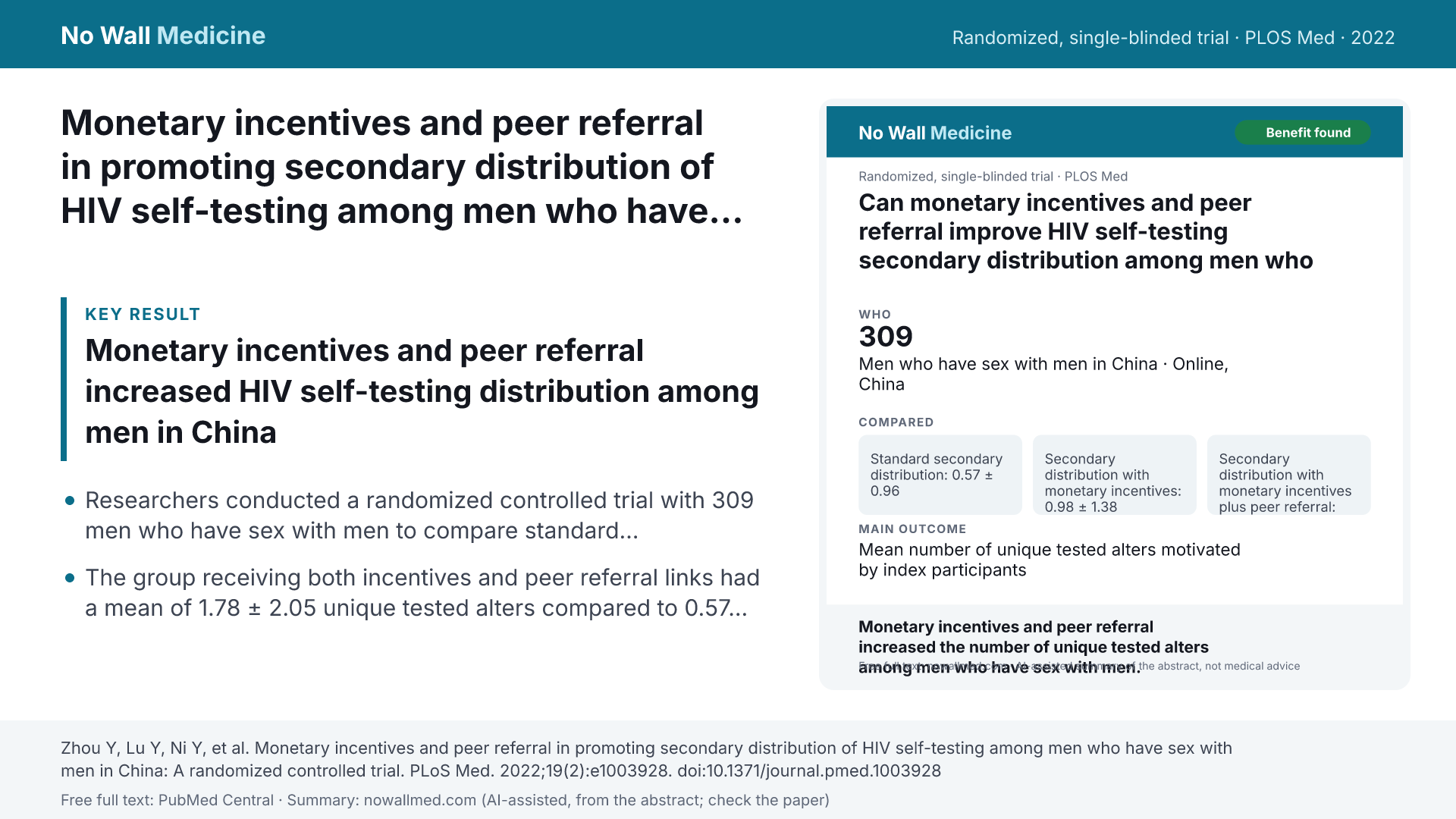
Monetary incentives and peer referral increased HIV self-testing distribution among men in China
Monetary incentives and peer referral in promoting secondary distribution of HIV self-testing among men who have sex with men in China: A randomized controlled trial
Randomized, single-blinded trialBenefit found
Can monetary incentives and peer referral improve HIV self-testing secondary distribution among men who have sex with men?
Who
309
Men who have sex with men in China · Online, China
Compared
Standard secondary distribution: 0.57 ± 0.96
Secondary distribution with monetary incentives: 0.98 ± 1.38
Secondary distribution with monetary incentives plus peer referral: 1.78 ± 2.05
Main outcome
Mean number of unique tested alters motivated by index participants
Result: incidence rate ratio 3.26 (95% CI 2.29 to 4.63)
Bottom line: Monetary incentives and peer referral increased the number of unique tested alters among men who have sex with men.
PLOS Med · 2022-02-14Download image
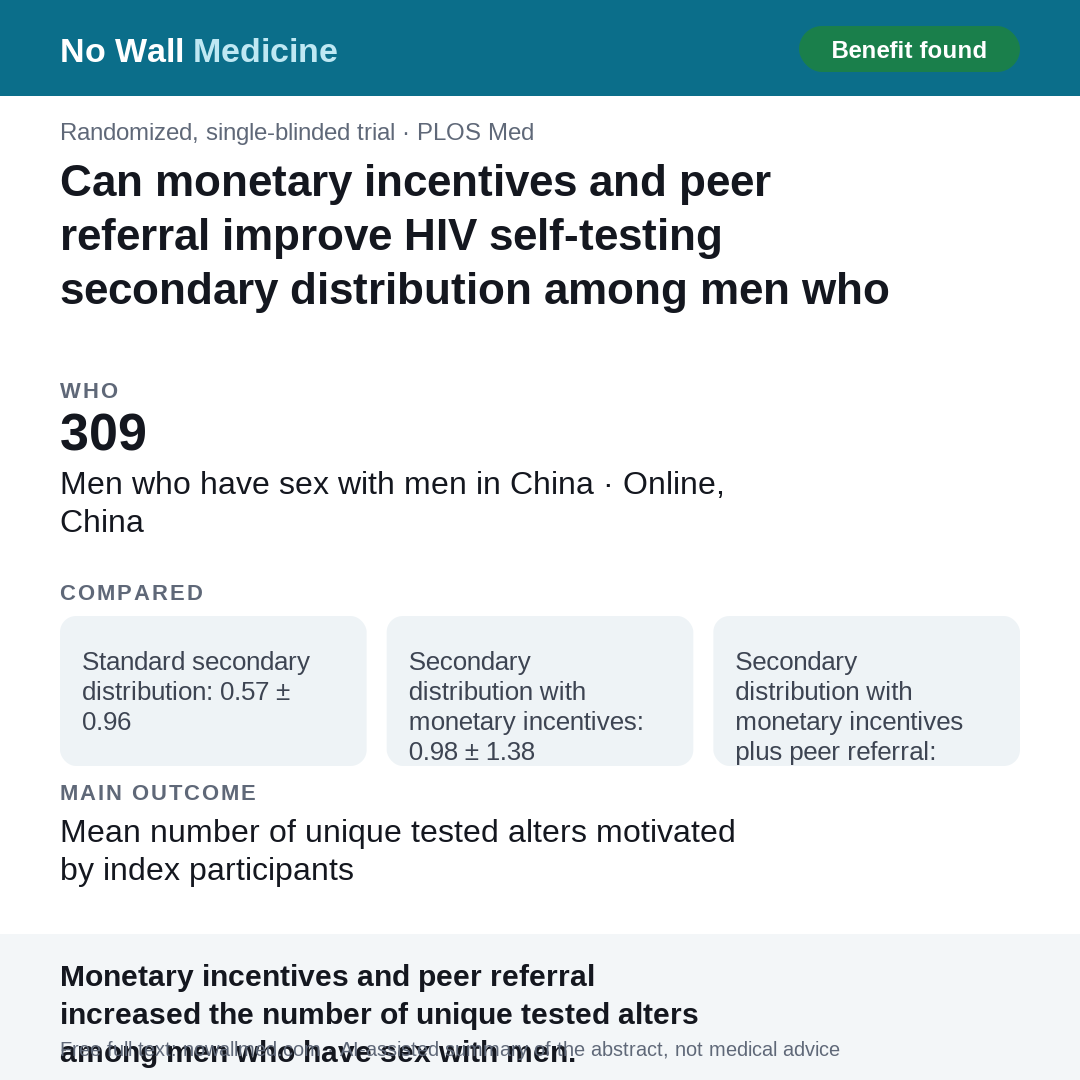
Clinical question: Can monetary incentives and peer referral improve HIV self-testing secondary distribution among men who have sex with men?
Why it matters: It was unknown which digital network-based methods, such as monetary incentives or peer referral links, could optimize the secondary distribution of HIV self-testing kits.
Key points
- Researchers conducted a randomized controlled trial with 309 men who have sex with men to compare standard distribution, distribution with $3 USD monetary incentives, and distribution with both incentives and peer referral links.
- The group receiving both incentives and peer referral links had a mean of 1.78 ± 2.05 unique tested alters compared to 0.57 ± 0.96 in the control group.
- The mean number of newly tested alters was 0.57 ± 0.91 in the incentive and referral group, 0.41 ± 0.73 in the incentive group, and 0.16 ± 0.39 in the control group.
Headline and key points written with AI from the paper’s abstract, with every number checked against it. Read the paper before relying on them.
Was this summary helpful?
Subject terms
Cite this article
Zhou Y, Lu Y, Ni Y, et al. Monetary incentives and peer referral in promoting secondary distribution of HIV self-testing among men who have sex with men in China: A randomized controlled trial. PLOS Med. 2022. doi:10.1371/journal.pmed.1003928
Spotted a mistake? Suggest a correction