Monocyte distribution width shows good diagnostic performance for sepsis and COVID-19 infections
Monocyte Distribution Width as a Diagnostic Marker for Infection: A Systematic Review and Meta-analysis
Systematic review and meta-analysisBenefit found
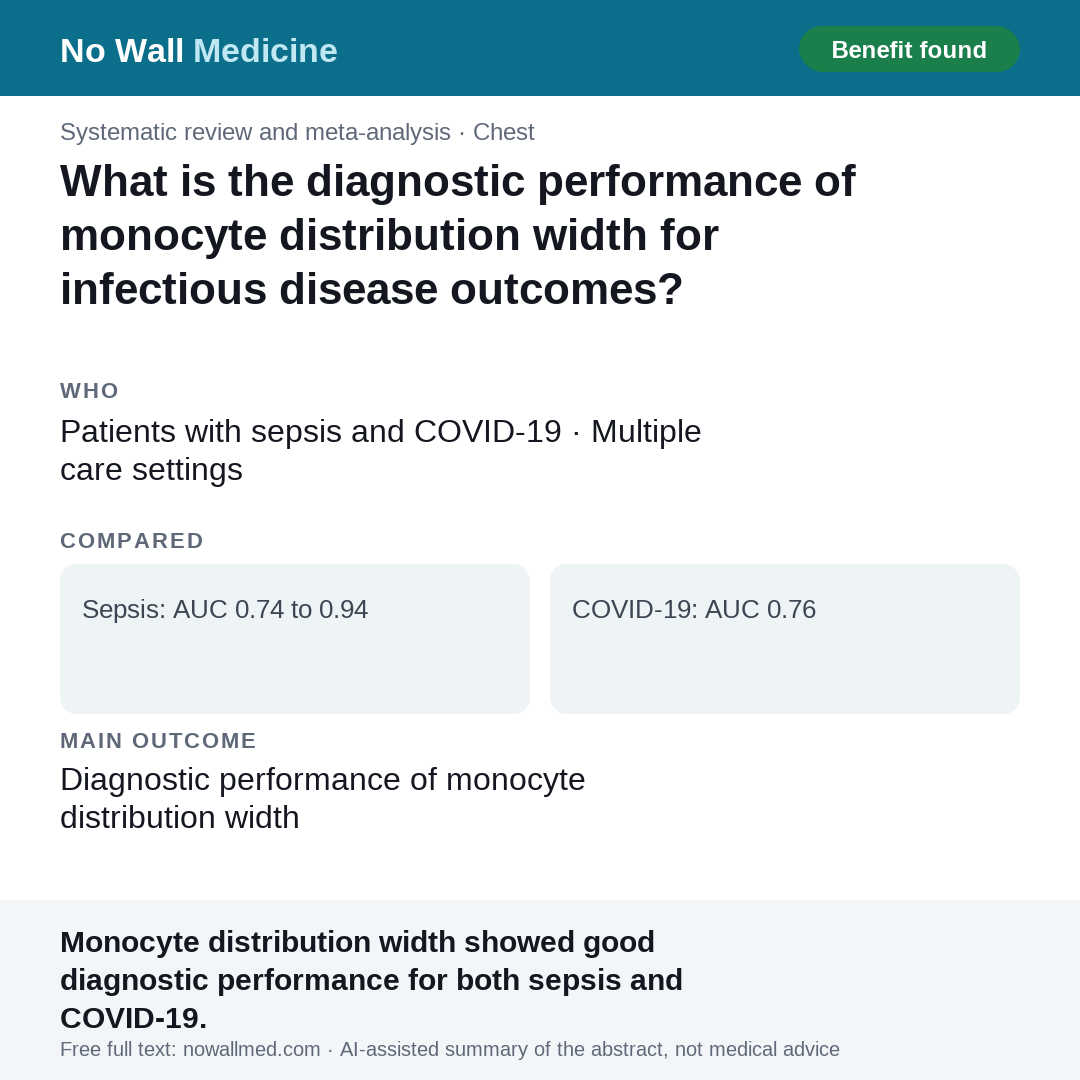
What is the diagnostic performance of monocyte distribution width for infectious disease outcomes?
Who
Patients with sepsis and COVID-19 · Multiple care settings
Compared
Sepsis: AUC 0.74 to 0.94
COVID-19: AUC 0.76
Main outcome
Diagnostic performance of monocyte distribution width
Bottom line: Monocyte distribution width showed good diagnostic performance for both sepsis and COVID-19.
Chest · 2023-01-18Download image
Clinical question: What is the diagnostic performance of monocyte distribution width for infectious disease outcomes?
Why it matters: The diagnostic performance of monocyte distribution width across various infectious disease outcomes and different care settings was unknown.
Key points
- Researchers analyzed 29 studies to evaluate the diagnostic performance of monocyte distribution width, a measure of the variation in the size of white blood cells.
- For sepsis, the pooled area under the receiver operating characteristic curve ranged from 0.74 to 0.94, with mean sensitivity of 0.69 to 0.79 and mean specificity of 0.57 to 0.86.
- For COVID-19, the pooled area under the receiver operating characteristic curve was 0.76, with a mean sensitivity of 0.79 and a mean specificity of 0.59.
Headline and key points written with AI from the paper’s abstract, with every number checked against it. Read the paper before relying on them.
Was this summary helpful?
Subject terms
Cite this article
Malinovska A, Hernried B, Lin A, Badaki-Makun O, Fenstermacher K, Ervin AM. Monocyte Distribution Width as a Diagnostic Marker for Infection: A Systematic Review and Meta-analysis. Chest. 2023. doi:10.1016/j.chest.2022.12.049
Spotted a mistake? Suggest a correction
Top studies every Monday
The week’s key trials and guidelines in your specialties, plus any topics you follow. By email, free.
Get the weekly digest