Intensive triplet therapy was associated with lower mortality in frail patients with multiple myeloma
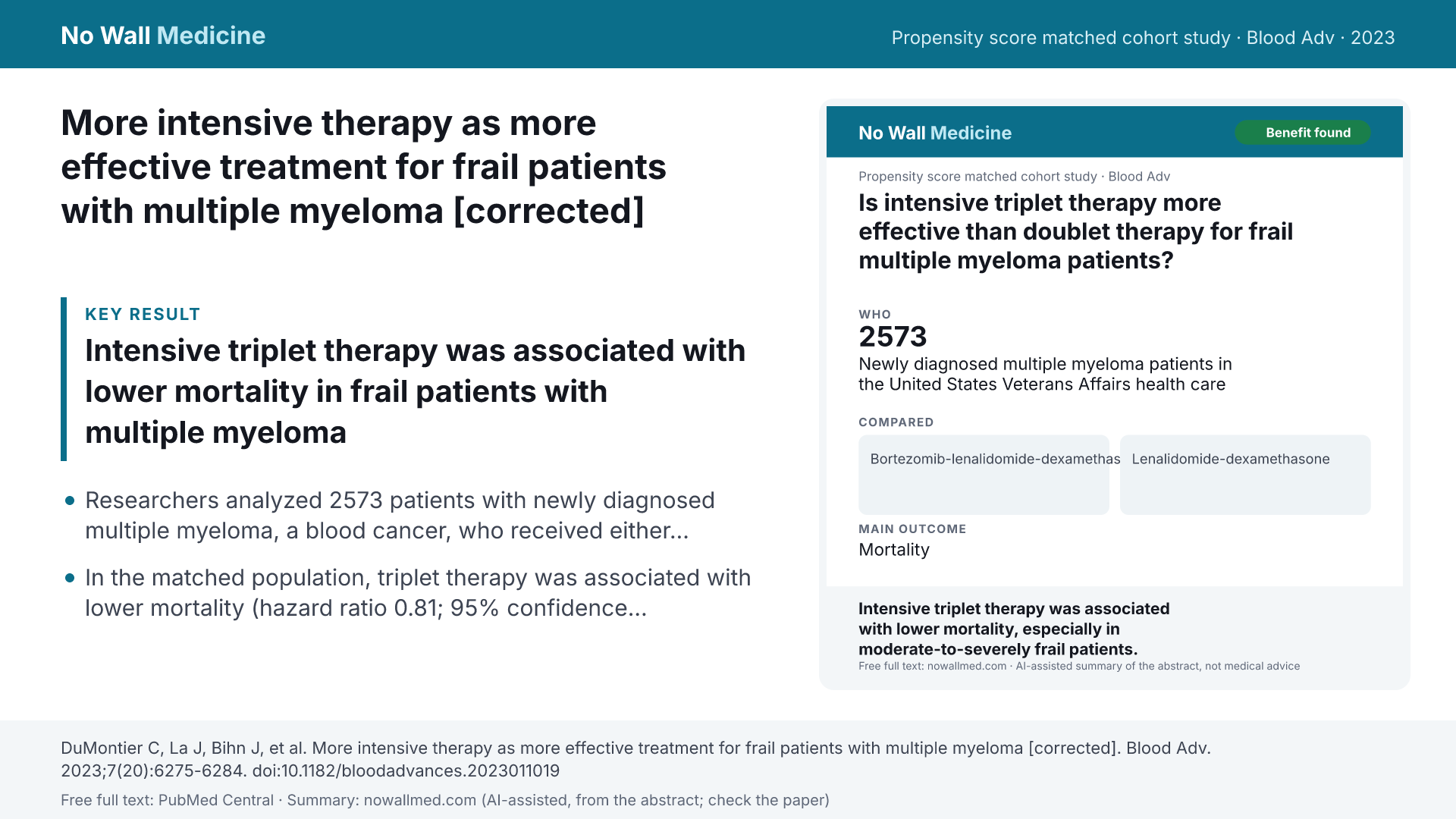
More intensive therapy as more effective treatment for frail patients with multiple myeloma [corrected]
Propensity score matched cohort studyBenefit found
Is intensive triplet therapy more effective than doublet therapy for frail multiple myeloma patients?
Who
2573
Newly diagnosed multiple myeloma patients in the United States Veterans Affairs health care System · United States Veterans Affairs health care System
Compared
Bortezomib-lenalidomide-dexamethasone
Lenalidomide-dexamethasone
Main outcome
Mortality
Result: hazard ratio 0.81 (95% CI 0.70-0.94)
Bottom line: Intensive triplet therapy was associated with lower mortality, especially in moderate-to-severely frail patients.
Blood Adv · 2023-08-15 · Save PNG
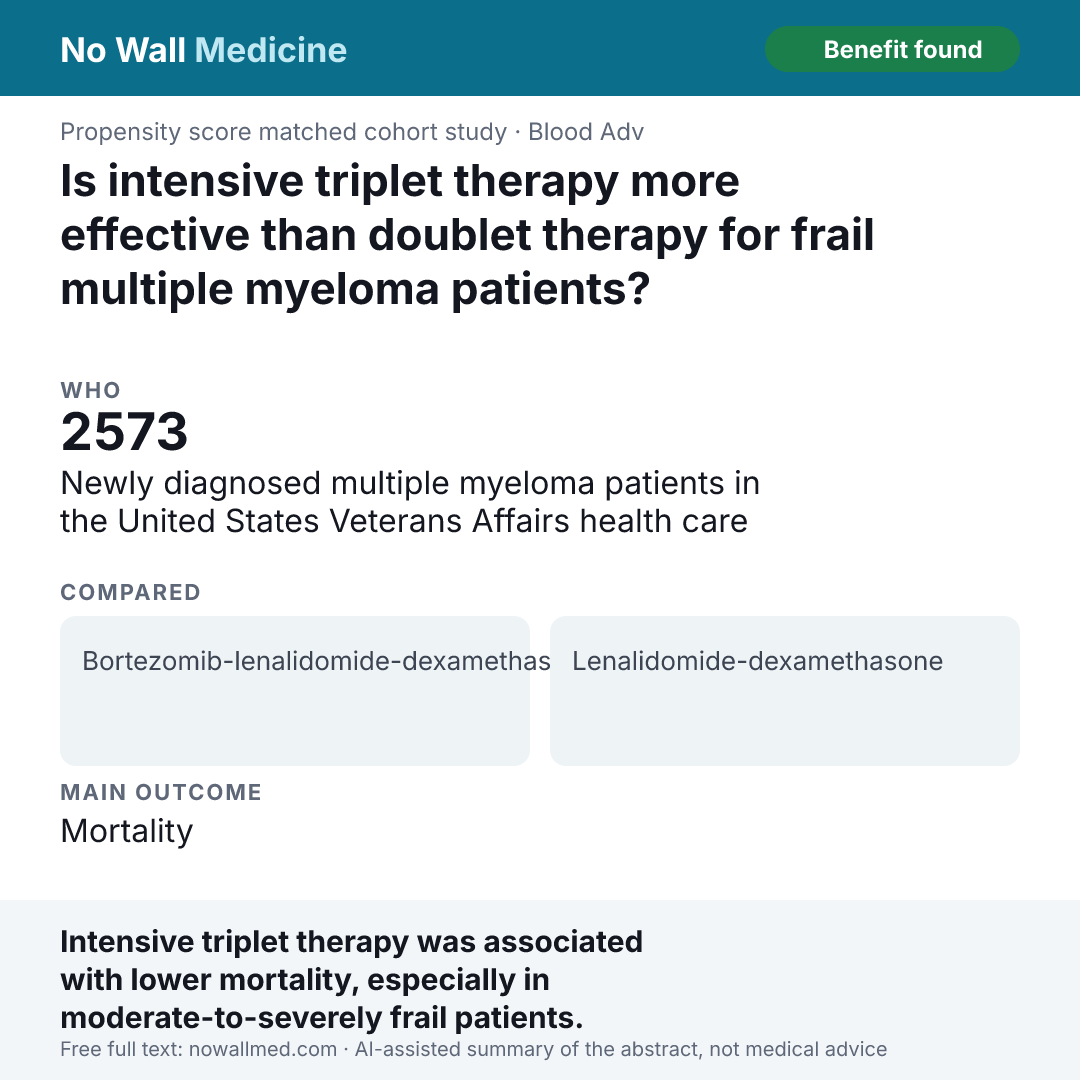
Clinical question: Is intensive triplet therapy more effective than doublet therapy for frail multiple myeloma patients?
Why it matters: Guidelines have historically recommended less intensive doublet therapy over triplet therapy for frail patients with multiple myeloma who may not tolerate more intensive treatment.
Key points
- Researchers analyzed 2573 patients with newly diagnosed multiple myeloma, a blood cancer, who received either triplet therapy (bortezomib, lenalidomide, and dexamethasone) or doublet therapy (lenalidomide and dexamethasone).
- In the matched population, triplet therapy was associated with lower mortality (hazard ratio 0.81; 95% confidence interval 0.70-0.94) compared to doublet therapy.
- The strongest association between triplet therapy and lower mortality was seen in moderate-to-severely frail patients (hazard ratio 0.74; 95% confidence interval 0.56-0.97).
Headline and key points written with AI from the paper’s abstract, with every number checked against it. Read the paper before relying on them.
Was this summary helpful?
Abstract
Although randomized controlled trial data suggest that the more intensive triplet bortezomib-lenalidomide-dexamethasone (VRd) is superior to the less intensive doublet lenalidomide-dexamethasone (Rd) in patients newly diagnosed with multiple myeloma (MM), guidelines have historically recommended Rd over VRd for patients who are frail and may not tolerate a triplet. We identified 2573 patients (median age, 69.7 years) newly diagnosed with MM who were initiated on VRd (990) or Rd (1583) in the national US Veterans Affairs health care System from 2004 to 2020. We measured frailty using the Veterans Affairs Frailty Index. To reduce imbalance in confounding, we matched patients for MM stage and 1:1 based on a propensity score. Patients who were moderate-severely frail had a higher prevalence of stage III MM and myeloma-related frailty deficits than patients who were not frail. VRd vs Rd was associated with lower mortality (hazard ratio [HR], 0.81; 95% confidence interval [CI], 0.70-0.94) in the overall matched population. Patients who were moderate-severely frail demonstrated the strongest association (HR 0.74; 95% CI, 0.56-0.97), whereas the association weakened in those who were mildly frail (HR, 0.80; 95% CI, 0.61-1.05) and nonfrail (HR, 0.86; 95% CI, 0.67-1.10). VRd vs Rd was associated with a modestly higher incidence of hospitalizations in the overall population, but this association weakened in patients who were moderate-severely frail. Our findings confirm the benefit of VRd over Rd in US veterans and further suggest that this benefit is strongest in patients with the highest levels of frailty, arguing that more intensive treatment of myeloma may be more effective treatment of frailty itself.
Abstract reproduced under the article’s CC BY NC ND licence.
Subject terms
Headline, design, result, key points, caveat and citation as plain text.
Cite this article
DuMontier C, La J, Bihn J, et al. More intensive therapy as more effective treatment for frail patients with multiple myeloma [corrected]. Blood Adv. 2023;7(20):6275-6284. doi:10.1182/bloodadvances.2023011019
Spotted a mistake? Suggest a correction