Frequent follow-up testing did not change 10-year mortality in stage II or III colorectal cancer
More vs Less Frequent Follow-Up Testing and 10-Year Mortality in Patients With Stage II or III Colorectal Cancer: Secondary Analysis of the COLOFOL Randomized Clinical Trial
Randomized clinical trialNo clear difference
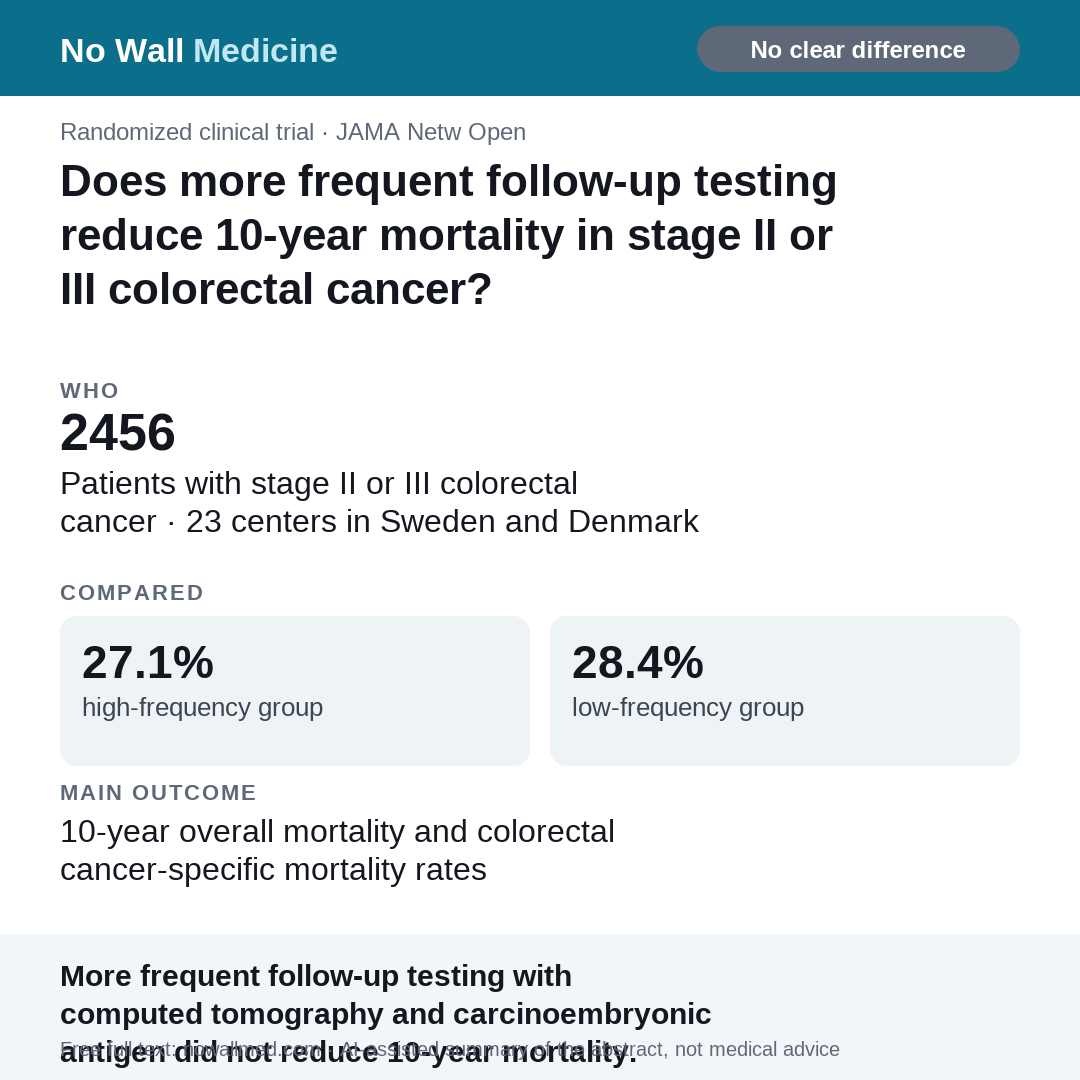
Does more frequent follow-up testing reduce 10-year mortality in stage II or III colorectal cancer?
Who
2456
Patients with stage II or III colorectal cancer · 23 centers in Sweden and Denmark
Compared
27.1%high-frequency group (333/1227)
28.4%low-frequency group (349/1229)
Main outcome
10-year overall mortality and colorectal cancer-specific mortality rates
Result: risk difference, 1.3% (95% CI, -2.3% to 4.8%)
Bottom line: More frequent follow-up testing with computed tomography and carcinoembryonic antigen did not reduce 10-year mortality.
JAMA Netw Open · 2024-11-04Download image
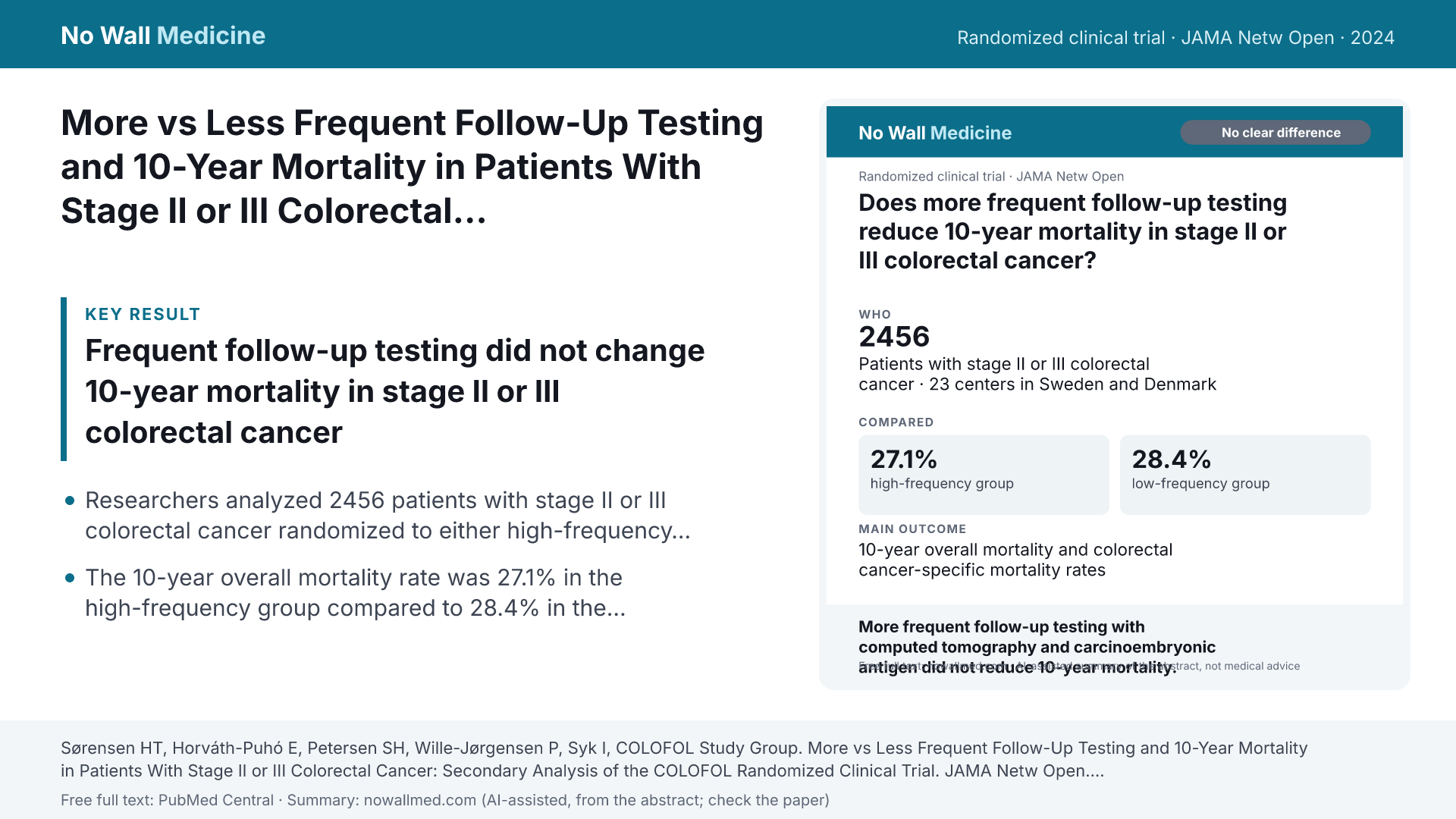
Clinical question: Does more frequent follow-up testing reduce 10-year mortality in stage II or III colorectal cancer?
Why it matters: It is unknown if intensive follow-up testing after curative surgery for colorectal cancer provides a long-term survival benefit.
Key points
- Researchers analyzed 2456 patients with stage II or III colorectal cancer randomized to either high-frequency or low-frequency testing using computed tomography scans and blood protein screening.
- The 10-year overall mortality rate was 27.1% in the high-frequency group compared to 28.4% in the low-frequency group, which was not a statistically significant difference.
- The 10-year colorectal cancer-specific mortality rate was 15.6% for the high-frequency group and 16.0% for the low-frequency group.
Headline and key points written with AI from the paper’s abstract, with every number checked against it. Read the paper before relying on them.
Was this summary helpful?
Subject terms
Cite this article
Sørensen HT, Horváth-Puhó E, Petersen SH, Wille-Jørgensen P, Syk I, COLOFOL Study Group. More vs Less Frequent Follow-Up Testing and 10-Year Mortality in Patients With Stage II or III Colorectal Cancer: Secondary Analysis of the COLOFOL Randomized Clinical Trial. JAMA Netw Open. 2024. doi:10.1001/jamanetworkopen.2024.46243
Spotted a mistake? Suggest a correction
Top studies every Monday
The week’s key trials and guidelines in your specialties, plus any topics you follow. By email, free.
Get the weekly digest