Haemoadsorption therapy during heart bypass surgery showed no significant benefit for mortality or hospital stay
Mortality and adverse events of extracorporeal haemoadsorption therapy in cardiac surgery: a systematic review and meta-analysis of randomised controlled trials
Systematic review and meta-analysis of 12 randomized controlled trialsNo clear difference
Does extracorporeal haemoadsorption therapy during cardiopulmonary bypass improve mortality in cardiac surgery?
Who
713
Adult patients undergoing cardiac surgery with cardiopulmonary bypass
Compared
Haemoadsorption therapy
Conventional cardiopulmonary bypass
Main outcome
Mortality
Result: odds ratio 1.08 (95% CI 0.59 to 2.01)
Bottom line: Haemoadsorption therapy during cardiopulmonary bypass showed no significant benefit for mortality or length of stay.
Limitation: Only one study had low risk of bias, limiting the strength of findings.
Br J Anaesth · 2026-07-21Download image
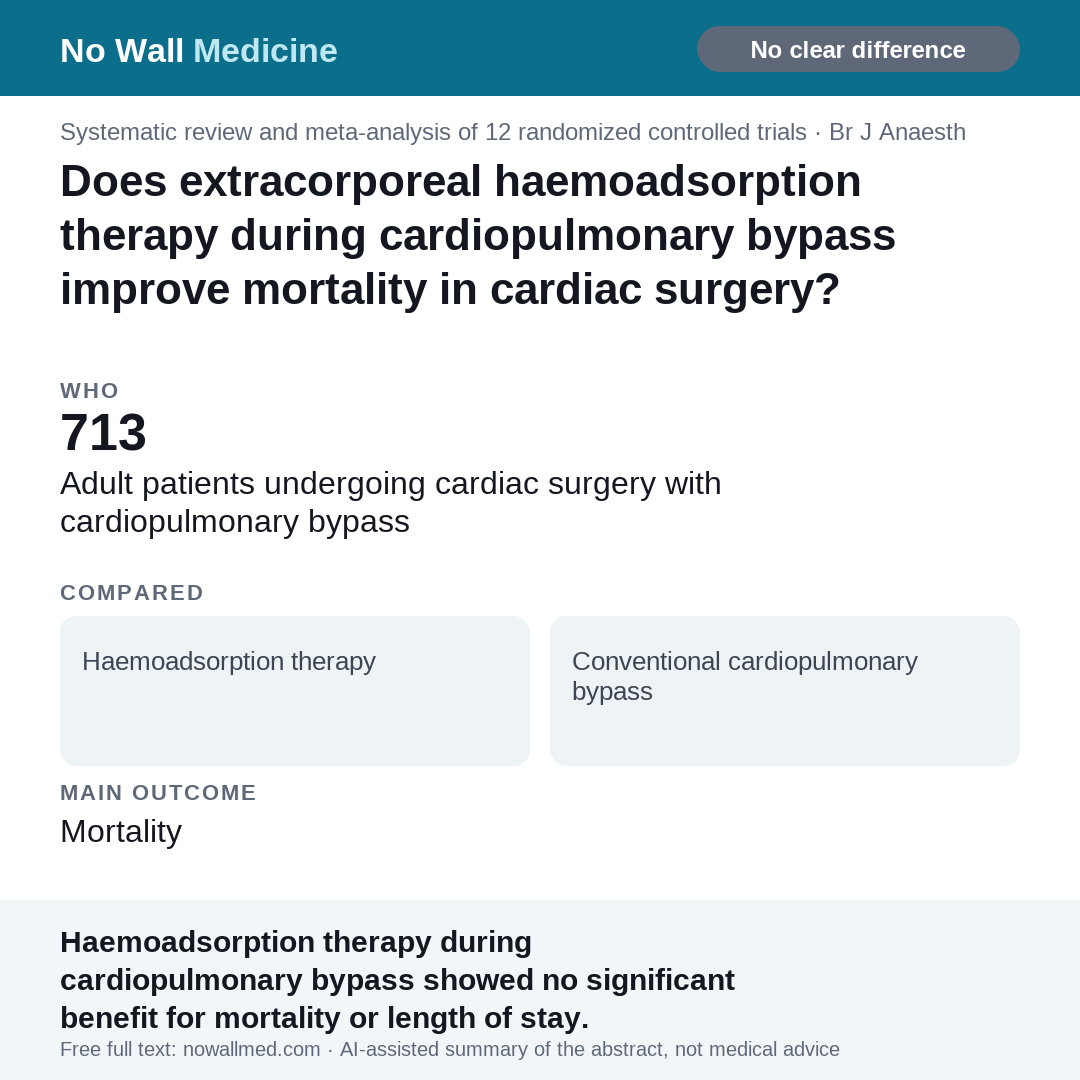
Clinical question: Does extracorporeal haemoadsorption therapy during cardiopulmonary bypass improve mortality in cardiac surgery?
Why it matters: Doctors have sought to determine if removing pro-inflammatory mediators through haemoadsorption can mitigate the systemic inflammatory response caused by cardiopulmonary bypass.
Key points
- Researchers analyzed 12 randomized controlled trials involving 713 adult patients undergoing cardiac surgery with cardiopulmonary bypass, which is a machine used to pump blood during surgery.
- The meta-analysis found no statistically significant difference in mortality, hospital length of stay, or intensive care unit length of stay when comparing haemoadsorption to standard bypass.
- There were also no significant differences found regarding adverse events or the need for ventilation, cardiovascular support, or renal replacement therapy.
Limitation the authors note: Only one study had a low risk of bias, which limits the strength of the findings.
Headline and key points written with AI from the paper’s abstract, with every number checked against it. Read the paper before relying on them.
Topics
Cite this article
Pittaway HCA, Kelly JM, Price MJ, Parekh D, Howells PA. Mortality and adverse events of extracorporeal haemoadsorption therapy in cardiac surgery: a systematic review and meta-analysis of randomised controlled trials. Br J Anaesth. 2026. doi:10.1016/j.bja.2026.06.005
Spotted a mistake? Suggest a correction