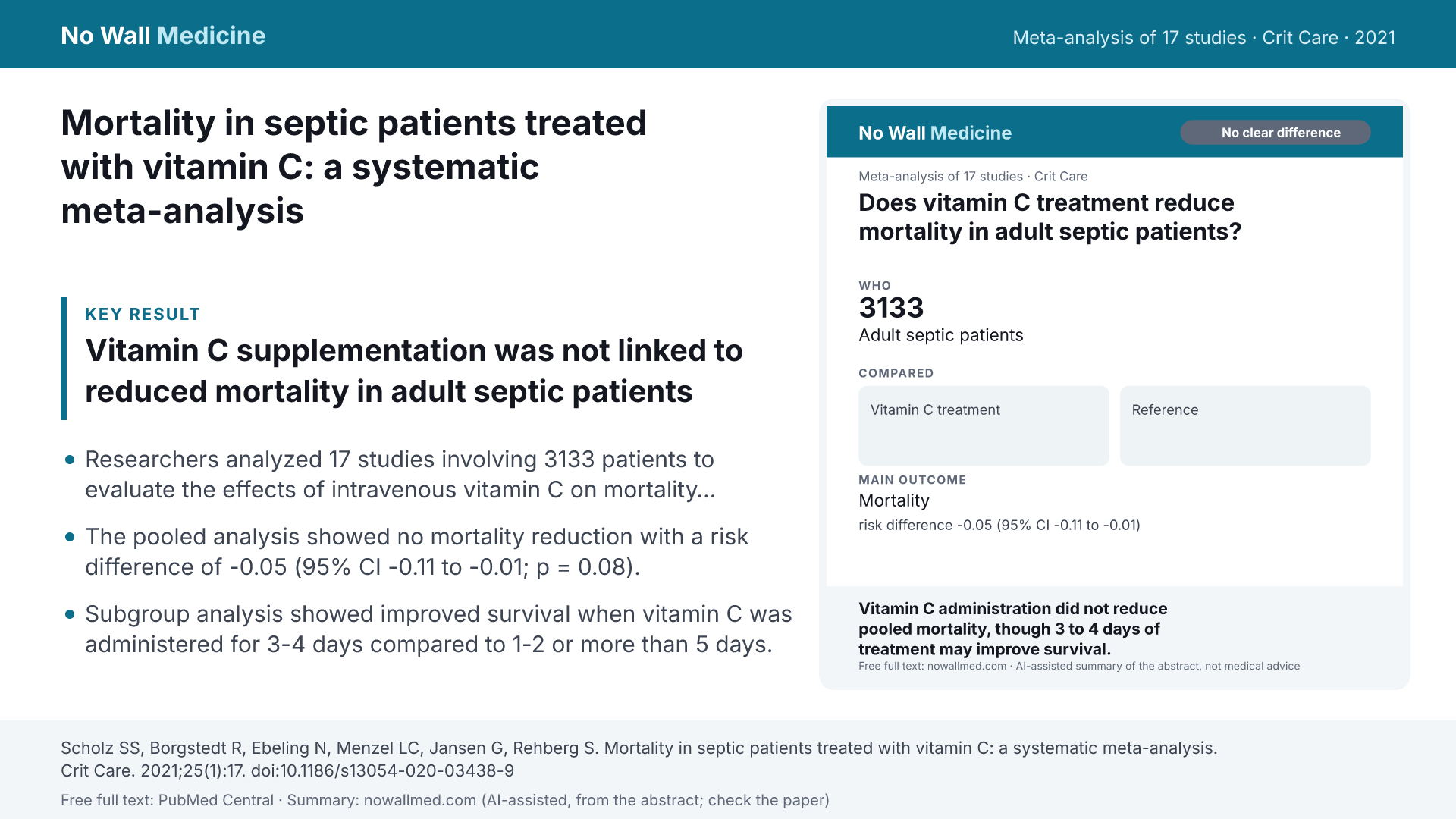
Vitamin C supplementation was not linked to reduced mortality in adult septic patients
Mortality in septic patients treated with vitamin C: a systematic meta-analysis
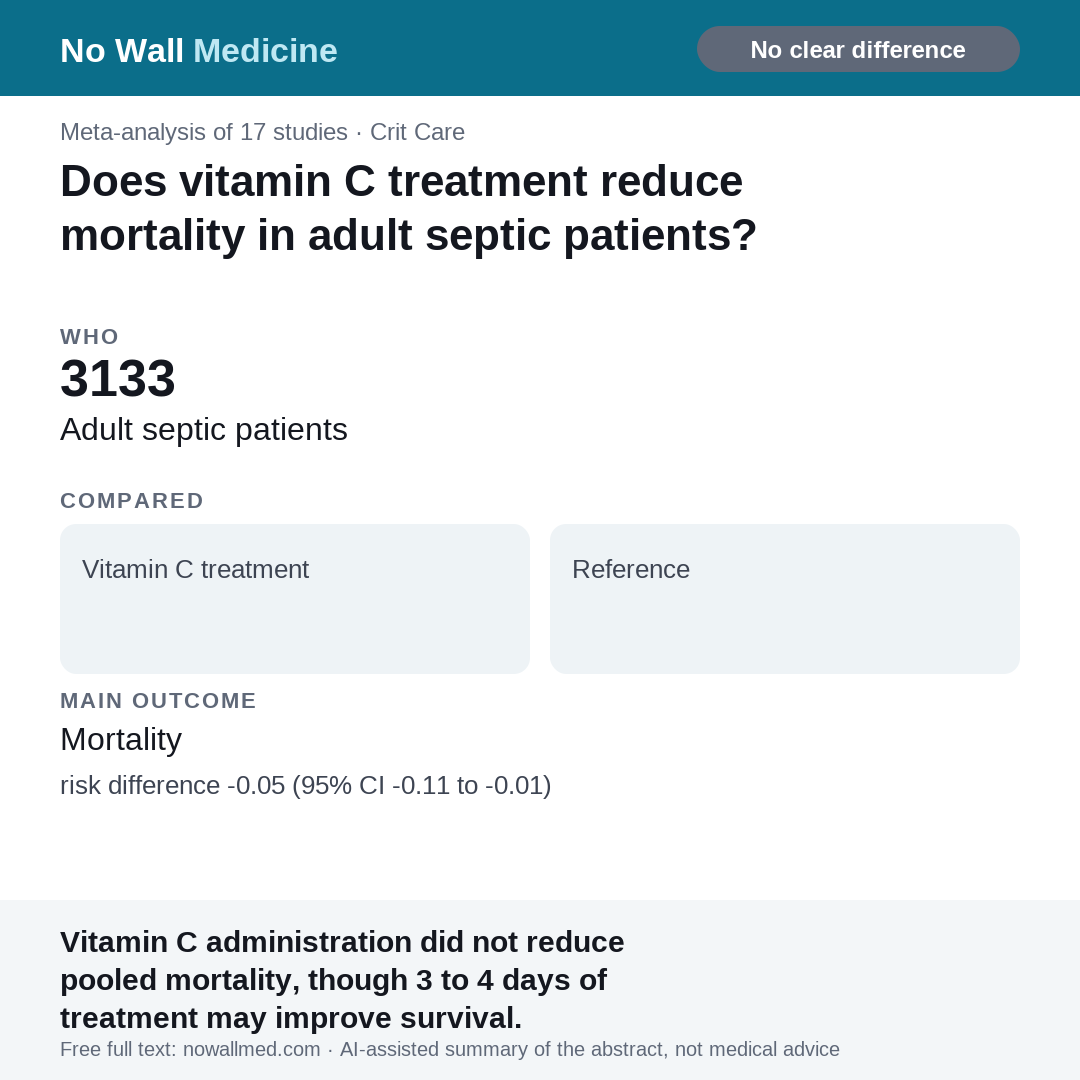
Meta-analysis of 17 studiesNo clear difference
Does vitamin C treatment reduce mortality in adult septic patients?
Who
3133
Adult septic patients
Compared
Vitamin C treatment
Reference
Main outcome
Mortality
Result: risk difference -0.05 (95% CI -0.11 to -0.01)
Bottom line: Vitamin C administration did not reduce pooled mortality, though 3 to 4 days of treatment may improve survival.
Limitation: Presence of statistical heterogeneity was noted.
Crit Care · 2021-01-06Download image
Clinical question: Does vitamin C treatment reduce mortality in adult septic patients?
Why it matters: The potential effects of vitamin C treatment on mortality in adult septic patients remain controversial.
Key points
- Researchers analyzed 17 studies involving 3133 patients to evaluate the effects of intravenous vitamin C on mortality in adults with sepsis.
- The pooled analysis showed no mortality reduction with a risk difference of -0.05 (95% CI -0.11 to -0.01; p = 0.08).
- Subgroup analysis showed improved survival when vitamin C was administered for 3-4 days compared to 1-2 or more than 5 days.
Headline and key points written with AI from the paper’s abstract, with every number checked against it. Read the paper before relying on them.
Was this summary helpful?
Abstract
Background
Supplementation of vitamin C in septic patients remains controversial despite eight large clinical trials published only in 2020. We aimed to evaluate the evidence on potential effects of vitamin C treatment on mortality in adult septic patients. Methods
Data search included PubMed, Web of Science, and the Cochrane Library. A meta-analysis of eligible peer-reviewed studies was performed in accordance with the PRISMA statement. Only studies with valid classifications of sepsis and intravenous vitamin C treatment (alone or combined with hydrocortisone/thiamine) were included. Results
A total of 17 studies including 3133 patients fulfilled the predefined criteria and were analyzed. Pooled analysis indicated no mortality reduction in patients treated with vitamin C when compared to reference (risk difference - 0.05 [95% CI - 0.11 to - 0.01]; p = 0.08; p for Cochran Q = 0.002; I2 = 56%). Notably, subgroup analyses revealed an improved survival, if vitamin C treatment was applied for 3-4 days (risk difference, - 0.10 [95% CI - 0.19 to - 0.02]; p = 0.02) when compared to patients treated for 1-2 or > 5 days. Also, timing of the pooled mortality assessment indicated a reduction concerning short-term mortality (< 30 days; risk difference, - 0.08 [95% CI - 0.15 to - 0.01]; p = 0.02; p for Cochran Q = 0.02; I2 = 63%). Presence of statistical heterogeneity was noted with no sign of significant publication bias. Conclusion
Although vitamin C administration did not reduce pooled mortality, patients may profit if vitamin C is administered over 3 to 4 days. Consequently, further research is needed to identify patient subgroups that might benefit from intravenous supplementation of vitamin C.
Abstract reproduced under the article’s CC BY licence.
Subject terms
Cite this article
Scholz SS, Borgstedt R, Ebeling N, Menzel LC, Jansen G, Rehberg S. Mortality in septic patients treated with vitamin C: a systematic meta-analysis. Crit Care. 2021. doi:10.1186/s13054-020-03438-9
Spotted a mistake? Suggest a correction