Motor activated ear nerve stimulation showed greater upper limb improvement than unpaired stimulation in stroke survivors
Motor Activated Auricular Vagus Nerve Stimulation as a Potential Neuromodulation Approach for Post-Stroke Motor Rehabilitation: A Pilot Study
Randomized, double-blind, pilot trialBenefit found
Does motor activated auricular vagus nerve stimulation improve post-stroke upper limb function?
Who
16
20 stroke survivors
Compared
Motor activated auricular vagus nerve stimulation: 5.00 ± 1.02
Active unpaired transcutaneous auricular vagus nerve stimulation: 3.14 ± 0.63
Main outcome
Fugl-Meyer Assessment upper extremity scores
Result: Cohen's d = 0.63 vs 0.30
Bottom line: Motor activated auricular vagus nerve stimulation may be superior to unpaired stimulation for post-stroke motor rehabilitation.
Neurorehabil Neural Repair · 2023-05-20Download image
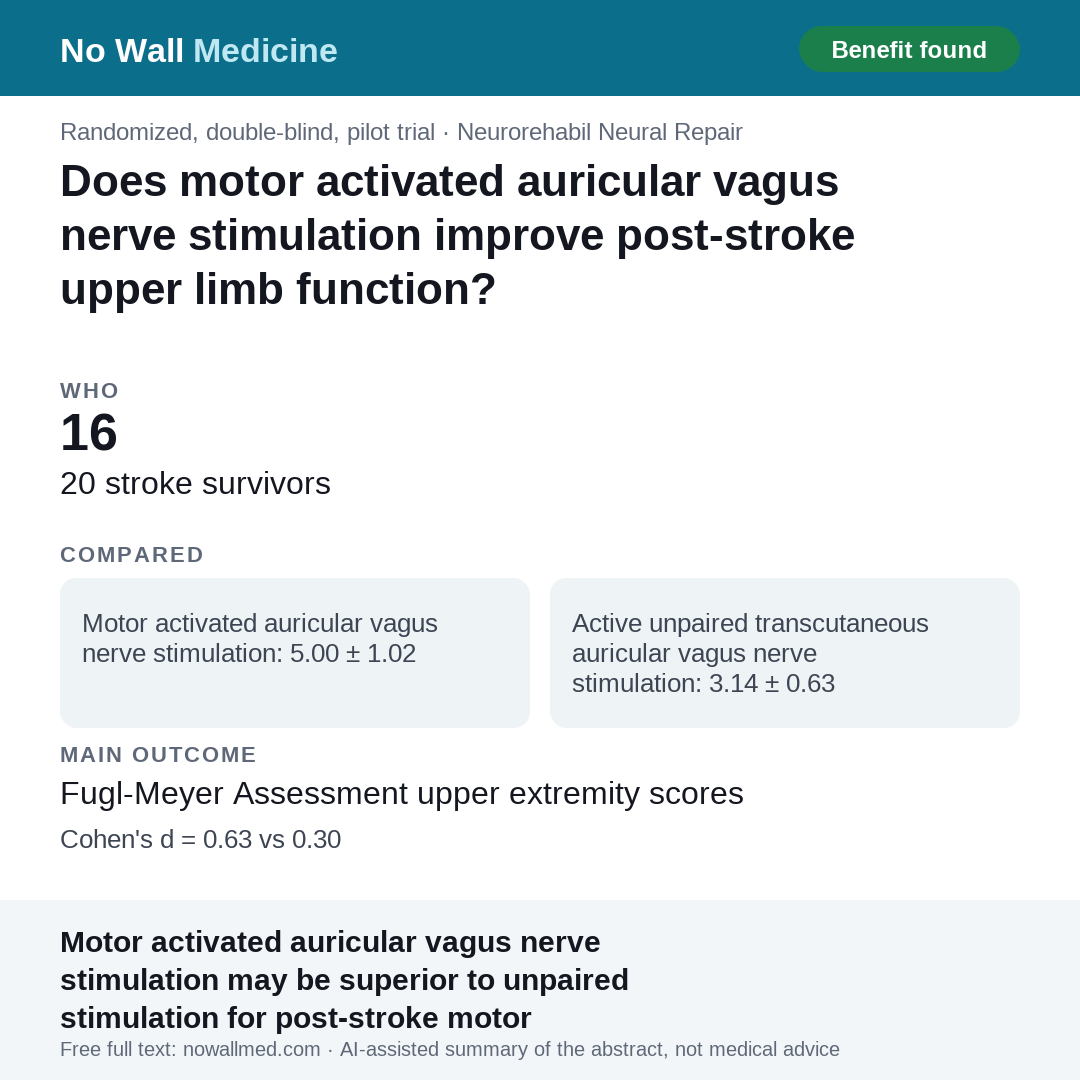
Clinical question: Does motor activated auricular vagus nerve stimulation improve post-stroke upper limb function?
Why it matters: It is unknown if pairing non-invasive ear nerve stimulation with movement or the amount of stimulation used is critical for improving motor function after a stroke.
Key points
- In this pilot trial, 20 stroke survivors were randomized to receive either motor activated auricular vagus nerve stimulation or unpaired transcutaneous auricular vagus nerve stimulation during 12 rehabilitation sessions.
- The motor activated group showed a Fugl-Meyer Assessment upper extremity score increase of 5.00 ± 1.02 compared to 3.14 ± 0.63 for the unpaired group.
- The motor activated group had a larger effect size of 0.63 and received significantly fewer stimulation pulses, averaging 36,070 ± 3,205, compared to 45,000 pulses in the unpaired group.
Headline and key points written with AI from the paper’s abstract, with every number checked against it. Read the paper before relying on them.
Topics
Cite this article
Badran BW, Peng X, Baker-Vogel B, Hutchison S, Finetto P, Rishe K. Motor Activated Auricular Vagus Nerve Stimulation as a Potential Neuromodulation Approach for Post-Stroke Motor Rehabilitation: A Pilot Study. Neurorehabil Neural Repair. 2023. doi:10.1177/15459683231173357
Spotted a mistake? Suggest a correction
Top studies every Monday
The week’s key trials and guidelines in your specialties, plus any topics you follow. By email, free.
Get the weekly digest