MRI-Targeted Biopsy Detected More Clinically Significant Prostate Cancers
MRI-Targeted or Standard Biopsy for Prostate-Cancer Diagnosis
Why it matters: MRI first, with targeted biopsy only if suspicious, found more clinically significant prostate cancer and less insignificant cancer than standard biopsy.
Related landmark trials: ERSPC (prostate screening)
Context written by the No Wall Medicine team.
Randomized trialBenefit found
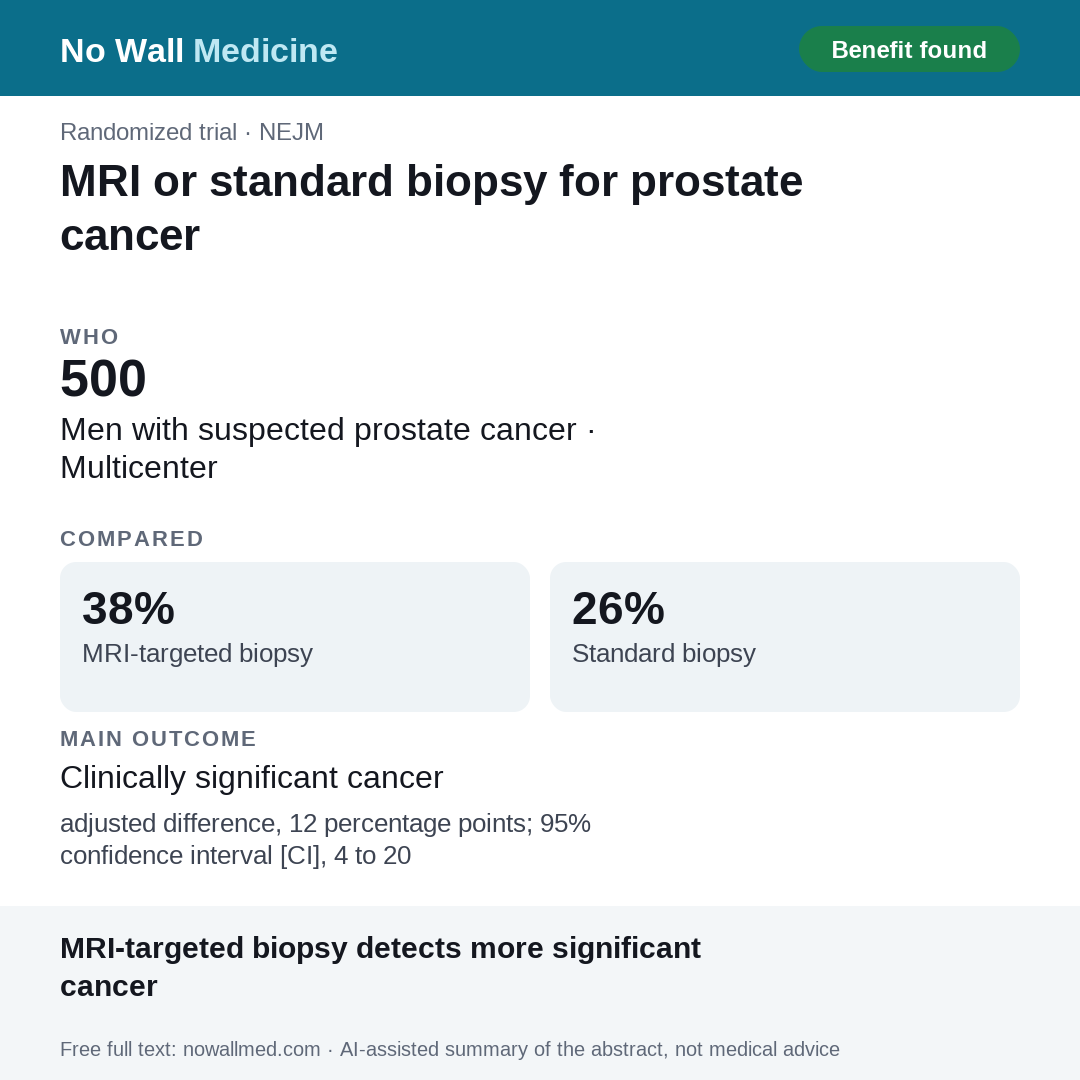
MRI or standard biopsy for prostate cancer
Who
500
Men with suspected prostate cancer · Multicenter
Compared
38%MRI-targeted biopsy (95/252)
26%Standard biopsy (64/248)
Main outcome
Clinically significant cancer
Result: adjusted difference, 12 percentage points; 95% confidence interval [CI], 4 to 20
Bottom line: MRI-targeted biopsy detects more significant cancer
Funded by: National Institute for Health Research
NEJM · 2018-03-18Download image
Trial at a glance
Bottom line: MRI-targeted biopsy was superior to standard biopsy in detecting clinically significant cancer.
Clinical question
Is MRI-targeted biopsy noninferior to standard biopsy for prostate-cancer diagnosis?
Design
Multicenter, randomized, noninferiority trial. 11 countries, 25 centers, 2016-2017
Who was studied
500 men with suspected prostate cancer
Key inclusion criteria
- clinical suspicion of prostate cancer
- elevated PSA level
- no previous biopsy
- suitable for MRI and biopsy
Key exclusion criteria
- previous biopsy
- extracapsular disease
- PSA level > 20 ng/mL
Interventions
- MRI-targeted biopsy: MRI with or without targeted biopsy
- standard-biopsy: 10-to-12-core transrectal ultrasonography–guided biopsy
Primary outcome
proportion of men with clinically significant cancer. 38% in MRI-targeted biopsy group, 26% in standard-biopsy group, adjusted difference 12 percentage points
Secondary outcomes
- proportion of men with clinically insignificant cancer: 9% in MRI-targeted biopsy group, 22% in standard-biopsy group, adjusted difference -13 percentage points
Harms
2% of men in both groups had serious adverse events
Limitations reported by the authors
- single-center studies lack generalizability
- small and nonrandomized studies
Funding
National Institute for Health Research and European Association of Urology Research Foundation
Written with AI from the full paper; every number was checked against it. Read the paper before relying on it.
Key points
- 500 men with suspected prostate cancer were randomly assigned to MRI-targeted or standard biopsy.
- MRI-targeted biopsy detected clinically significant cancer in 38% of men, compared to 26% with standard biopsy.
- Fewer men in the MRI-targeted group received a diagnosis of clinically insignificant cancer, with an adjusted difference of -13 percentage points.
Limitation the authors note: None stated in the abstract
Headline and key points written with AI from the paper’s abstract, with every number checked against it. Read the paper before relying on them.
Was this summary helpful?
Subject terms
Cite this article
Kasivisvanathan V, Rannikko AS, Borghi M, Panebianco V, Mynderse LA, Vaarala MH. MRI-Targeted or Standard Biopsy for Prostate-Cancer Diagnosis. NEJM. 2018. doi:10.1056/NEJMoa1801993
Spotted a mistake? Suggest a correction
Top studies every Monday
The week’s key trials and guidelines in your specialties, plus any topics you follow. By email, free.
Get the weekly digest