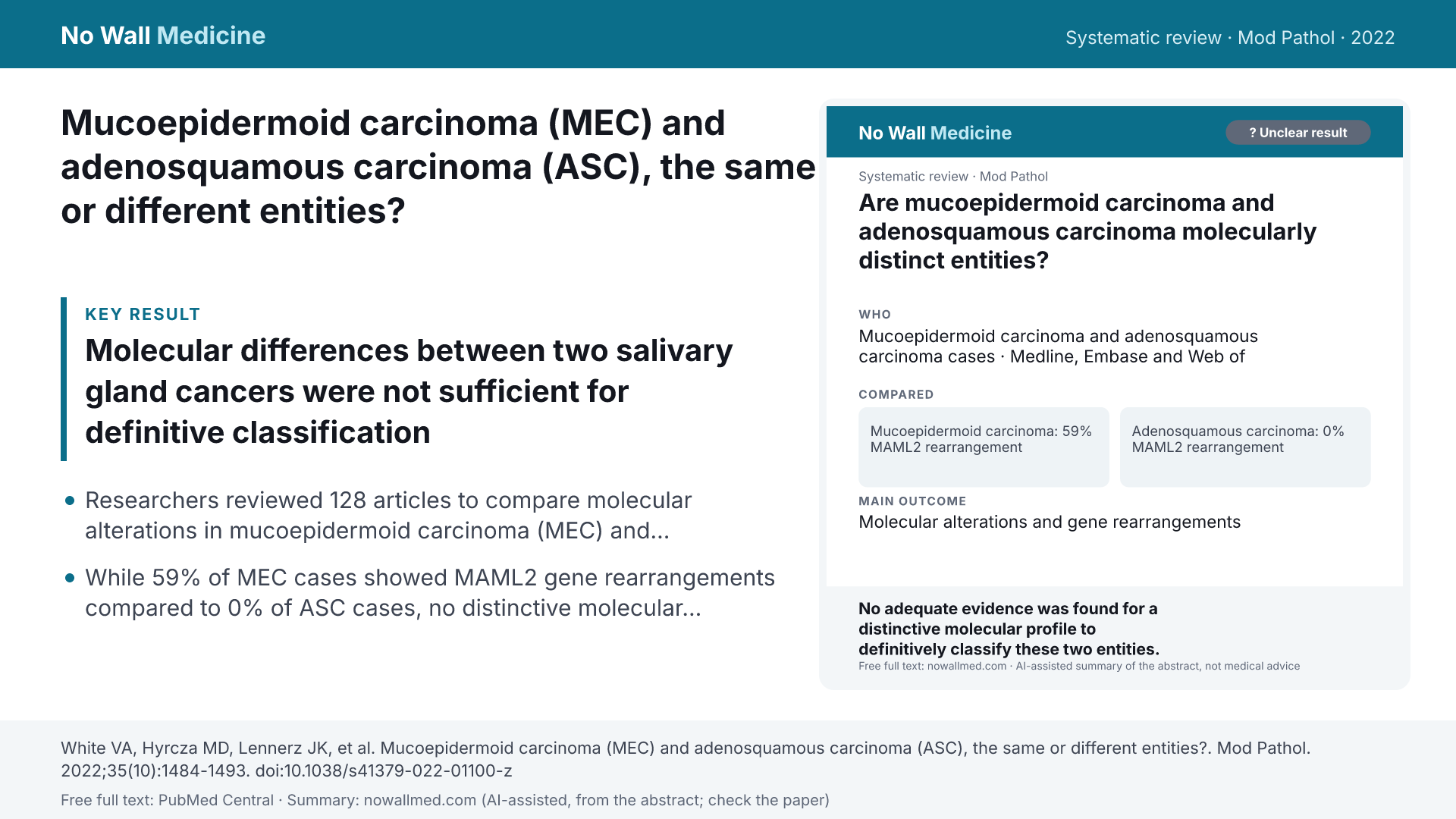
Mucoepidermoid carcinoma (MEC) and adenosquamous carcinoma (ASC), the same or different entities?
Key result: Molecular differences between two salivary gland cancers were not sufficient for definitive classification
Systematic reviewUnclear result
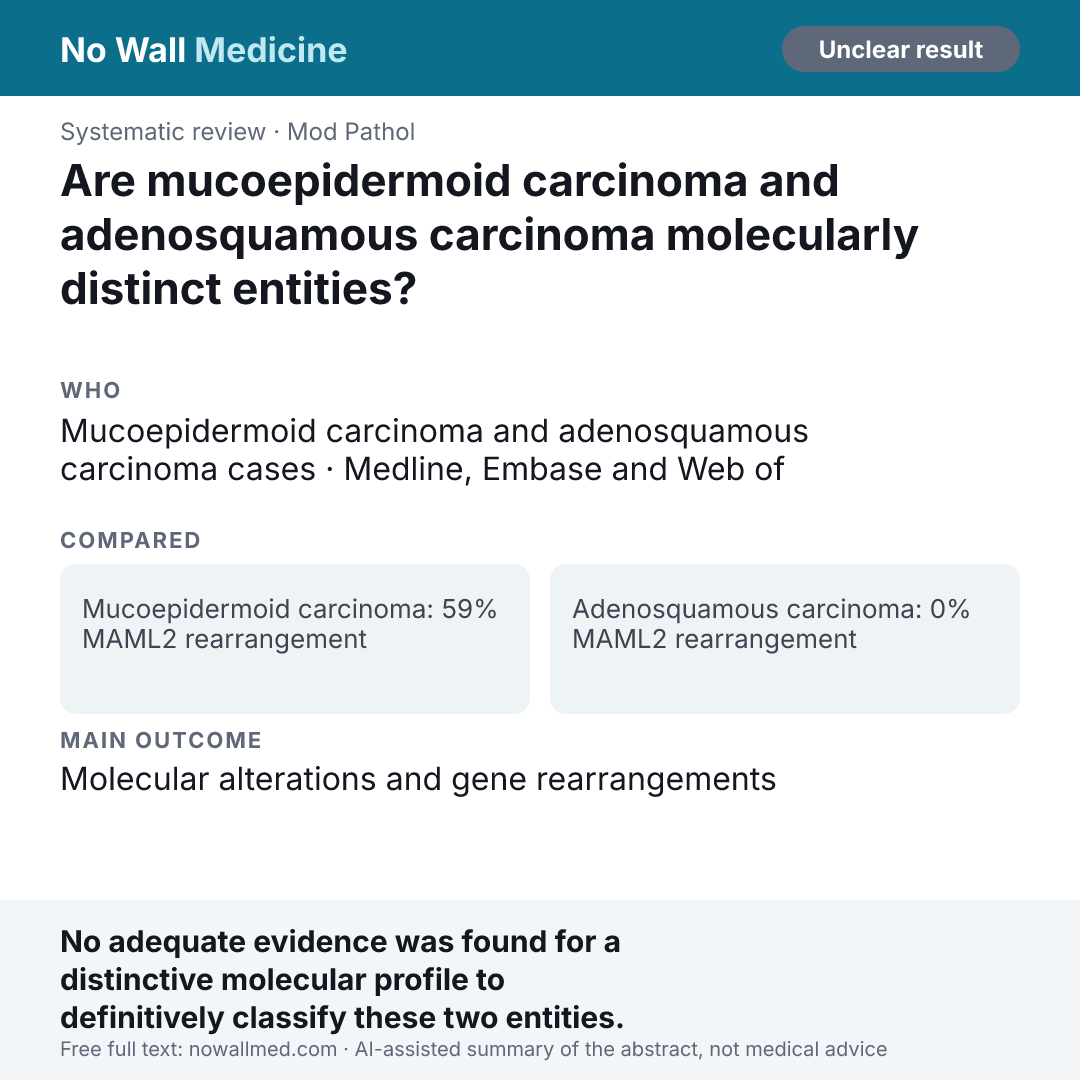
Are mucoepidermoid carcinoma and adenosquamous carcinoma molecularly distinct entities?
Who
Mucoepidermoid carcinoma and adenosquamous carcinoma cases · Medline, Embase and Web of Science
Compared
Mucoepidermoid carcinoma: 59% MAML2 rearrangement
Adenosquamous carcinoma: 0% MAML2 rearrangement
Main outcome
Molecular alterations and gene rearrangements
Bottom line: No adequate evidence was found for a distinctive molecular profile to definitively classify these two entities.
Mod Pathol · 2022-07-23 · Save PNG
Key points
- Researchers reviewed 128 articles to compare molecular alterations in mucoepidermoid carcinoma (MEC) and adenosquamous carcinoma (ASC).
- While 59% of MEC cases showed MAML2 gene rearrangements compared to 0% of ASC cases, no distinctive molecular profile was found to aid classification.
- ASC was associated with higher EGFR mutation rates at 38.7% compared to 3.3% in MEC, and KRAS mutations were 22.9% in ASC versus 4.1% in MEC.
Discussion prompts
- Would these patients look like yours? Who was left out?
- Is the main outcome one that matters to patients?
- Is the difference large enough to change what you do?
Cite: White VA, Hyrcza MD, Lennerz JK, et al. Mucoepidermoid carcinoma (MEC) and adenosquamous carcinoma (ASC), the same or different entities?. Mod Pathol. 2022;35(10):1484-1493. doi:10.1038/s41379-022-01100-z
Free full text: PubMed Central · Summary and visual abstract: nowallmed.com/a/mucoepidermoid-carcinoma-mec-and-adenosquamous-carcinoma-asc-the-same-1mld49r/ (AI-assisted from the abstract; check the paper before relying on it).