Robot-assisted surgery had higher success rates for lymph node removal than video-assisted surgery
Multicentre randomized clinical trial on robot-assisted versus video-assisted thoracoscopic oesophagectomy (REVATE trial)
Multicentre randomized clinical trialBenefit found
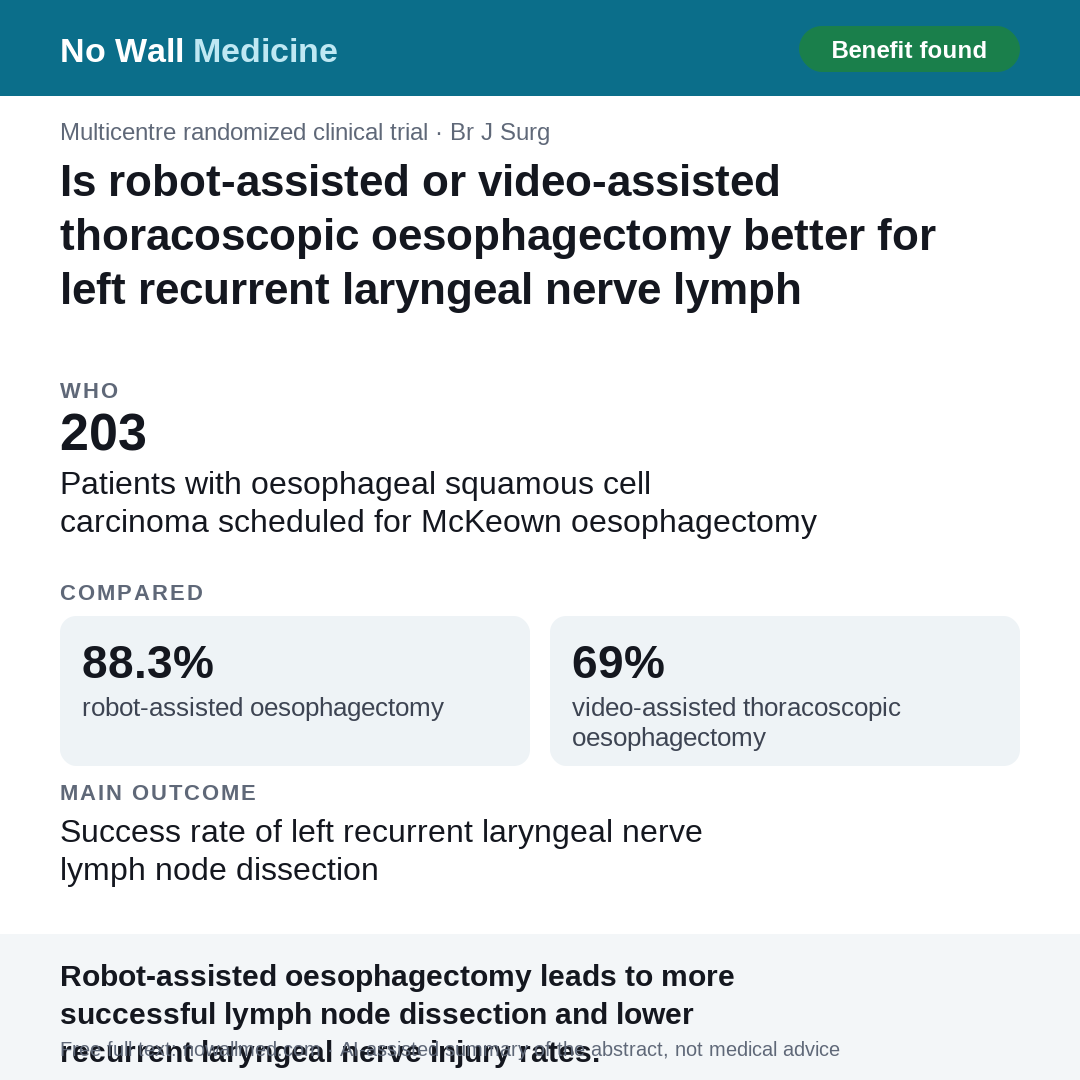
Is robot-assisted or video-assisted thoracoscopic oesophagectomy better for left recurrent laryngeal nerve lymph node dissection?
Who
203
Patients with oesophageal squamous cell carcinoma scheduled for McKeown oesophagectomy · 3 centres in Asia
Compared
88.3%robot-assisted oesophagectomy
69%video-assisted thoracoscopic oesophagectomy
Main outcome
Success rate of left recurrent laryngeal nerve lymph node dissection
Bottom line: Robot-assisted oesophagectomy leads to more successful lymph node dissection and lower recurrent laryngeal nerve injury rates.
Br J Surg · 2024-07-04Download image
Clinical question: Is robot-assisted or video-assisted thoracoscopic oesophagectomy better for left recurrent laryngeal nerve lymph node dissection?
Why it matters: It was unknown whether robot-assisted or video-assisted thoracoscopic surgery is more effective for dissecting lymph nodes along the left recurrent laryngeal nerve without causing nerve damage.
Key points
- Researchers randomized 203 patients with esophageal squamous cell carcinoma to receive either robot-assisted or video-assisted thoracoscopic oesophagectomy.
- Successful lymph node dissection without nerve damage lasting over 6 months was achieved in 88.3% of the robot-assisted group compared to 69% of the video-assisted group.
- Permanent nerve palsy at 6 months occurred in 5.8% of the robot-assisted group and 20% of the video-assisted group.
Headline and key points written with AI from the paper’s abstract, with every number checked against it. Read the paper before relying on them.
Was this summary helpful?
Subject terms
Cite this article
Chao YK, Li Z, Jiang H, Wen YW, Chiu CH, Li B. Multicentre randomized clinical trial on robot-assisted versus video-assisted thoracoscopic oesophagectomy (REVATE trial). Br J Surg. 2024. doi:10.1093/bjs/znae143
Spotted a mistake? Suggest a correction
Top studies every Monday
The week’s key trials and guidelines in your specialties, plus any topics you follow. By email, free.
Get the weekly digest