Aerobic exercise and cognitive training slowed brain aging more than other interventions
Multicomponent Lifestyle Intervention and Brain Aging: A Secondary Analysis of a Randomized Clinical Trial
Randomized clinical trialBenefit found
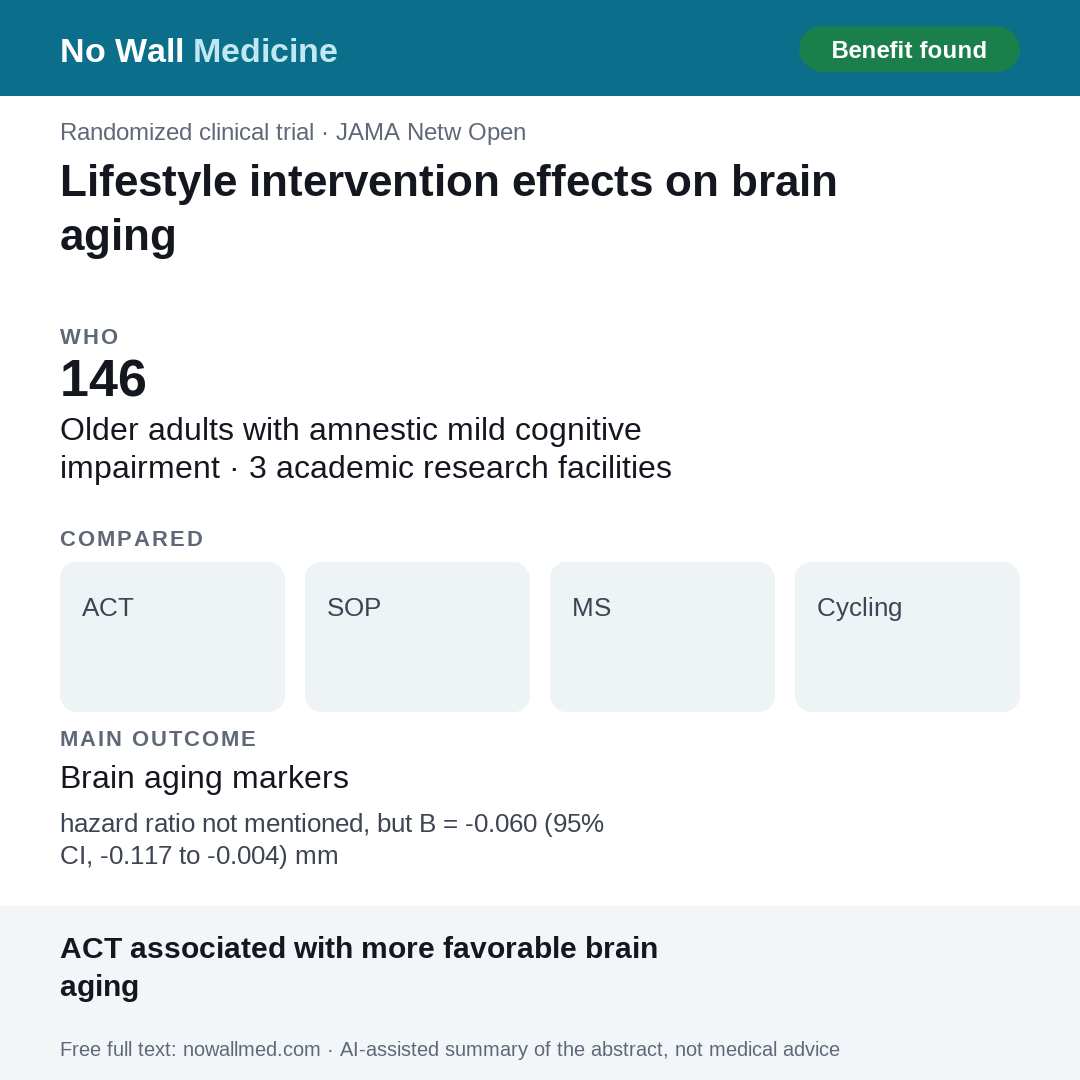
Lifestyle intervention effects on brain aging
Who
146
Older adults with amnestic mild cognitive impairment · 3 academic research facilities
Compared
ACT
SOP
MS
Cycling
Main outcome
Brain aging markers
Result: hazard ratio not mentioned, but B = -0.060 (95% CI, -0.117 to -0.004) mm
Bottom line: ACT associated with more favorable brain aging
JAMA Netw Open · 2026-11-02Download image
Key points
- 146 participants with amnestic mild cognitive impairment were randomized and studied for up to 18 months.
- Aerobic exercise and cognitive training was associated with more favorable brain aging marker change than speed-of-processing training at 18 months and mental leisure activities at 12 months.
- No significant difference was found in white matter hyperintensity change between aerobic exercise and cognitive training and other interventions, except in a subgroup analysis where cycling was associated with greater progression.
Headline and key points written with AI from the paper’s abstract, with every number checked against it. Read the paper before relying on them.
Topics
Spotted a mistake? Suggest a correction
More in Neurology
Automated model correctly identified 68 out of 90 seizure events as epileptic or nonepileptic
Video-Based Automated Seizure Classification Using Multimodal Large Language Models
Neuroimmune interactions contribute to migraine headache generation
Cortical and meningeal neuroimmune interactions contribute to the generation of migraine headaches
Pain and depressive symptoms linked to lower cognitive performance in older adults
Joint trajectories of pain and depressive symptoms in relation to repeated cognitive performance: a harmonized longitudinal analysis of four aging cohorts
AD biomarker-positive participants with DLB had faster cognitive decline than biomarker-negative ones
Biomarker-informed differences in treatment-associated cognitive decline in dementia with Lewy bodies