Five potential stroke treatments failed to meet efficacy boundaries in a large preclinical trial
Multilaboratory, Blinded, Randomized Trial of Five Cerebroprotectants in Ischemic Stroke
Multilaboratory, blinded, randomized trialNo clear difference
Are five cerebroprotectants effective in treating ischemic stroke in animal models?
Who
1768
Rodents including healthy mice, aging mice, mice with metabolic syndrome, and hypertensive rats · 6 research laboratories and 1 coordinating center
Compared
BPN-27332
uric acid
tatCN19o
GSK2256294: odds ratio for benefit of 1.28 (95% CI, 0.99-1.65)
Main outcome
behavioral battery
Result: odds ratio 1.28 (95% CI 0.99-1.65)
Bottom line: None of the five tested cerebroprotectants met the prespecified efficacy boundary in this rigorous preclinical trial.
Circ Res · 2026-09-23Download image
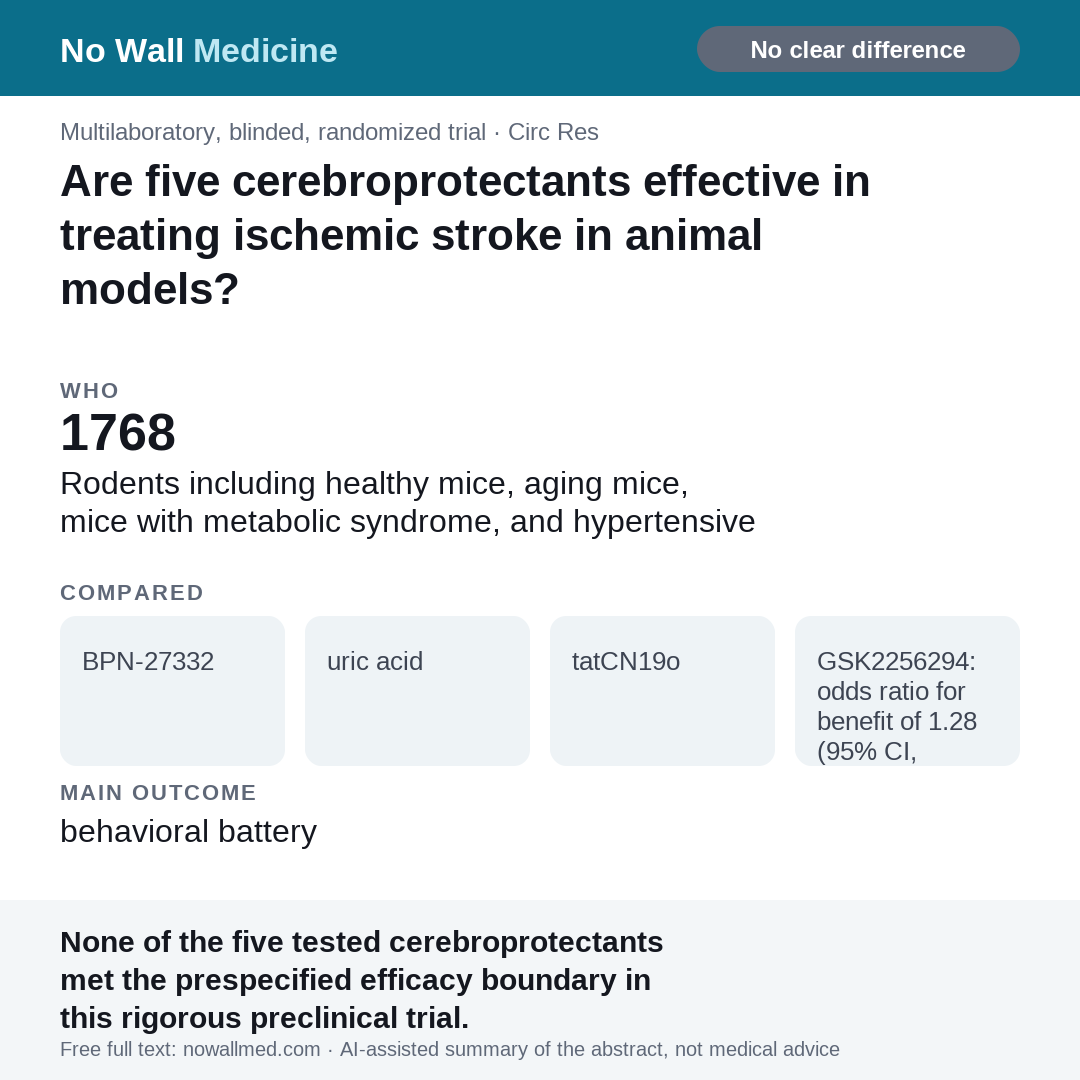
Clinical question: Are five cerebroprotectants effective in treating ischemic stroke in animal models?
Why it matters: Negative clinical trials can lead to skepticism, so researchers used a multicenter network to improve the rigor of preclinical testing for new stroke treatments.
Key points
- Researchers tested five different treatments in 1768 rodents, including mice and rats with various health conditions like obesity and hypertension.
- None of the five candidate treatments met the pre-established efficacy boundaries for improving behavioral outcomes.
- The treatment GSK2256294, an inhibitor of soluble epoxide hydrolase, showed an odds ratio for benefit of 1.28 (95% CI, 0.99-1.65) with a P value less than 0.05.
Headline and key points written with AI from the paper’s abstract, with every number checked against it. Read the paper before relying on them.
Topics
Cite this article
Ayata C, Chauhan AK, Hess DC, Hu B, Leira EC, Sansing L. Multilaboratory, Blinded, Randomized Trial of Five Cerebroprotectants in Ischemic Stroke. Circ Res. 2026. doi:10.1161/CIRCRESAHA.126.329467
Spotted a mistake? Suggest a correction