Multilevel intervention increased human papillomavirus vaccination for most children but had limited effect in high deprivation areas
Multilevel Intervention and Human Papillomavirus Vaccination Disparities: A Secondary Analysis of a Cluster Randomized Trial
Stepped-wedge cluster randomized trialMixed results
Did a multilevel intervention effectiveness on HPV vaccination differ by race, rurality, and area deprivation?
Who
6232
Children aged 11 to 12 years · 6 Mayo Clinic primary care practices in Minnesota
Compared
Usual care
Multilevel intervention: initiation: 9.2% to 24.0%; completion: 19.4% to 31.2%
Main outcome
Human papillomavirus vaccine initiation and completion
Bottom line: The multilevel intervention increased human papillomavirus vaccination for most children but had limited effect in highest deprivation areas.
Limitation: The intervention had limited effect for those residing in areas of highest deprivation.
JAMA Netw Open · 2025-07-01Download image
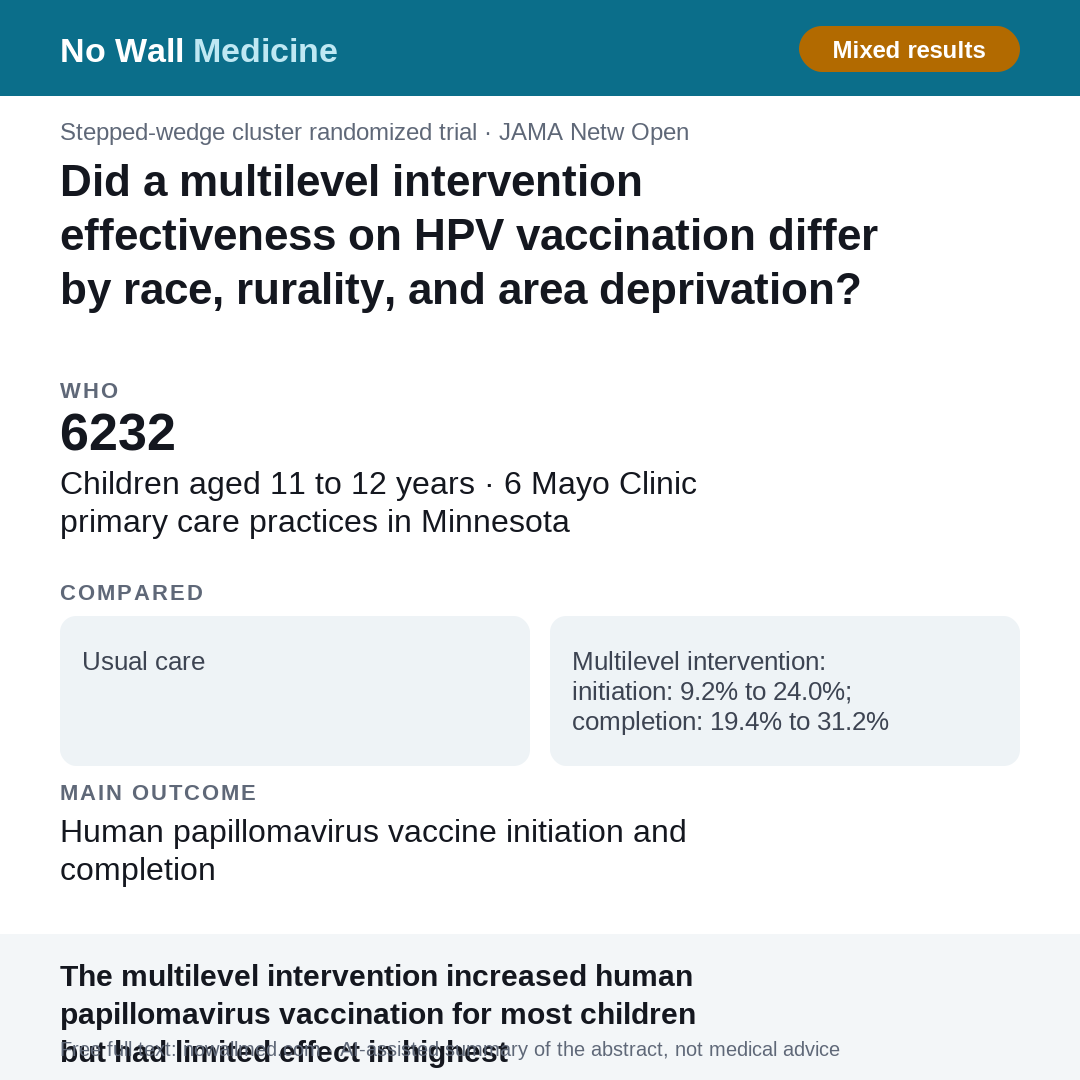
Clinical question: Did a multilevel intervention effectiveness on HPV vaccination differ by race, rurality, and area deprivation?
Why it matters: It is unknown if a multilevel intervention targeting parents and healthcare providers works equally well across different races, ethnicities, ruralities, and socioeconomic deprivation levels.
Key points
- Researchers analyzed 6232 children aged 11 to 12 years at six primary care practices to see if a multilevel intervention affected vaccination rates across different demographics.
- The intervention, involving parent reminders and provider feedback, increased vaccine initiation for most groups but not for Black children, rural residents, or those in the highest deprivation quartile.
- Vaccine completion rates increased for most groups, ranging from 19.4% to 31.2%, but did not show a significant increase for children in the highest area deprivation quartile.
Headline and key points written with AI from the paper’s abstract, with every number checked against it. Read the paper before relying on them.
Topics
Cite this article
Kong WY, Finney Rutten LJ, Herrin J, St Sauver JL, Jenkins GD, Griffin JM. Multilevel Intervention and Human Papillomavirus Vaccination Disparities: A Secondary Analysis of a Cluster Randomized Trial. JAMA Netw Open. 2025. doi:10.1001/jamanetworkopen.2025.18895
Spotted a mistake? Suggest a correction