Multimodal intervention increased child passenger safety guideline adherence among caregivers in a randomized trial
Multimodal Intervention and Child Passenger Safety Guideline Adherence in Young Children: A Sequential, Multiple-Assignment, Randomized Clinical Trial
Randomized clinical trialBenefit found
Does intervention improve child safety?
Who
1517
Caregivers of young children with suboptimal safety behaviors · Chicago, Illinois
Compared
47.1%Basic intervention (131/278)
32.2%Enhanced usual care (38/118)
Main outcome
Child passenger safety guideline adherence
Result: absolute change in treatment response, 13.1% (95% CI 3.6% to 22.6%)
Bottom line: Intervention improves child safety guideline adherence
JAMA Netw Open · 2025-09-02Download image
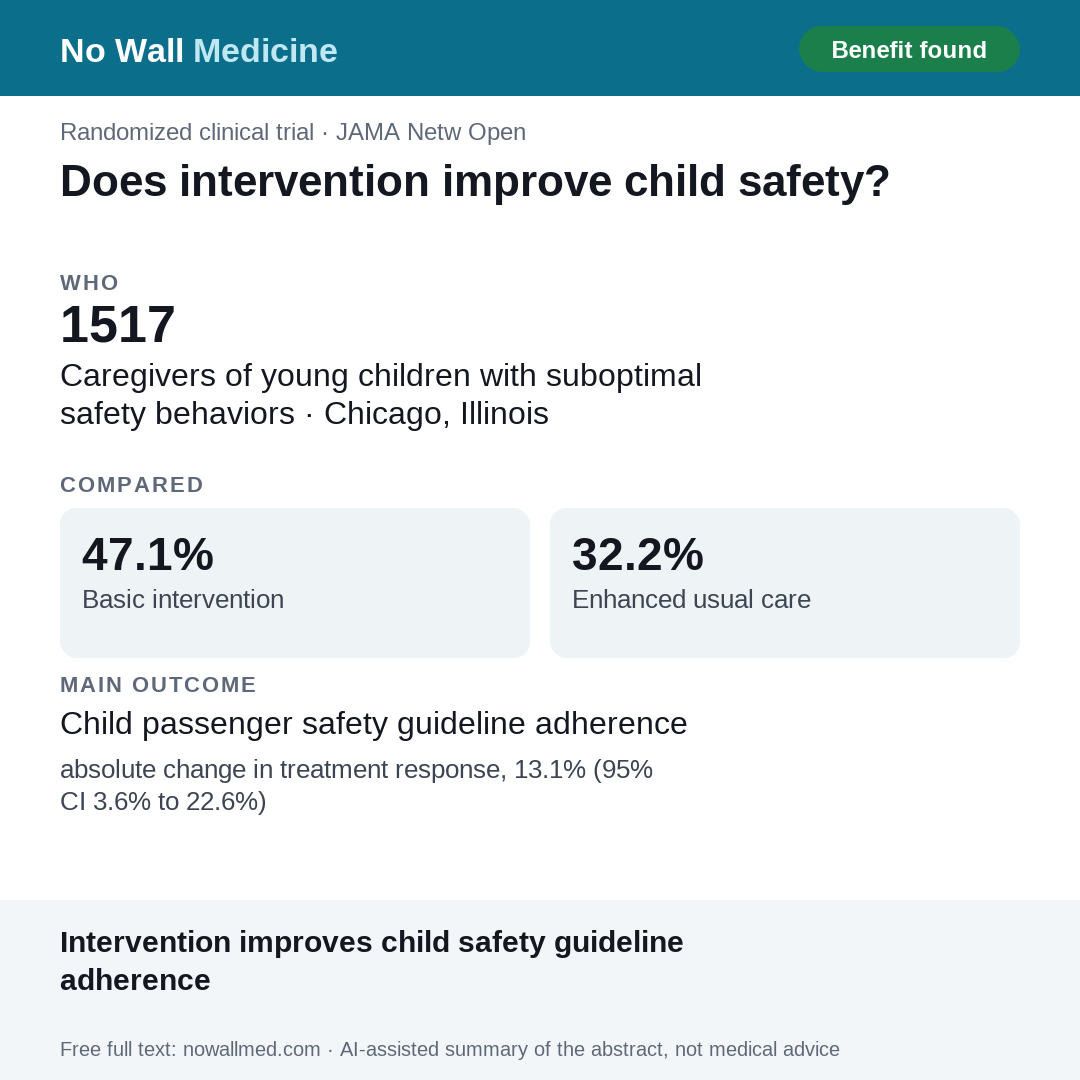
Clinical question: Does intervention improve child safety?
Why it matters: Child passenger safety behaviors are often suboptimal despite the availability of effective child restraint systems and legal requirements.
In absolute numbers
Basic intervention: 47.1% · Enhanced usual care: 32.2% → a difference of 14.9 percentage points, so about 7 people would need the treatment for 1 more to benefit (number needed to treat) over the trial’s follow-up.
Worked out by us from the two group results above, not reported by the authors. Check the paper for the exact outcome and timing.
Key points
- The study randomized 474 caregivers of children aged 6 months to 11 years to receive either a multimodal intervention or enhanced usual care.
- At 6 months, 47.1% of caregivers in the multimodal intervention group followed safety guidelines compared to 32.2% in the usual care group.
- For caregivers who were not adherent at 6 months, high-intensity intervention showed no difference compared to low-intensity intervention.
Headline and key points written with AI from the paper’s abstract, with every number checked against it. Read the paper before relying on them.
Was this summary helpful?
Subject terms
Cite this article
Macy ML, Pollock B, Kendi S, Goldstick J, Cieslak K, Carter PM. Multimodal Intervention and Child Passenger Safety Guideline Adherence in Young Children: A Sequential, Multiple-Assignment, Randomized Clinical Trial. JAMA Netw Open. 2025. doi:10.1001/jamanetworkopen.2025.33912
Spotted a mistake? Suggest a correction
Top studies every Monday
The week’s key trials and guidelines in your specialties, plus any topics you follow. By email, free.
Get the weekly digest