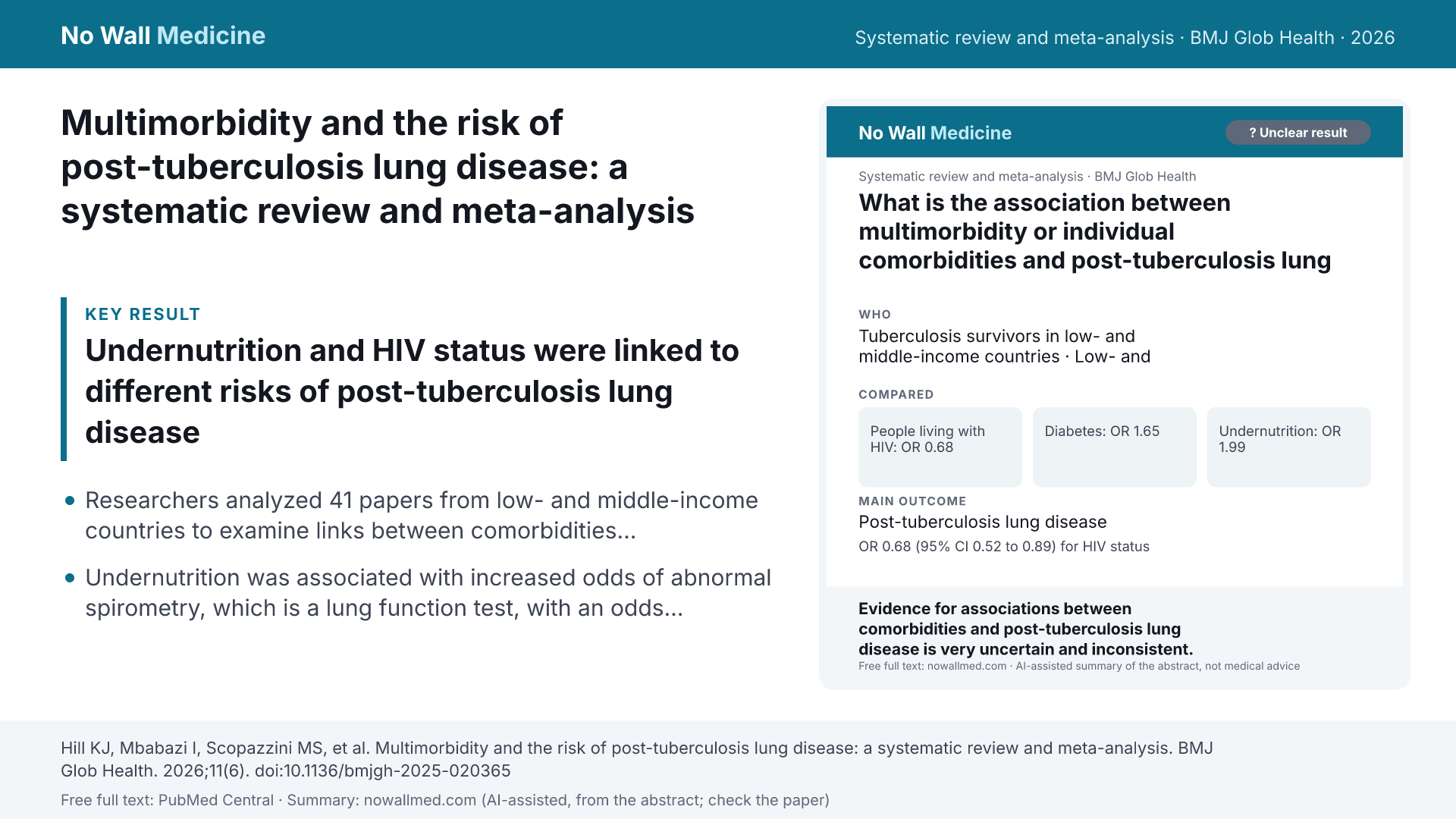
Undernutrition and HIV status were linked to different risks of post-tuberculosis lung disease
Multimorbidity and the risk of post-tuberculosis lung disease: a systematic review and meta-analysis
Systematic review and meta-analysisUnclear result
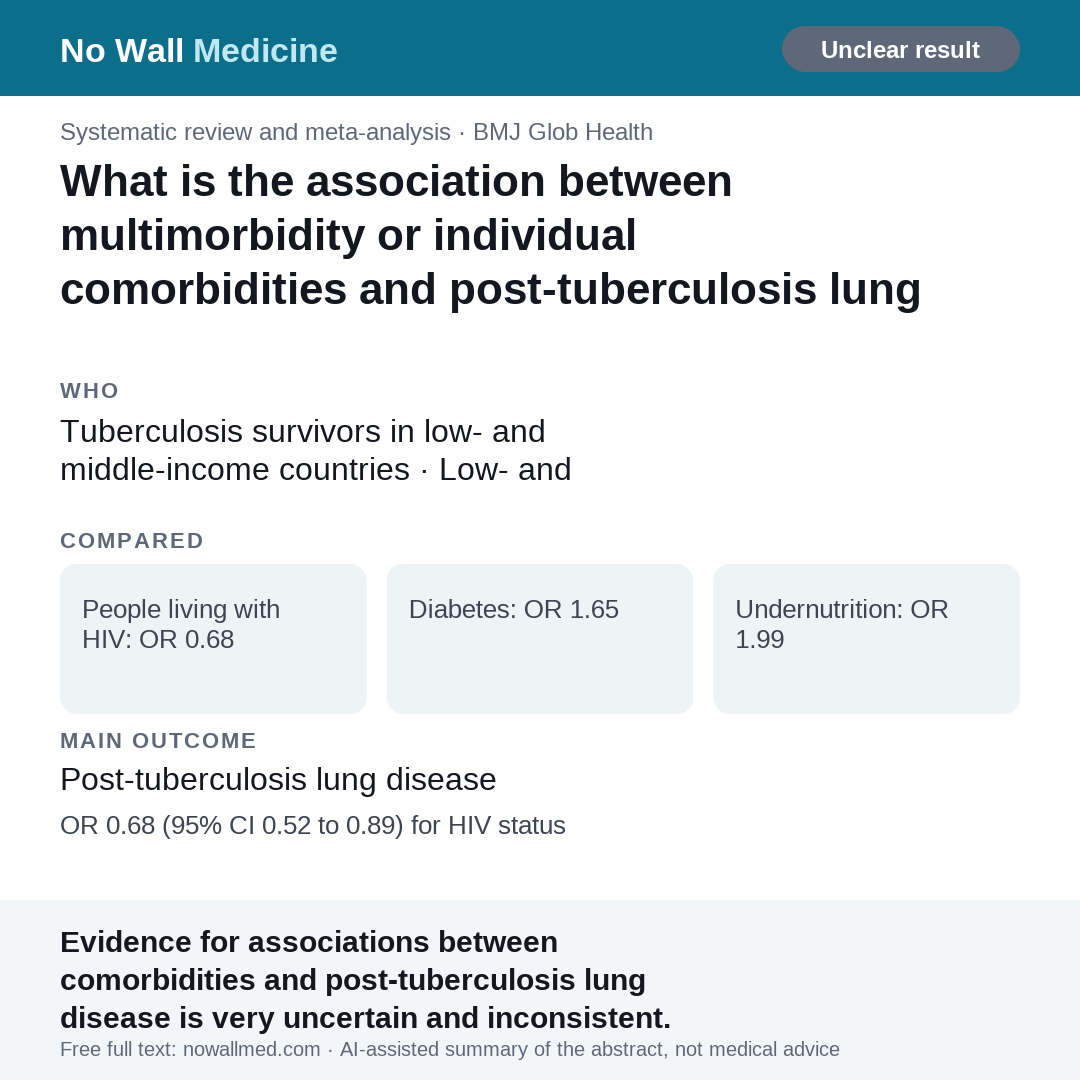
What is the association between multimorbidity or individual comorbidities and post-tuberculosis lung disease?
Who
Tuberculosis survivors in low- and middle-income countries · Low- and middle-income countries
Compared
People living with HIV: OR 0.68
Diabetes: OR 1.65
Undernutrition: OR 1.99
Main outcome
Post-tuberculosis lung disease
Result: OR 0.68 (95% CI 0.52 to 0.89) for HIV status
Bottom line: Evidence for associations between comorbidities and post-tuberculosis lung disease is very uncertain and inconsistent.
Limitation: High risk of bias in studies and very low certainty of evidence.
BMJ Glob Health · 2026-06-01Download image
Clinical question: What is the association between multimorbidity or individual comorbidities and post-tuberculosis lung disease?
Why it matters: It is unknown how having multiple chronic health conditions or specific individual comorbidities affects the risk of developing chronic respiratory issues after tuberculosis.
Key points
- Researchers analyzed 41 papers from low- and middle-income countries to examine links between comorbidities and post-tuberculosis lung disease, a chronic respiratory syndrome.
- Undernutrition was associated with increased odds of abnormal spirometry, which is a lung function test, with an odds ratio of 1.99 (95% CI 1.02 to 3.87).
- People living with HIV were associated with reduced odds of post-tuberculosis lung disease (OR 0.68, 95% CI 0.52 to 0.89), while diabetes showed inconsistent associations.
Limitation the authors note: The certainty of evidence for meta-analysed associations was very low and 58.5% of included studies were at high risk of bias.
Headline and key points written with AI from the paper’s abstract, with every number checked against it. Read the paper before relying on them.
Was this summary helpful?
Abstract
Introduction
Post-tuberculosis lung disease (PTLD), a chronic respiratory syndrome affecting approximately half of tuberculosis (TB) survivors, is an emerging public health threat in low- and middle-income countries (LMICs). Multimorbidity, defined as two or more coexisting chronic health conditions, is also rising in LMICs. This systematic review and meta-analysis examines associations between multimorbidity or individual comorbidities and PTLD. Methods
Medline, EMBASE, Web of Science, Global Health and Scopus databases up to 7 March 2024 were searched and studies in LMICs assessing PTLD and either a single comorbidity or multimorbidity were included. Summary data were extracted independently by two reviewers. Random effects meta-analyses were performed where sufficient comparable data were reported. Risk of bias was assessed using Risk Of Bias in Non-randomised Studies-of Exposure and certainty of evidence for meta-analysable associations was assessed using Grading of Recommendations Assessment, Development and Evaluation. Study protocol was registered with PROSPERO (CRD42024552486). Results
41 papers, from 10 321 screened, were included. None analysed multimorbidity. PTLD measurement tools varied widely. Meta-analysis of 10 of 24 papers analysing the association between spirometry-defined PTLD and HIV status found reduced odds of PTLD in people living with HIV (OR 0.68, 95% CI 0.52 to 0.89). 15 papers reported on diabetes and showed inconsistent associations; meta-analysis of three papers yielded an OR of 1.65 (95% CI 0.96 to 2.84). Adults with undernutrition had increased odds of abnormal spirometry following TB on meta-analysis of three studies (OR 1.99, 95% CI 1.02 to 3.87). Evidence for other comorbidities was limited and inconclusive. Overall, 24/41 (58.5%) of included studies were at high risk of bias and certainty of evidence for meta-analysed associations was very low. Conclusion
PTLD may be more common among adults who are HIV-negative or undernourished, but the evidence is very uncertain. The absence of dedicated multimorbidity studies and inconsistencies in defining PTLD highlight the need for prospective studies evaluating comorbidities in relation to PTLD. Prospero registration number
CRD42024552486.
Abstract reproduced under the article’s CC BY licence.
Subject terms
Cite this article
Hill KJ, Mbabazi I, Scopazzini MS, et al. Multimorbidity and the risk of post-tuberculosis lung disease: a systematic review and meta-analysis. BMJ Glob Health. 2026. doi:10.1136/bmjgh-2025-020365
Spotted a mistake? Suggest a correction