Adapting smoking cessation medications did not significantly improve abstinence rates for Black adults
Multiple Pharmacotherapy Adaptations for Smoking Cessation Based on Treatment Response in Black Adults Who Smoke: A Randomized Clinical Trial
Randomized clinical trialNo clear difference
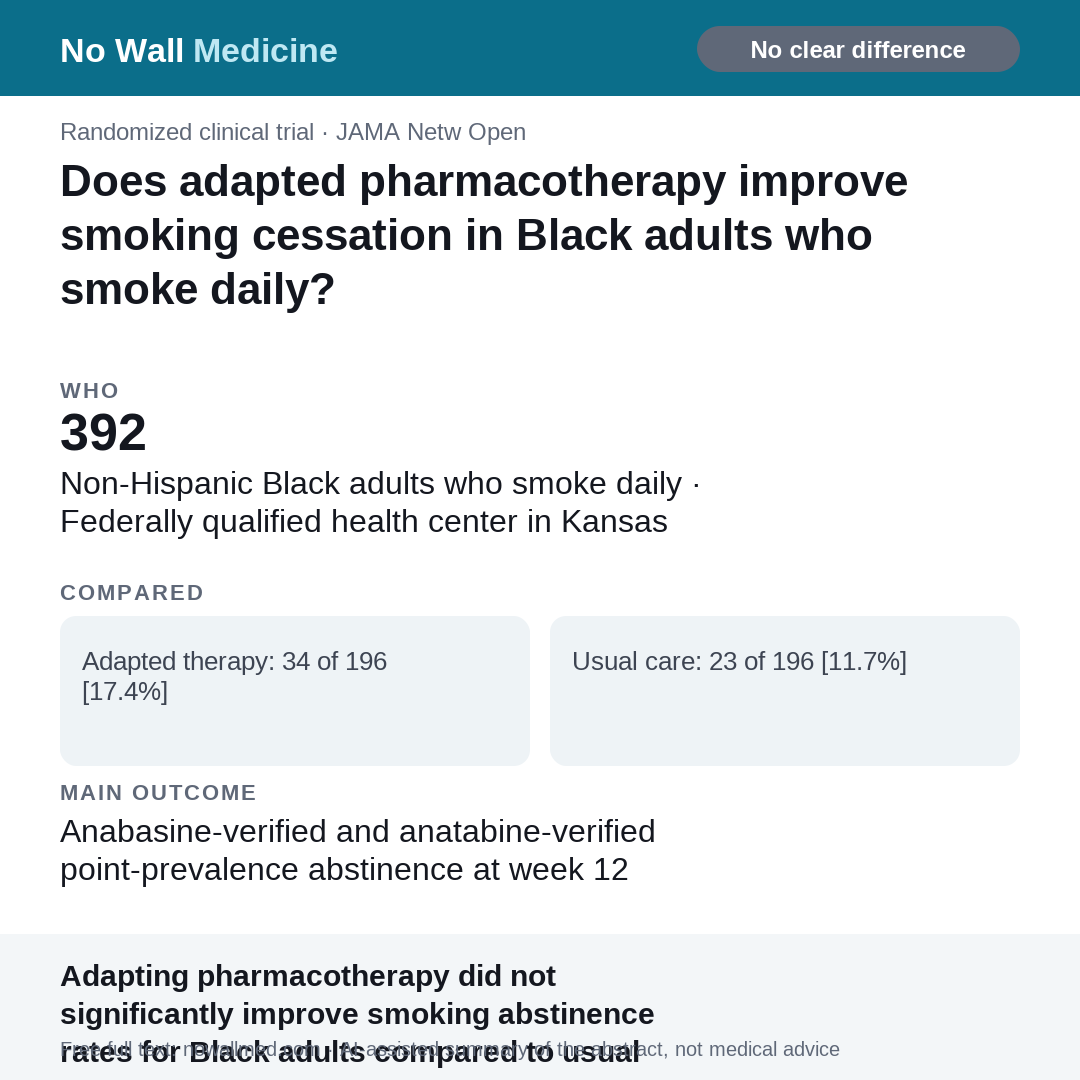
Does adapted pharmacotherapy improve smoking cessation in Black adults who smoke daily?
Who
392
Non-Hispanic Black adults who smoke daily · Federally qualified health center in Kansas City, Missouri
Compared
Adapted therapy: 34 of 196 [17.4%]
Usual care: 23 of 196 [11.7%]
Main outcome
Anabasine-verified and anatabine-verified point-prevalence abstinence at week 12
Result: odds ratio 1.58 (95% CI, 0.89-2.80)
Bottom line: Adapting pharmacotherapy did not significantly improve smoking abstinence rates for Black adults compared to usual care.
JAMA Netw Open · 2023-06-01Download image
Clinical question: Does adapted pharmacotherapy improve smoking cessation in Black adults who smoke daily?
Why it matters: It was unknown if adapting smoking cessation medications based on treatment response would be effective for Black adults, who often have less success quitting.
Key points
- The trial studied 392 non-Hispanic Black adults who were randomized to receive either adapted therapy with medication switches or enhanced usual care with nicotine patches.
- At 12 weeks, verified abstinence was 17.4% for the adapted therapy group and 11.7% for the usual care group, which was not a statistically significant difference.
- Participants who achieved abstinence at week 2 had 4.6 times greater odds of being abstinent at week 12 compared to those who did not respond to treatment.
Headline and key points written with AI from the paper’s abstract, with every number checked against it. Read the paper before relying on them.
Was this summary helpful?
Subject terms
Cite this article
Nollen NL, Ahluwalia JS, Mayo MS, Ellerbeck EF, Leavens ELS, Salzman G. Multiple Pharmacotherapy Adaptations for Smoking Cessation Based on Treatment Response in Black Adults Who Smoke: A Randomized Clinical Trial. JAMA Netw Open. 2023. doi:10.1001/jamanetworkopen.2023.17895
Spotted a mistake? Suggest a correction
Top studies every Monday
The week’s key trials and guidelines in your specialties, plus any topics you follow. By email, free.
Get the weekly digest