Presenting multiple treatment alternatives increases the likelihood of primary care physicians choosing new care plans
Multiple Suggested Care Alternatives and Decision-Making of Primary Care Physicians: A Randomized Clinical Trial
Randomized clinical trialBenefit found
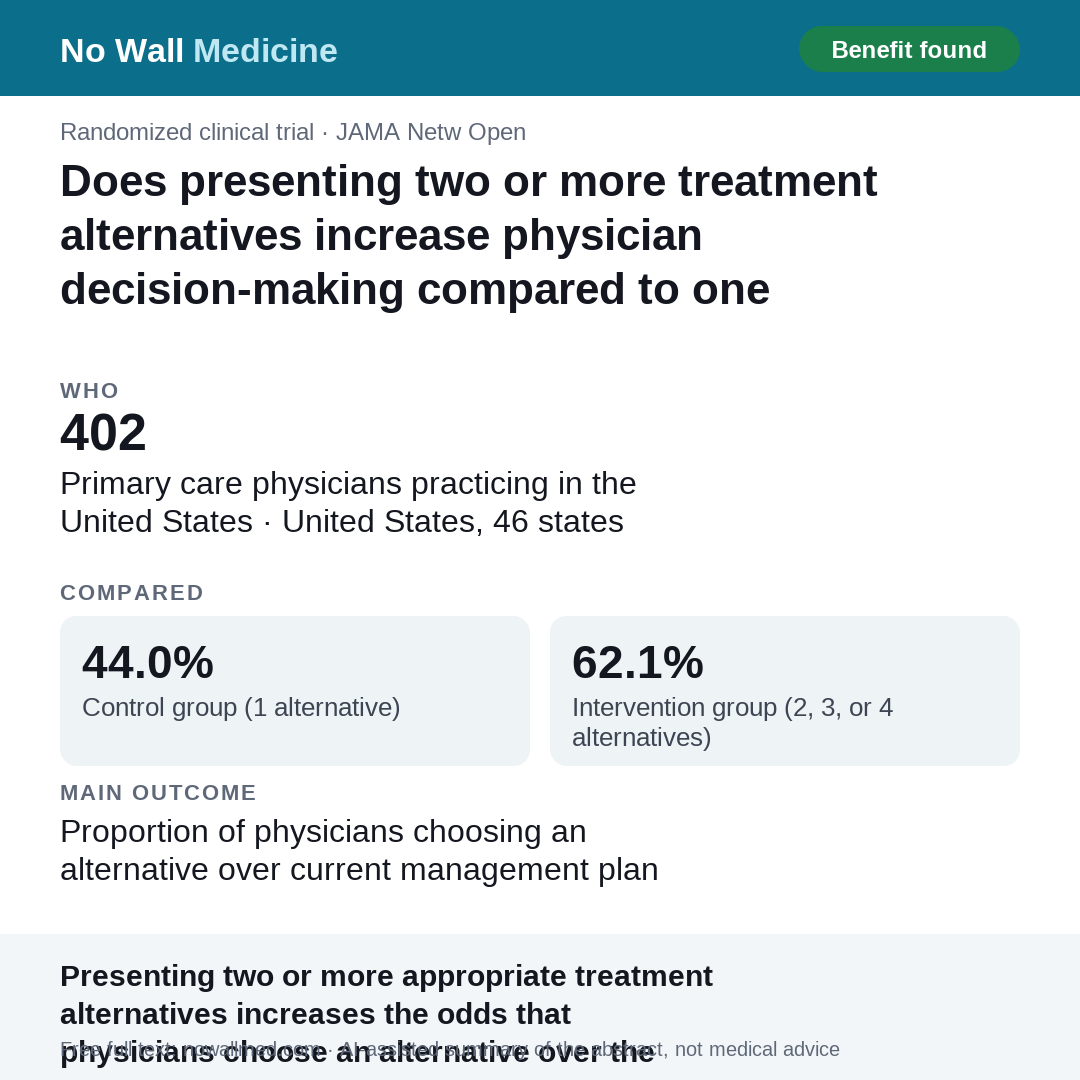
Does presenting two or more treatment alternatives increase physician decision-making compared to one alternative?
Who
402
Primary care physicians practicing in the United States · United States, 46 states
Compared
44.0%Control group (1 alternative)
62.1%Intervention group (2, 3, or 4 alternatives)
Main outcome
Proportion of physicians choosing an alternative over current management plan
Result: adjusted odds ratio 1.90 (95% CI 1.09-3.30)
Bottom line: Presenting two or more appropriate treatment alternatives increases the odds that physicians choose an alternative over the current management plan.
JAMA Netw Open · 2025-11-03Download image
Clinical question: Does presenting two or more treatment alternatives increase physician decision-making compared to one alternative?
Why it matters: It is unclear whether offering more than one treatment option leads to suboptimal decisions or if it helps guide clinical choices.
In absolute numbers
Control group (1 alternative): 44% · Intervention group (2, 3, or 4 alternatives): 62.1% → a difference of 18.1 percentage points, so about 6 people would need the treatment for 1 more to benefit (number needed to treat) over the trial’s follow-up.
Worked out by us from the two group results above, not reported by the authors. Check the paper for the exact outcome and timing.
Key points
- Researchers studied 402 primary care physicians who were randomly assigned to receive either one treatment alternative or two, three, or four alternatives for two clinical scenarios.
- Physicians presented with multiple alternatives had higher odds of choosing an alternative (62.1%) compared to those presented with only one alternative (44.0%).
- The effect was stronger in the opioid prescribing scenario (56.4%) than in the surgery referral scenario (67.8%) when comparing the intervention group to the control group.
Headline and key points written with AI from the paper’s abstract, with every number checked against it. Read the paper before relying on them.
Topics
Cite this article
Altinger G, Maher CG, Jones CMP, Collins J, Linder JA, Bell KJL. Multiple Suggested Care Alternatives and Decision-Making of Primary Care Physicians: A Randomized Clinical Trial. JAMA Netw Open. 2025. doi:10.1001/jamanetworkopen.2025.42949
Spotted a mistake? Suggest a correction