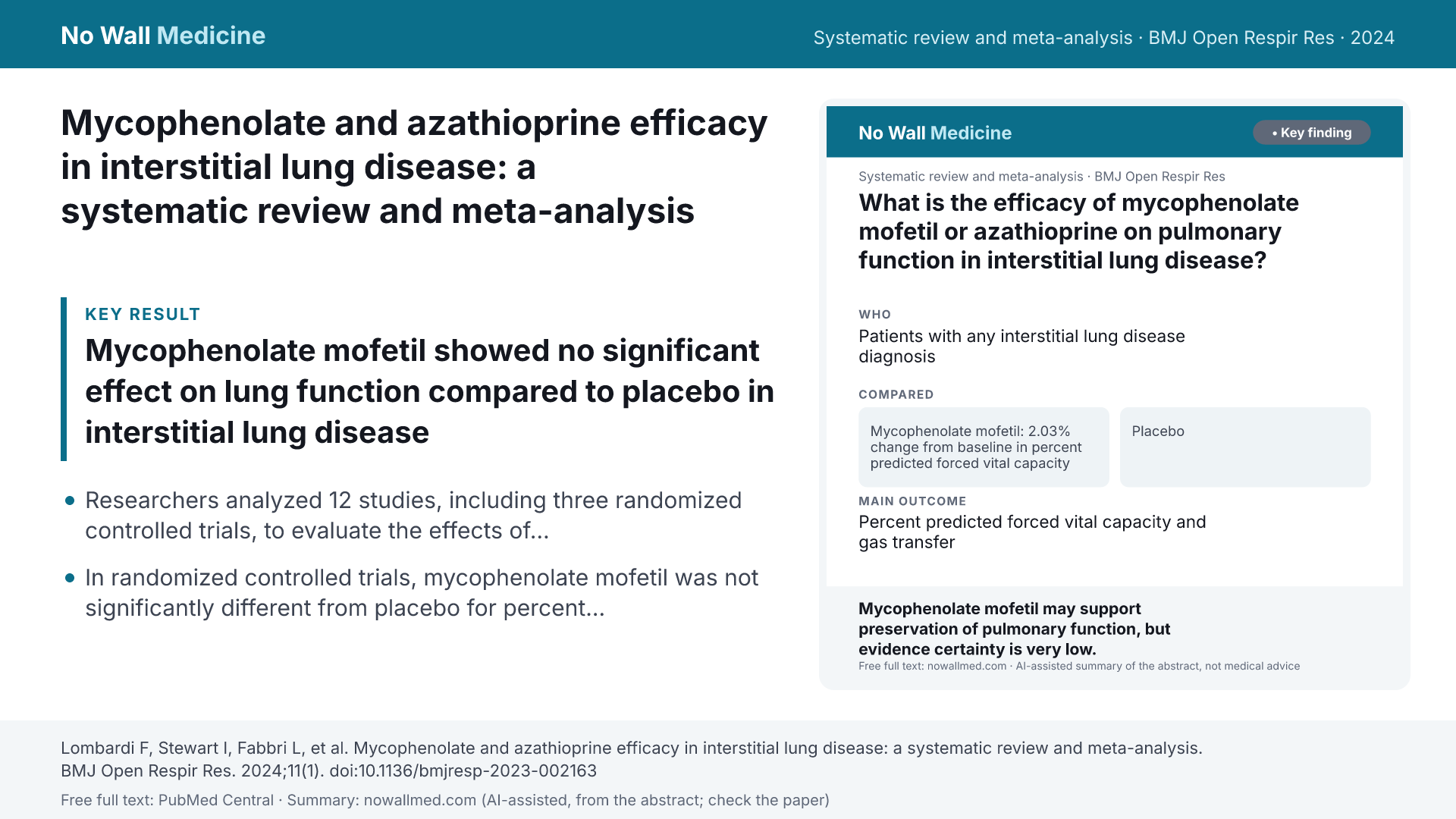
Mycophenolate mofetil showed no significant effect on lung function compared to placebo in interstitial lung disease
Mycophenolate and azathioprine efficacy in interstitial lung disease: a systematic review and meta-analysis
Systematic review and meta-analysisBenefit found
What is the efficacy of mycophenolate mofetil or azathioprine on pulmonary function in interstitial lung disease?
Who
Patients with any interstitial lung disease diagnosis
Compared
Mycophenolate mofetil: 2.03% change from baseline in percent predicted forced vital capacity
Placebo
Main outcome
Percent predicted forced vital capacity and gas transfer
Result: percent predicted forced vital capacity 2.03% (95% CI 0.65 to 3.42)
Bottom line: Mycophenolate mofetil may support preservation of pulmonary function, but evidence certainty is very low.
Limitation: Limited randomized controlled trials and very low certainty of evidence.
BMJ Open Respir Res · 2024-02-27Download image

Clinical question: What is the efficacy of mycophenolate mofetil or azathioprine on pulmonary function in interstitial lung disease?
Why it matters: It is unknown whether mycophenolate mofetil or azathioprine effectively improves pulmonary function in patients with interstitial lung disease.
Key points
- Researchers analyzed 12 studies, including three randomized controlled trials, to evaluate the effects of mycophenolate mofetil or azathioprine on lung function in patients with interstitial lung disease.
- In randomized controlled trials, mycophenolate mofetil was not significantly different from placebo for percent predicted forced vital capacity (2.94, 95% CI -4.00 to 9.88) or gas transfer (percent predicted DLCO -2.03, 95% CI -4.38 to 0.32).
- An overall 2.03% change from baseline in percent predicted forced vital capacity was observed in mycophenolate mofetil, but all estimates were considered very low certainty evidence.
Limitation the authors note: The evidence was considered very low certainty due to the limited number of randomized controlled trials.
Headline and key points written with AI from the paper’s abstract, with every number checked against it. Read the paper before relying on them.
Was this summary helpful?
Abstract
Objectives
Mycophenolate mofetil (MMF) and azathioprine (AZA) are immunomodulatory treatments in interstitial lung disease (ILD). This systematic review aimed to evaluate the efficacy of MMF or AZA on pulmonary function in ILD. Design
Population included any ILD diagnosis, intervention included MMF or AZA treatment, outcome was delta change from baseline in per cent predicted forced vital capacity (%FVC) and gas transfer (diffusion lung capacity of carbon monoxide, %DLco). The primary endpoint compared outcomes relative to placebo comparator, the secondary endpoint assessed outcomes in treated groups only. Eligibility criteria
Randomised controlled trials (RCTs) and prospective observational studies were included. No language restrictions were applied. Retrospective studies and studies with high-dose concomitant steroids were excluded. Data synthesis
The systematic search was performed on 9 May. Meta-analyses according to drug and outcome were specified with random effects, I2 evaluated heterogeneity and Grading of Recommendations, Assessment, Development and Evaluation evaluated certainty of evidence. Primary endpoint analysis was restricted to RCT design, secondary endpoint included subgroup analysis according to prospective observational or RCT design. Results
A total of 2831 publications were screened, 12 were suitable for quantitative synthesis. Three MMF RCTs were included with no significant effect on the primary endpoints (%FVC 2.94, 95% CI -4.00 to 9.88, I2=79.3%; %DLco -2.03, 95% CI -4.38 to 0.32, I2=0.0%). An overall 2.03% change from baseline in %FVC (95% CI 0.65 to 3.42, I2=0.0%) was observed in MMF, and RCT subgroup summary estimated a 4.42% change from baseline in %DLCO (95% CI 2.05 to 6.79, I2=0.0%). AZA studies were limited. All estimates were considered very low certainty evidence. Conclusions
There were limited RCTs of MMF or AZA and their benefit in ILD was of very low certainty. MMF may support preservation of pulmonary function, yet confidence in the effect was weak. To support high certainty evidence, RCTs should be designed to directly assess MMF efficacy in ILD. Prospero registration number
CRD42023423223.
Abstract reproduced under the article’s CC BY NC licence.
Subject terms
Cite this article
Lombardi F, Stewart I, Fabbri L, et al. Mycophenolate and azathioprine efficacy in interstitial lung disease: a systematic review and meta-analysis. BMJ Open Respir Res. 2024. doi:10.1136/bmjresp-2023-002163
Spotted a mistake? Suggest a correction