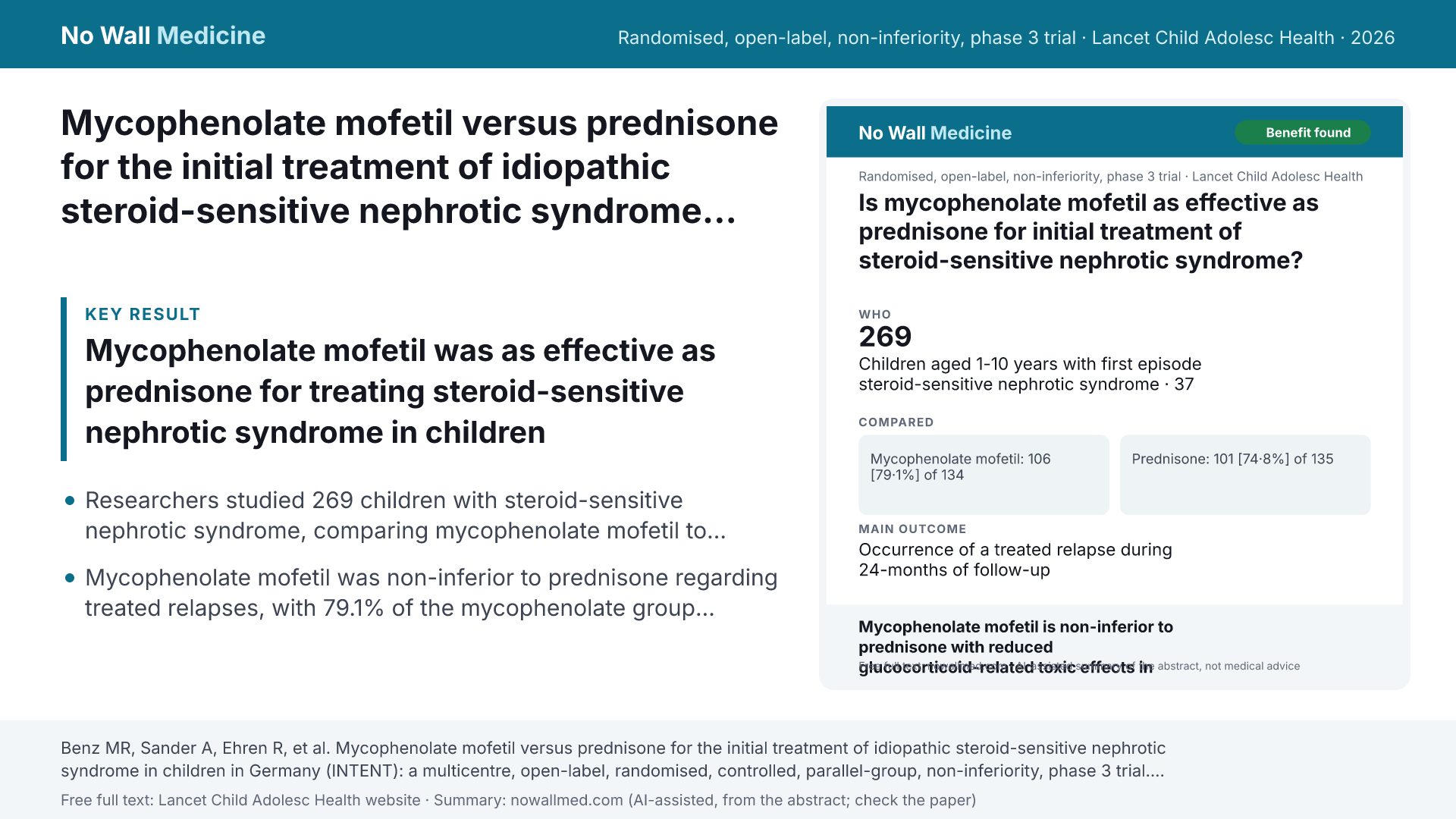
Mycophenolate mofetil was as effective as prednisone for treating steroid-sensitive nephrotic syndrome in children
Mycophenolate mofetil versus prednisone for the initial treatment of idiopathic steroid-sensitive nephrotic syndrome in children in Germany (INTENT): a multicentre, open-label, randomised, controlled, parallel-group, non-inferiority, phase 3 trial
Randomised, open-label, non-inferiority, phase 3 trialBenefit found
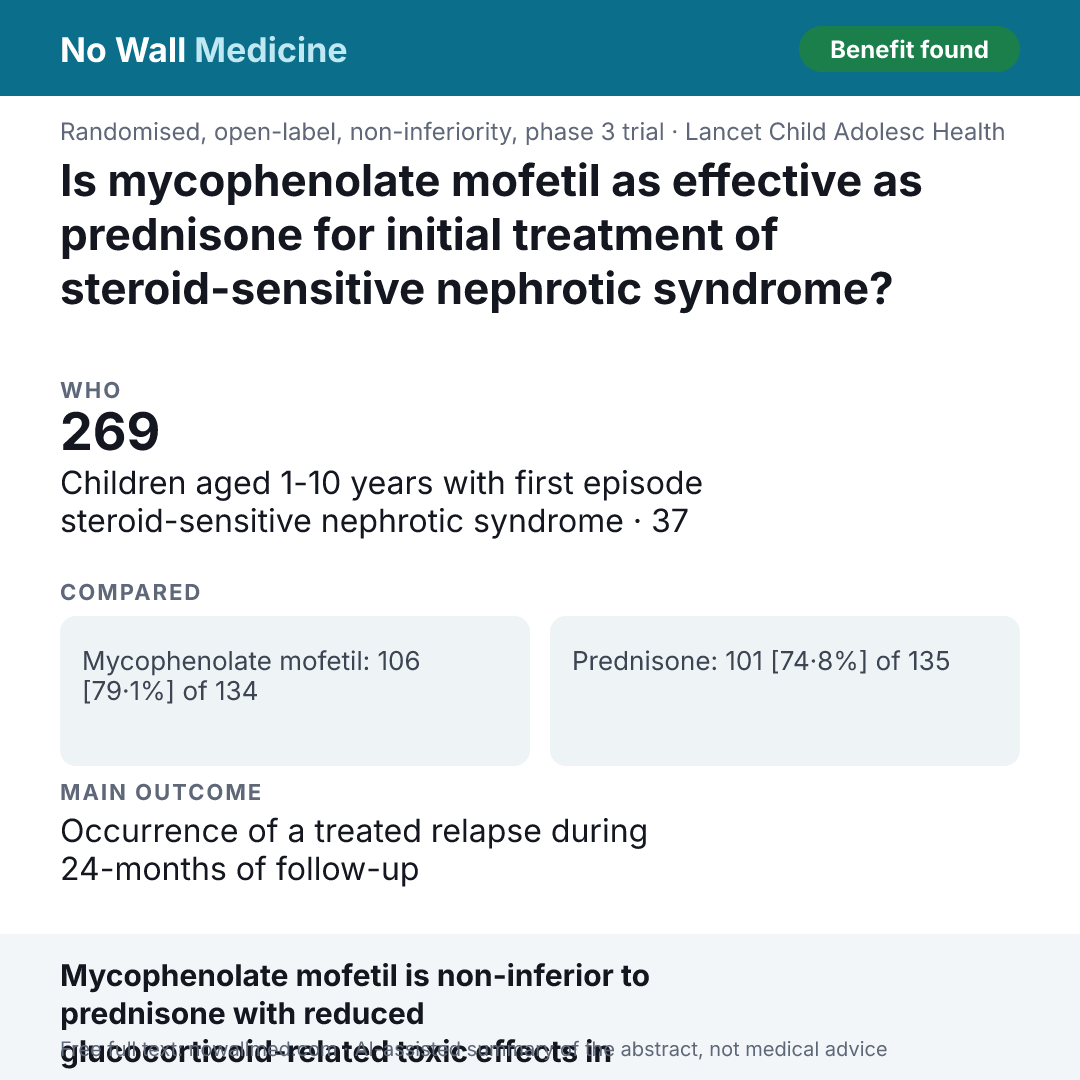
Is mycophenolate mofetil as effective as prednisone for initial treatment of steroid-sensitive nephrotic syndrome?
Who
269
Children aged 1-10 years with first episode steroid-sensitive nephrotic syndrome · 37 hospitals in Germany
Compared
Mycophenolate mofetil: 106 [79·1%] of 134
Prednisone: 101 [74·8%] of 135
Main outcome
Occurrence of a treated relapse during 24-months of follow-up
Result: difference 4·3% [90% CIs -4·2 to 12·7]
Bottom line: Mycophenolate mofetil is non-inferior to prednisone with reduced glucocorticoid-related toxic effects in children.
Funded by: German Federal Ministry of Education and Research
Lancet Child Adolesc Health · 2026-03-16 · Save PNG
Clinical question: Is mycophenolate mofetil as effective as prednisone for initial treatment of steroid-sensitive nephrotic syndrome?
Why it matters: Prolonged use of steroids for treating idiopathic nephrotic syndrome in children is associated with significant toxic side effects.
Key points
- Researchers studied 269 children with steroid-sensitive nephrotic syndrome, comparing mycophenolate mofetil to the standard treatment of prednisone.
- Mycophenolate mofetil was non-inferior to prednisone regarding treated relapses, with 79.1% of the mycophenolate group versus 74.8% of the prednisone group.
- The mycophenolate mofetil group had fewer side effects like high blood pressure and psychological abnormalities, but more patients developed infections.
Headline and key points written with AI from the paper’s abstract, with every number checked against it. Read the paper before relying on them.
Was this summary helpful?
Abstract
Background
Prolonged glucocorticoid therapy is the standard initial treatment for idiopathic nephrotic syndrome in children, but is associated with marked toxic effects. We aimed to assess whether a novel treatment protocol with mycophenolate mofetil is as effective as standard therapy with prednisone, while reducing the burden of glucocorticoid-related side-effects. Methods
INTENT was a multicentre, open-label, randomised, controlled, parallel-group, non-inferiority, phase 3 trial done in 37 community, municipal, and university hospitals in Germany. Patients aged 1-10 years with a first episode of steroid-sensitive nephrotic syndrome were randomly assigned (1:1) by a centralised web-based tool to receive either mycophenolate mofetil or prednisone (standard treatment), after remission induced by prednisone or prednisolone at a dose of 60 mg/m2 body surface area (maximum 80 mg/day) within 28 days. Block randomisation (block size of eight) was stratified by age (<7 years or ≥7 years). Mycophenolate mofetil was given at 1200 mg/m2 body surface area per day, twice daily, as a suspension (200 mg/mL) for a total treatment duration of 12 weeks. Prednisone was administered once, twice, or three times daily for 6 weeks at 60 mg/m2 body surface area per day (maximum 80 mg). Thereafter, prednisone was given for a further 6 weeks at 40 mg/m2 body surface area (maximum 60 mg) once daily in the morning on alternate days. The primary endpoint was the occurrence of a treated relapse during the 24-months of follow-up in the modified intention-to-treat population. The non-inferiority margin was 15%. This trial is registered with the European Union Drug Regulating Authorities Clinical Trials database (EudraCT 2014-001991-76) and has been completed. Findings
Between Oct 12, 2015, and April 23, 2021, 497 patients were screened for eligibility, 272 of whom were randomly assigned (136 to each group). The modified intention-to-treat population comprised 269 patients, of whom 173 (64%) were boys and 96 (36%) were girls (median age 4·0 years [IQR 2·0-5·0]). Mycophenolate mofetil was non-inferior to prednisone for the primary endpoint of treated relapse (106 [79·1%] of 134 vs 101 [74·8%] of 135; difference 4·3% [90% CIs -4·2 to 12·7]; p=0·019). At the end of the first 12 weeks of treatment, fewer glucocorticoid-related side-effects were observed in the mycophenolate mofetil group than the prednisone group, including arterial hypertension (78 [59·1%] of 132 vs 115 [87·1%] of 132; difference -28·0% [95% CI -37·7 to -17·5]), lower BMI (BMI Z score 0·16 [SD 0·85] vs 1·41 [1·02]; difference -1·24 [-1·47 to -1·02]), and fewer psychological abnormalities (37 [27·8%] of 133 vs 77 [57·9%] of 133; difference -30·1% [-40·9 to -18·4]). More patients in the mycophenolate mofetil group than in the prednisone group developed infections (93 [69·9%] of 133 vs 74 [55·6%] of 133; difference 14·3% [2·7 to 25·5]) and there was no statistically significant difference in the number of patients who developed at least one gastrointestinal disorder (22 [16·5%] of 133 vs 13 [9·8%] of 133; difference 6·8% [-1·5 to 14·8]). Interpretation
Our findings suggest that mycophenolate mofetil is non-inferior to standard prednisone treatment, with reduced glucocorticoid-related toxic effects. These findings could modify the initial standard of care for patients with steroid-sensitive nephrotic syndrome. Funding
German Federal Ministry of Education and Research.
Abstract reproduced under the article’s CC BY licence.
Subject terms
Headline, design, result, key points, caveat and citation as plain text.
Cite this article
Benz MR, Sander A, Ehren R, et al. Mycophenolate mofetil versus prednisone for the initial treatment of idiopathic steroid-sensitive nephrotic syndrome in children in Germany (INTENT): a multicentre, open-label, randomised, controlled, parallel-group, non-inferiority, phase 3 trial. Lancet Child Adolesc Health. 2026;10(5):340-351. doi:10.1016/S2352-4642(25)00373-6
Spotted a mistake? Suggest a correction