Inconsistent definitions of muscle jerks after cardiac arrest lead to weak links with outcomes
Myoclonus After Cardiac Arrest: Need for Standardization-A Systematic Review and Research Proposal on Terminology
Systematic reviewMixed results
What are the characteristics and outcomes of myoclonus after cardiac arrest?
Who
3881
Adults with myoclonus within 72 hours after cardiac arrest
Compared
Myoclonus: 9.8% Cerebral Performance Category 1-2
Myoclonic status/status myoclonus: 5.8% Cerebral Performance Category 1-2
Myoclonic status epilepticus: 5.7% Cerebral Performance Category 1-2
Early Lance-Adams Syndrome: 82.0% Cerebral Performance Category 1-2
Main outcome
Cerebral Performance Category 1-2
Bottom line: Substantial heterogeneity in definitions of post-cardiac arrest myoclonus leads to weak associations with clinical outcomes.
Limitation: Heterogeneity in definitions resulted in weak associations with outcomes.
Crit Care Med · 2024-11-22Download image
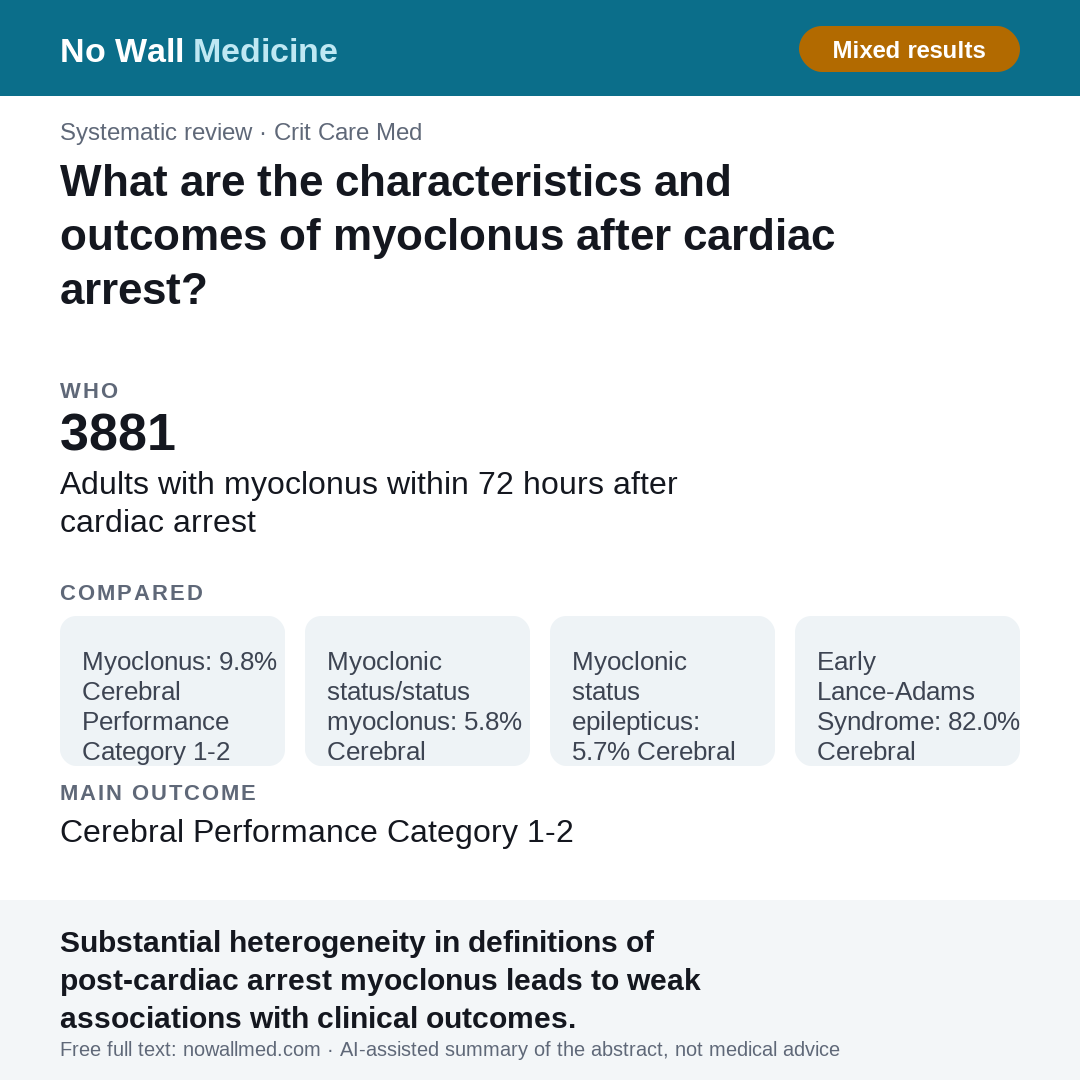
Clinical question: What are the characteristics and outcomes of myoclonus after cardiac arrest?
Why it matters: Clinical definitions, electroencephalogram patterns, and outcomes for myoclonus after cardiac arrest are highly inconsistent across existing research.
Key points
- Researchers reviewed 119 studies involving 3881 patients to examine different types of myoclonus, which are involuntary muscle jerks, occurring within 72 hours of cardiac arrest.
- Among patients with defined outcomes, a good neurological outcome (Cerebral Performance Category 1-2) was reported in 9.8% of those with myoclonus and 82.0% with early Lance-Adams Syndrome.
- The rate of good neurological outcomes was 1.6% for patients with suppression or suppression burst patterns on an electroencephalogram, compared to 22.3% for those without those patterns and without status epilepticus.
Headline and key points written with AI from the paper’s abstract, with every number checked against it. Read the paper before relying on them.
Topics
Cite this article
De Stefano P, Leitinger M, Misirocchi F, Quintard H, Degano G, Trinka E. Myoclonus After Cardiac Arrest: Need for Standardization-A Systematic Review and Research Proposal on Terminology. Crit Care Med. 2024. doi:10.1097/CCM.0000000000006521
Spotted a mistake? Suggest a correction
Top studies every Monday
The week’s key trials and guidelines in your specialties, plus any topics you follow. By email, free.
Get the weekly digest