Special spectacle lenses with dual-index aspherical lenslets slowed eye growth in children with myopia
Myopia Control Efficacy of Spectacle Lenses with Dual-Index Aspherical Lenslets: A 1-Year Randomized Clinical Trial
Prospective, randomized, double-masked clinical trialBenefit found
Does Dual-Index Aspherical Lenslets spectacle lenses control myopia efficacy better than single-vision spectacle lenses?
Who
76
Eighty children aged 8 to 13 years with myopia · Singapore
Compared
Dual-Index Aspherical Lenslets: 0.04 ± 0.02 mm
Single-vision spectacle lenses: 0.22 ± 0.04 mm
Main outcome
Axial length change
Result: -0.18 mm (95% CI, -0.26 to -0.10 mm)
Bottom line: Dual-Index Aspherical Lenslets spectacle lenses showed good myopia control efficacy regarding axial elongation compared to single-vision spectacle lenses.
Ophthalmol Sci · 2025-03-14 · Save PNG
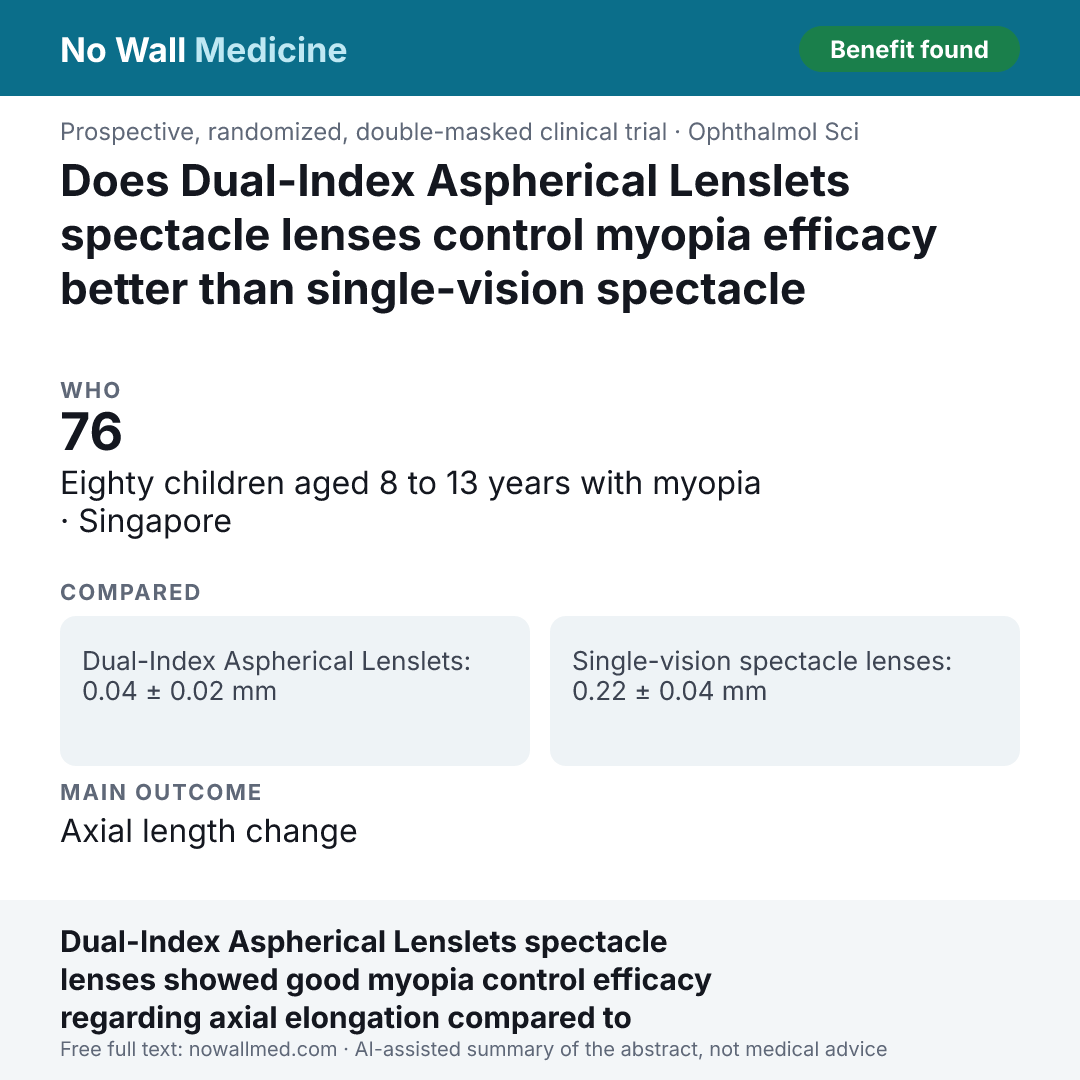
Clinical question: Does Dual-Index Aspherical Lenslets spectacle lenses control myopia efficacy better than single-vision spectacle lenses?
Key points
- The study followed 76 children aged 8 to 13 years who were randomized to wear either dual-index aspherical lenslets (DIAL) or single-vision spectacle lenses (SVL) for 1 year.
- The DIAL group had a mean axial length change of 0.04 ± 0.02 mm compared to 0.22 ± 0.04 mm in the SVL group, a mean difference of -0.18 mm.
- The DIAL lenses were associated with a mean spherical equivalent refraction change of -0.13 ± 0.06 D compared to -0.39 ± 0.08 D in the SVL group.
Headline and key points written with AI from the paper’s abstract, with every number checked against it. Read the paper before relying on them.
Was this summary helpful?
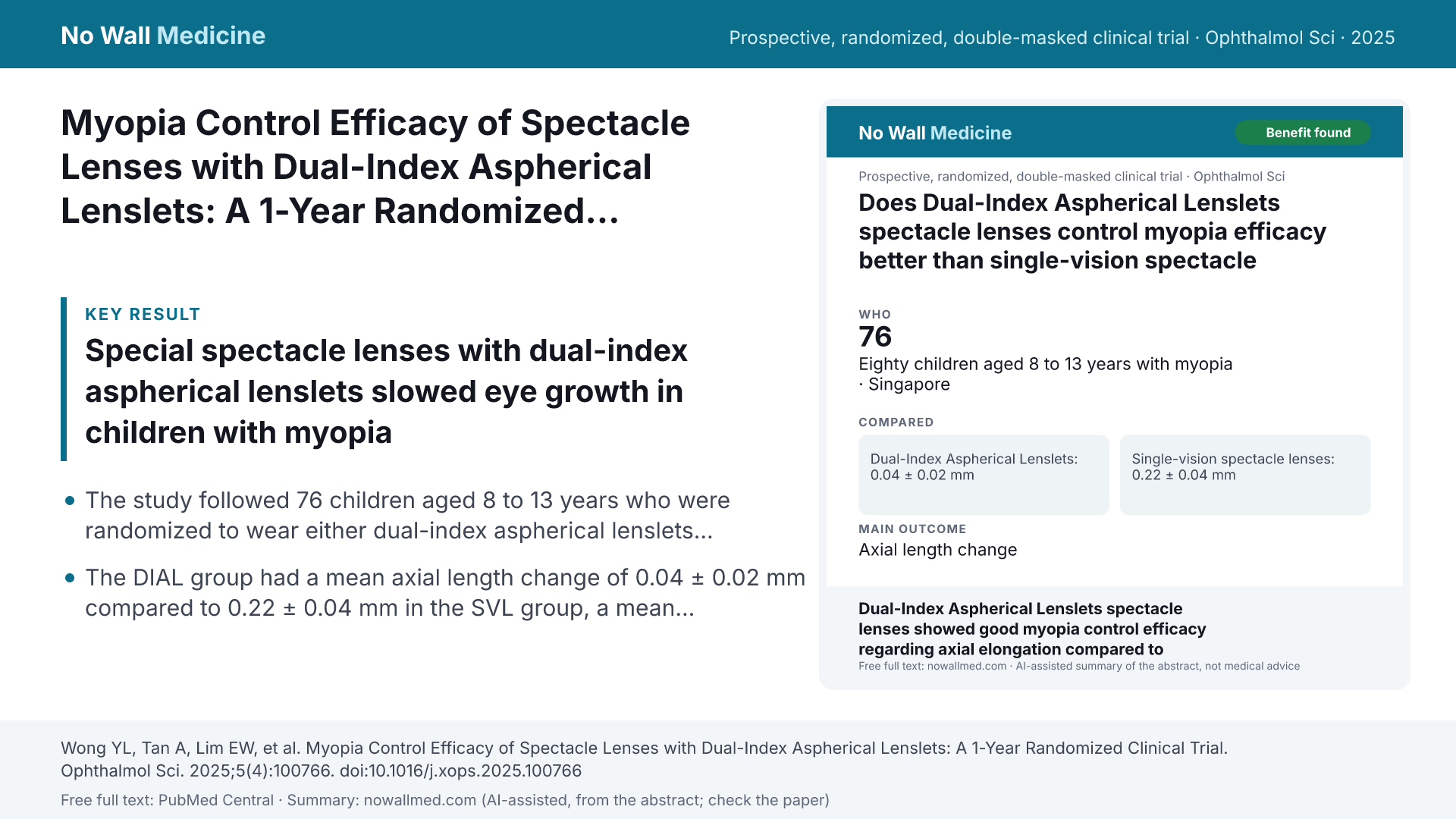
Headline, design, result, key points, caveat and citation as plain text.
Cite this article
Wong YL, Tan A, Lim EW, et al. Myopia Control Efficacy of Spectacle Lenses with Dual-Index Aspherical Lenslets: A 1-Year Randomized Clinical Trial. Ophthalmol Sci. 2025;5(4):100766. doi:10.1016/j.xops.2025.100766
Spotted a mistake? Suggest a correction