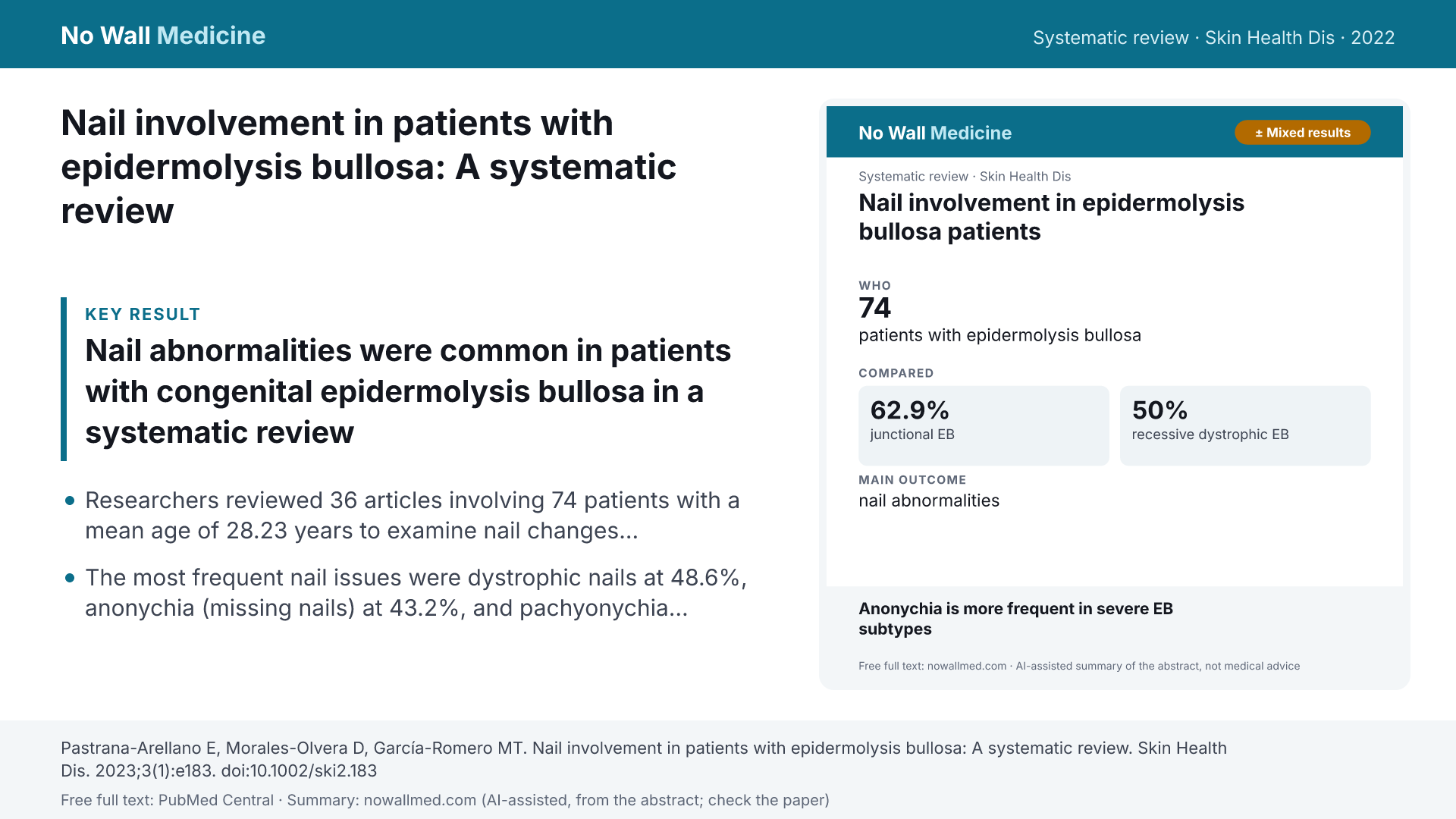
Nail abnormalities were common in patients with congenital epidermolysis bullosa in a systematic review
Nail involvement in patients with epidermolysis bullosa: A systematic review
Systematic reviewMixed results
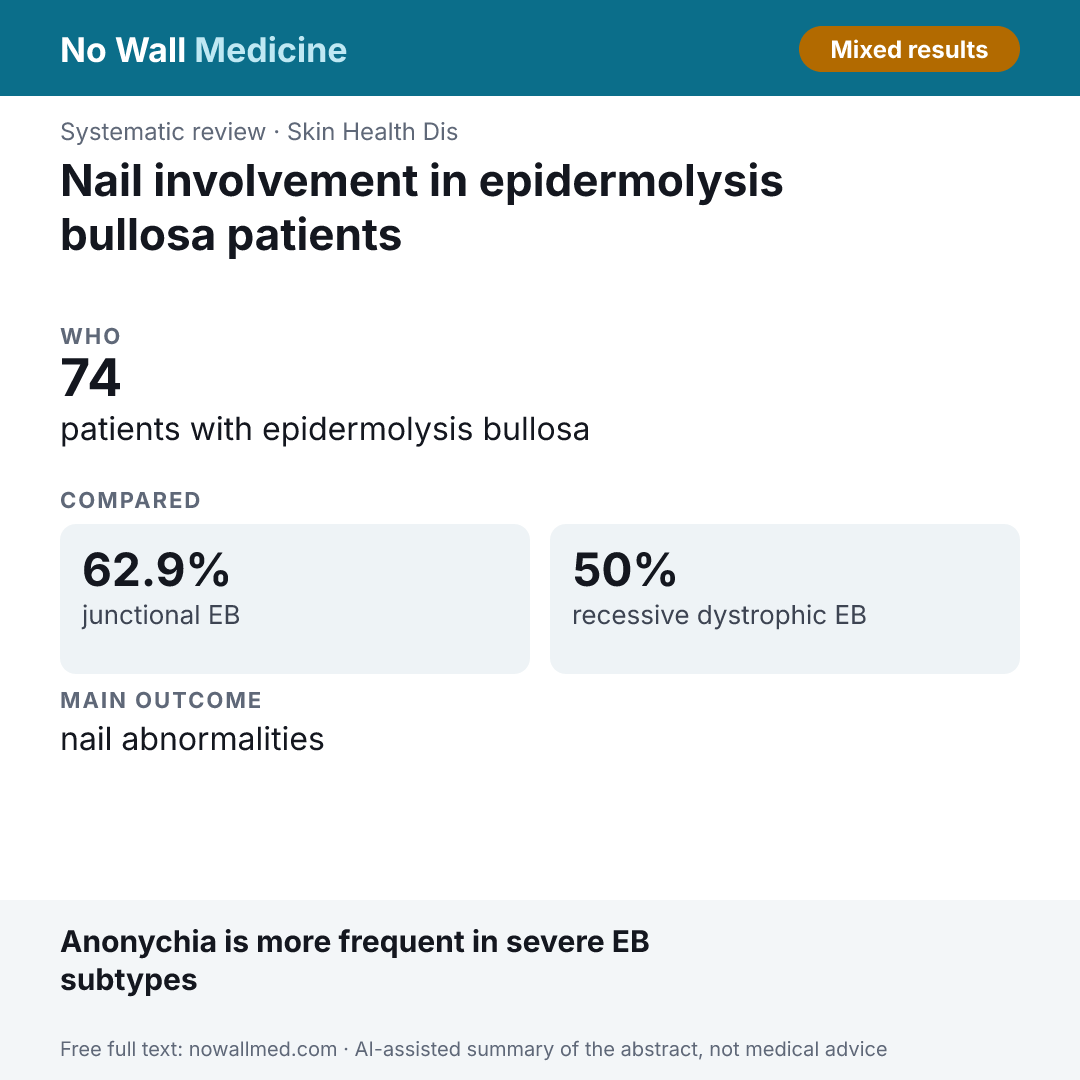
Nail involvement in epidermolysis bullosa patients
Who
74
patients with epidermolysis bullosa
Compared
62.9%junctional EB
50%recessive dystrophic EB
Main outcome
nail abnormalities
Bottom line: Anonychia is more frequent in severe EB subtypes
Skin Health Dis · 2022-11-10 · Save PNG
Key points
- Researchers reviewed 36 articles involving 74 patients with a mean age of 28.23 years to examine nail changes in epidermolysis bullosa, a group of skin blistering diseases.
- The most frequent nail issues were dystrophic nails at 48.6%, anonychia (missing nails) at 43.2%, and pachyonychia (thickened nails) at 40.5%.
- Anonychia was associated with junctional epidermolysis bullosa at 62.9% and recessive dystrophic epidermolysis bullosa at 50%.
Headline and key points written with AI from the paper’s abstract, with every number checked against it. Read the paper before relying on them.
Was this summary helpful?
Headline, design, result, key points, caveat and citation as plain text.
Cite this article
Pastrana-Arellano E, Morales-Olvera D, García-Romero MT. Nail involvement in patients with epidermolysis bullosa: A systematic review. Skin Health Dis. 2023;3(1):e183. doi:10.1002/ski2.183
Spotted a mistake? Suggest a correction