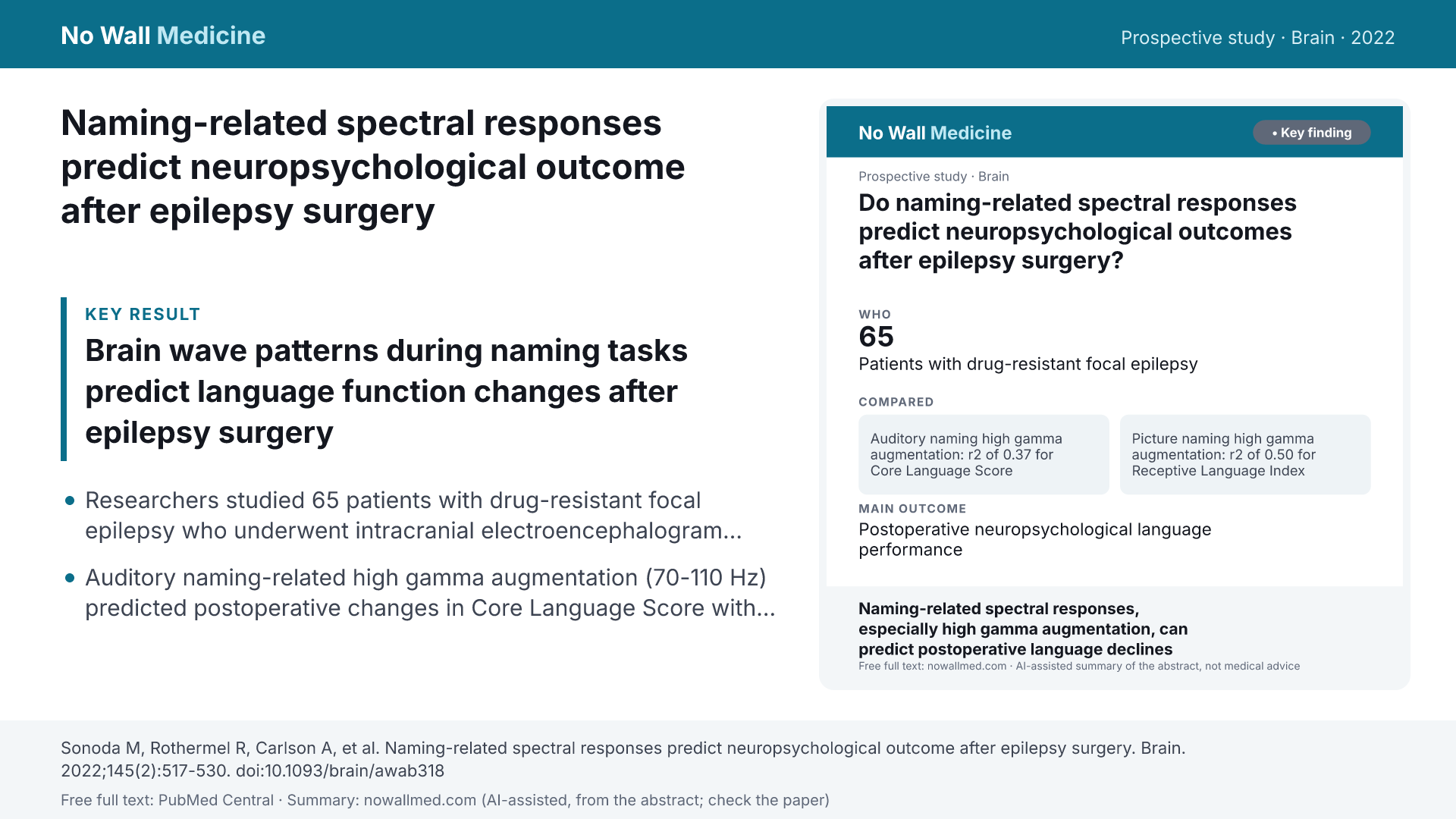
Naming-related spectral responses predict neuropsychological outcome after epilepsy surgery
Key result: Brain wave patterns during naming tasks predict language function changes after epilepsy surgery
Prospective studyKey finding
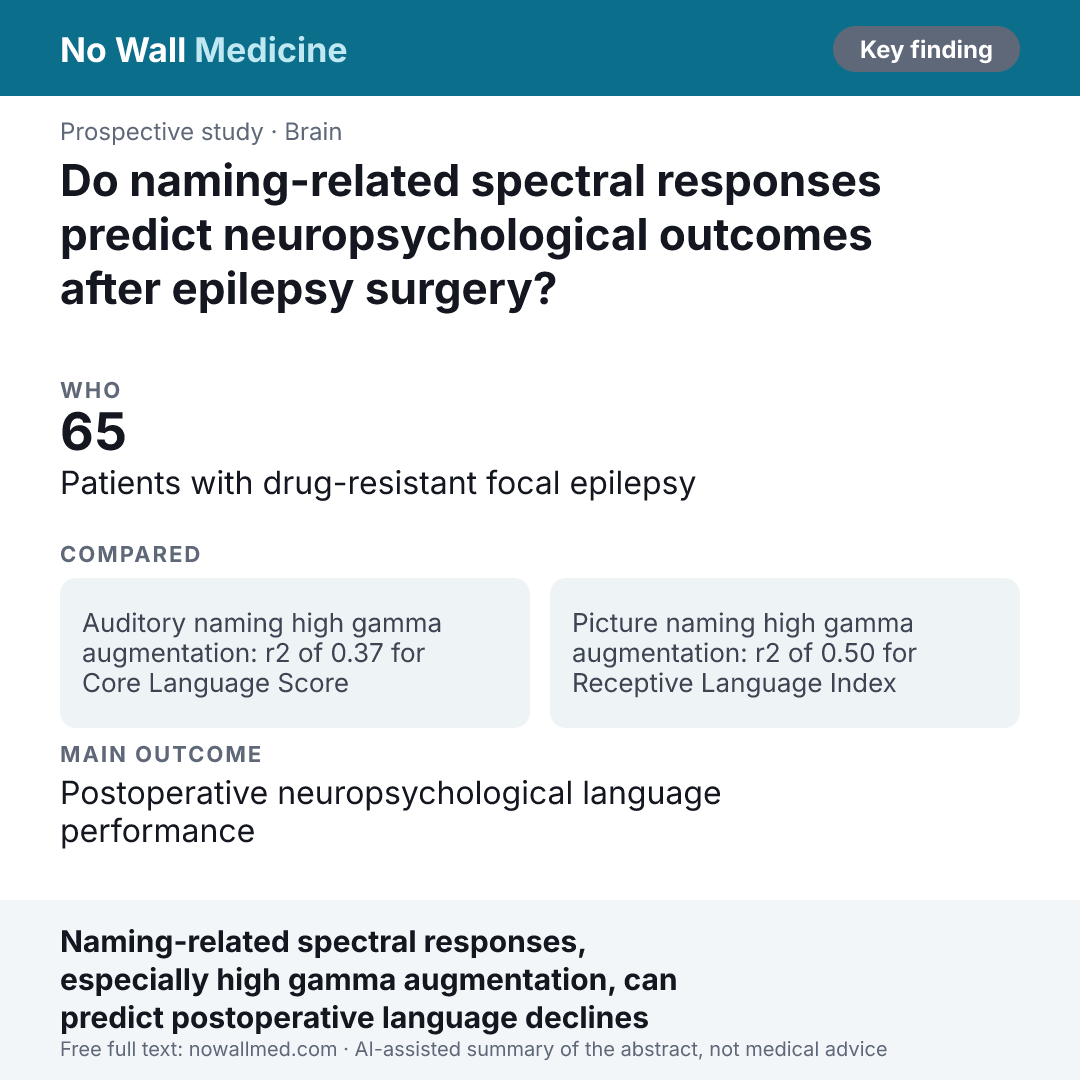
Do naming-related spectral responses predict neuropsychological outcomes after epilepsy surgery?
Who
65
Patients with drug-resistant focal epilepsy
Compared
Auditory naming high gamma augmentation: r2 of 0.37 for Core Language Score
Picture naming high gamma augmentation: r2 of 0.50 for Receptive Language Index
Main outcome
Postoperative neuropsychological language performance
Result: relative risk 5.28 (95% confidence interval: 3.47-8.02)
Bottom line: Naming-related spectral responses, especially high gamma augmentation, can predict postoperative language declines after epilepsy surgery.
Brain · 2022-03-22 · Save PNG
Key points
- Researchers studied 65 patients with drug-resistant focal epilepsy who underwent intracranial electroencephalogram (brain wave) recording and neuropsychological testing.
- Auditory naming-related high gamma augmentation (70-110 Hz) predicted postoperative changes in Core Language Score with r2 of 0.37 and Expressive Language Index with r2 of 0.32.
- A machine learning model using auditory naming-related high gamma augmentation predicted a decline of more than 5 points in Core Language Score with 0.80 accuracy.
Discussion prompts
- Would these patients look like yours? Who was left out?
- Is the main outcome one that matters to patients?
- Is the difference large enough to change what you do?
Cite: Sonoda M, Rothermel R, Carlson A, et al. Naming-related spectral responses predict neuropsychological outcome after epilepsy surgery. Brain. 2022;145(2):517-530. doi:10.1093/brain/awab318
Free full text: PubMed Central · Summary and visual abstract: nowallmed.com/a/naming-related-spectral-responses-predict-neuropsychological-outcome-1oz253a/ (AI-assisted from the abstract; check the paper before relying on it).