Nasal sprays were associated with fewer days of respiratory illness compared to usual care
Nasal sprays and behavioural interventions compared with usual care for acute respiratory illness in primary care: a randomised, controlled, open-label, parallel-group trial
Randomised, controlled, open-label, parallel-group trialBenefit found
Do nasal sprays or behavioural interventions reduce respiratory illness duration compared with usual care?
Who
13799
Adults with comorbidities or frequent respiratory tract infections · 332 general practitioner practices in the UK
Compared
Usual care: mean 8·2 (SD 16·1) days
Gel-based spray: mean 6·5 days [SD 12·8]
Saline spray: 6·4 days [12·4]
Behavioural website: 7·4 days [14·7]
Main outcome
Total number of days of illness due to respiratory tract illnesses
Result: adjusted incidence rate ratio 0·82 (99% CI 0·76-0·90) for gel-based spray
Bottom line: Gel-based and saline nasal sprays significantly reduced respiratory illness days compared to usual care.
Lancet Respir Med · 2024-07-11Download image
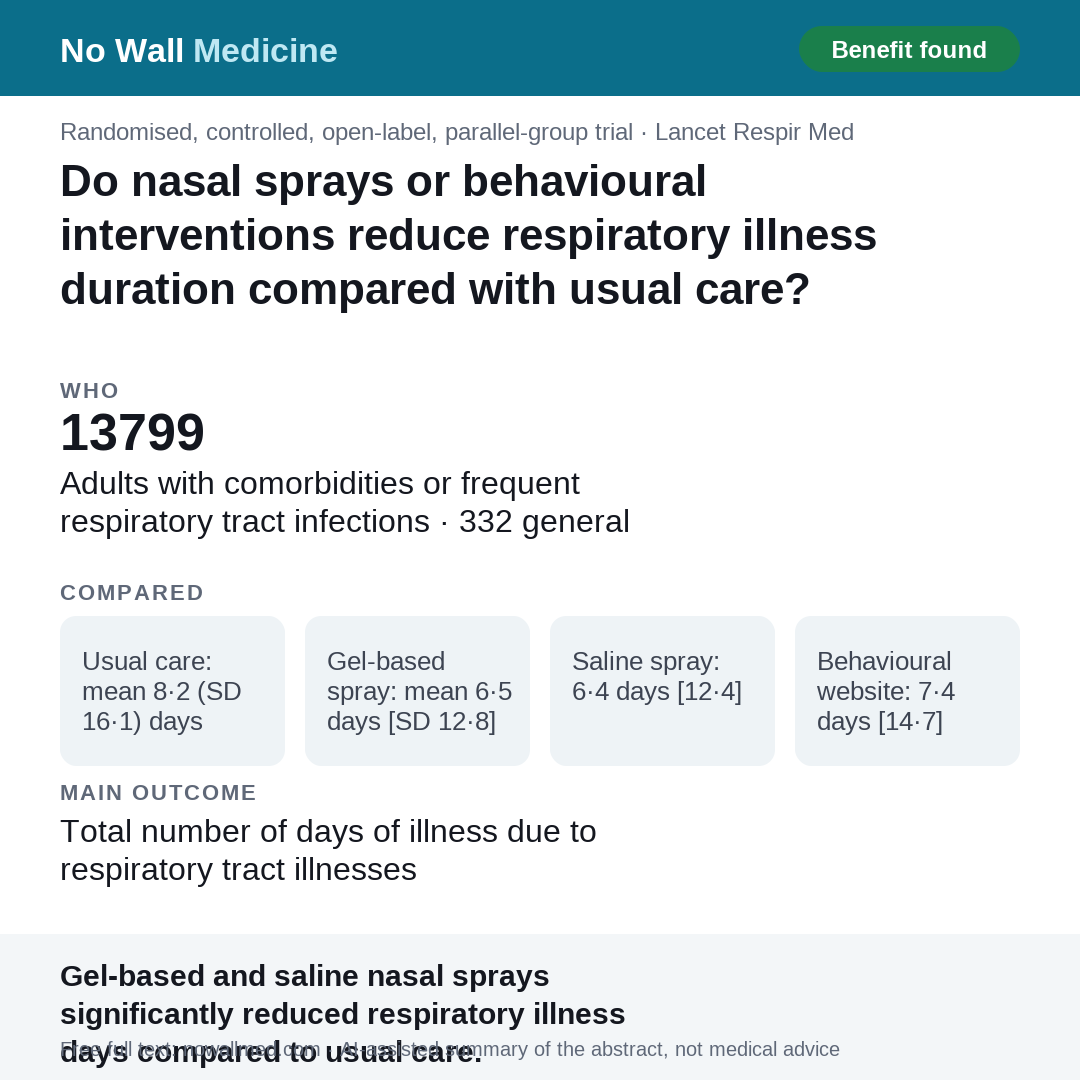
Clinical question: Do nasal sprays or behavioural interventions reduce respiratory illness duration compared with usual care?
Why it matters: It was unknown if nasal sprays or behavioral interventions like physical activity and stress management could shorten the duration of respiratory infections.
Key points
- In this trial of 13,799 participants, gel-based nasal sprays and saline sprays were compared to usual care and a digital behavioral intervention for respiratory illness.
- The gel-based spray group had a mean of 6.5 days of illness compared to 8.2 days in the usual care group, and the saline spray group had 6.4 days.
- The behavioral website group had 7.4 days of illness, which was not significantly different from the 8.2 days in the usual care group.
Headline and key points written with AI from the paper’s abstract, with every number checked against it. Read the paper before relying on them.
Was this summary helpful?
Abstract
Background
A small amount of evidence suggests that nasal sprays, or physical activity and stress management, could shorten the duration of respiratory infections. This study aimed to assess the effect of nasal sprays or a behavioural intervention promoting physical activity and stress management on respiratory illnesses, compared with usual care. Methods
This randomised, controlled, open-label, parallel-group trial was done at 332 general practitioner practices in the UK. Eligible adults (aged ≥18 years) had at least one comorbidity or risk factor increasing their risk of adverse outcomes due to respiratory illness (eg, immune compromise due to serious illness or medication; heart disease; asthma or lung disease; diabetes; mild hepatic impairment; stroke or severe neurological problem; obesity [BMI ≥30 kg/m2]; or age ≥65 years) or at least three self-reported respiratory tract infections in a normal year (ie, any year before the COVID-19 pandemic). Participants were randomly assigned (1:1:1:1) using a computerised system to: usual care (brief advice about managing illness); gel-based spray (two sprays per nostril at the first sign of an infection or after potential exposure to infection, up to 6 times per day); saline spray (two sprays per nostril at the first sign of an infection or after potential exposure to infection, up to 6 times per day); or a brief behavioural intervention in which participants were given access to a website promoting physical activity and stress management. The study was partially masked: neither investigators nor medical staff were aware of treatment allocation, and investigators who did the statistical analysis were unaware of treatment allocation. The sprays were relabelled to maintain participant masking. Outcomes were assessed using data from participants' completed monthly surveys and a survey at 6 months. The primary outcome was total number of days of illness due to self-reported respiratory tract illnesses (coughs, colds, sore throat, sinus or ear infections, influenza, or COVID-19) in the previous 6 months, assessed in the modified intention-to-treat population, which included all randomly assigned participants who had primary outcome data available. Key secondary outcomes were possible harms, including headache or facial pain, and antibiotic use, assessed in all randomly assigned participants. This trial was registered with ISRCTN, 17936080, and is closed to recruitment. Findings
Between Dec 12, 2020, and April 7, 2023, of 19 475 individuals screened for eligibility, 13 799 participants were randomly assigned to usual care (n=3451), gel-based nasal spray (n=3448), saline nasal spray (n=3450), or the digital intervention promoting physical activity and stress management (n=3450). 11 612 participants had complete data for the primary outcome and were included in the primary outcome analysis (usual care group, n=2983; gel-based spray group, n=2935; saline spray group, n=2967; behavioural website group, n=2727). Compared with participants in the usual care group, who had a mean of 8·2 (SD 16·1) days of illness, the number of days of illness was significantly lower in the gel-based spray group (mean 6·5 days [SD 12·8]; adjusted incidence rate ratio [IRR] 0·82 [99% CI 0·76-0·90]; p<0·0001) and the saline spray group (6·4 days [12·4]; 0·81 [0·74-0·88]; p<0·0001), but not in the group allocated to the behavioural website (7·4 days [14·7]; 0·97 [0·89-1·06]; p=0·46). The most common adverse event was headache or sinus pain in the gel-based group: 123 (4·8%) of 2556 participants in the usual care group; 199 (7·8%) of 2498 participants in the gel-based group (risk ratio 1·61 [95% CI 1·30-1·99]; p<0·0001); 101 (4·5%) of 2377 participants in the saline group (0·81 [0·63-1·05]; p=0·11); and 101 (4·5%) of 2091 participants in the behavioural intervention group (0·95 [0·74-1·22]; p=0·69). Compared with usual care, antibiotic use was lower for all interventions: IRR 0·65 (95% CI 0·50-0·84; p=0·001) for the gel-based spray group; 0·69 (0·45-0·88; p=0·003) for the saline spray group; and 0·74 (0·57-0·94; p=0·02) for the behavioural website group. Interpretation
Advice to use either nasal spray reduced illness duration and both sprays and the behavioural website reduced antibiotic use. Future research should aim to address the impact of the widespread implementation of these simple interventions. Funding
National Institute for Health and Care Research.
Abstract reproduced under the article’s CC BY licence.
Subject terms
Cite this article
Little P, Vennik J, Rumsby K, Stuart B, Becque T, Moore M. Nasal sprays and behavioural interventions compared with usual care for acute respiratory illness in primary care: a randomised, controlled, open-label, parallel-group trial. Lancet Respir Med. 2024. doi:10.1016/S2213-2600(24)00140-1
Spotted a mistake? Suggest a correction
Top studies every Monday
The week’s key trials and guidelines in your specialties, plus any topics you follow. By email, free.
Get the weekly digest