Natural language processing application in electronic health records studies for psychosis: a systematic review
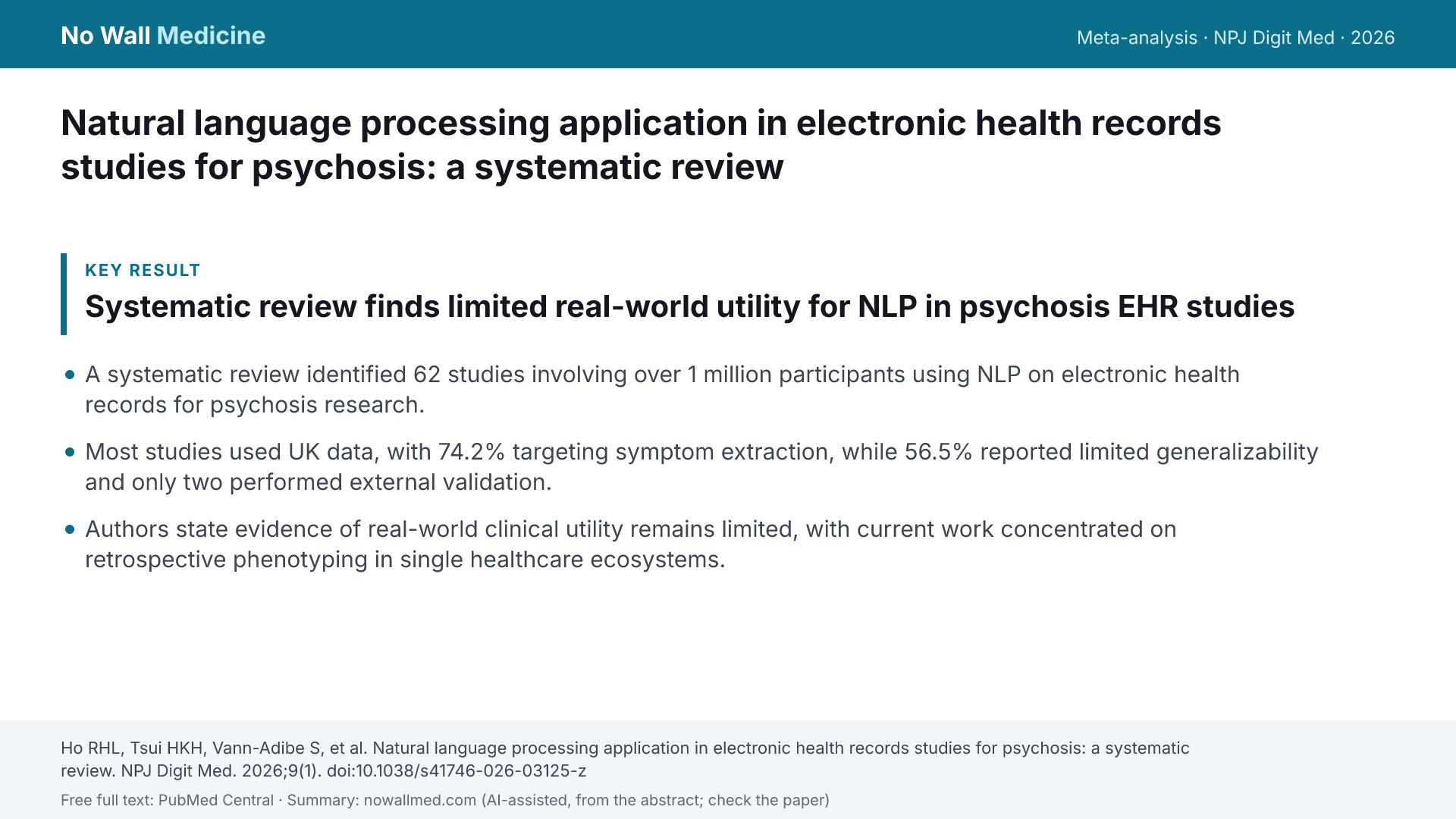
Key result: Systematic review finds limited real-world utility for NLP in psychosis EHR studies
Key points
- A systematic review identified 62 studies involving over 1 million participants using NLP on electronic health records for psychosis research.
- Most studies used UK data, with 74.2% targeting symptom extraction, while 56.5% reported limited generalizability and only two performed external validation.
- Authors state evidence of real-world clinical utility remains limited, with current work concentrated on retrospective phenotyping in single healthcare ecosystems.
Why it matters: Applies to researchers using electronic health records for psychosis; highlights the need for multi-system validation and temporal modeling to improve clinical utility.
Limitation the authors note: The abstract states that evidence of real-world clinical utility remains limited and current work is concentrated on retrospective phenotyping within a single healthcare ecosystem.
Discussion prompts
- Would these patients look like yours? Who was left out?
- Is the main outcome one that matters to patients?
- Is the difference large enough to change what you do?
Cite: Ho RHL, Tsui HKH, Vann-Adibe S, et al. Natural language processing application in electronic health records studies for psychosis: a systematic review. NPJ Digit Med. 2026;9(1). doi:10.1038/s41746-026-03125-z
Free full text: PubMed Central · Summary and visual abstract: nowallmed.com/a/natural-language-processing-application-in-electronic-health-records-bbvu86/ (AI-assisted from the abstract; check the paper before relying on it).