Natural language processing studies in mental health interventions show rapid growth and increasing use of large language models
Natural language processing for mental health interventions: a systematic review and research framework
Systematic reviewMixed results
What are the models, clinical applications, and biases of natural language processing in mental health interventions?
Who
102
Natural language processing studies for mental health interventions · PubMed, PsycINFO, Scopus, Google Scholar, and ArXiv
Compared
Text-based features: contributed more to model accuracy than audio markers
Audio markers: contributed less to model accuracy than text-based features
Main outcome
computational characteristics, clinical applications, and limitations of models
Bottom line: Natural language processing studies in mental health are growing rapidly but face limitations in linguistic diversity, reproducibility, and population bias.
Limitation: lack of linguistic diversity, limited reproducibility, and population bias
Transl Psychiatry · 2023-10-06Download image
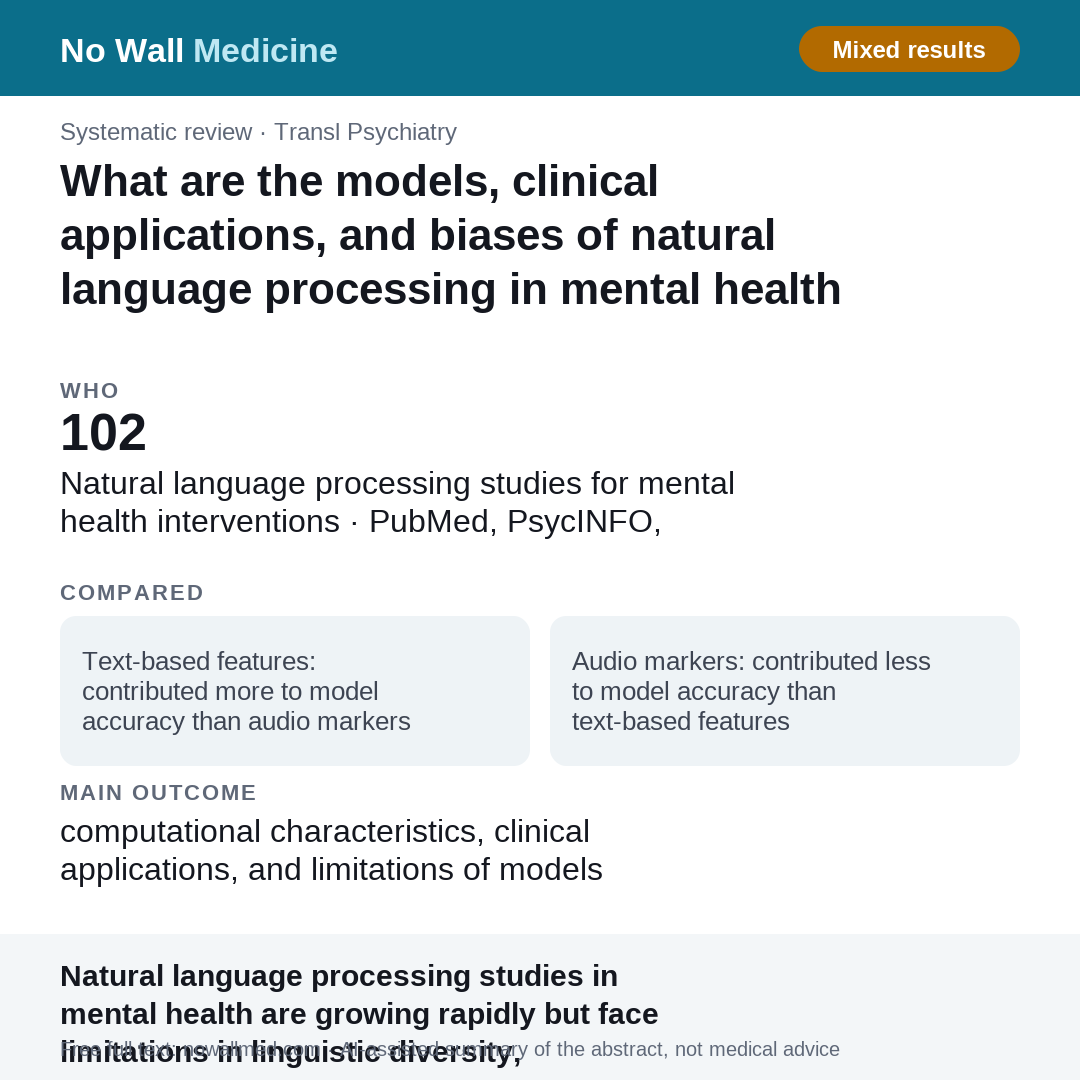
Clinical question: What are the models, clinical applications, and biases of natural language processing in mental health interventions?
Why it matters: The potential for natural language processing to address clinical and research challenges in mental health interventions remains unclear.
Key points
- Researchers reviewed 102 articles from 19,756 candidate studies to evaluate how natural language processing, which uses computers to analyze human speech and text, is used in mental health interventions.
- Text-based features contributed more to model accuracy than audio markers, and digital health platforms were the largest providers of data.
- Commonly investigated clinical categories included patient clinical presentation (n = 34), intervention monitoring (n = 20), and relational dynamics (n = 14).
Limitation the authors note: Reviewed studies showed a lack of linguistic diversity, limited reproducibility, and population bias.
Headline and key points written with AI from the paper’s abstract, with every number checked against it. Read the paper before relying on them.
Topics
Cite this article
Malgaroli M, Hull TD, Zech JM, Althoff T. Natural language processing for mental health interventions: a systematic review and research framework. Transl Psychiatry. 2023. doi:10.1038/s41398-023-02592-2
Spotted a mistake? Suggest a correction
Top studies every Monday
The week’s key trials and guidelines in your specialties, plus any topics you follow. By email, free.
Get the weekly digest