Transformer models showed highest performance for detecting delirium from clinical notes in systematic review
Natural language processing techniques to detect delirium in hospitalized patients from clinical notes: a systematic review
Systematic reviewMixed results
Can natural language processing techniques detect delirium in hospitalized patients from clinical notes?
Who
450,000
Hospitalized patients
Compared
Rule-based methods
Machine learning
Deep learning
Transformer models: AUROC 0.984
Main outcome
Detection performance of natural language processing techniques
Result: sensitivity ranged from 28.5% to 99.1%
Bottom line: Transformer models show high performance, but high risk of bias and lack of external validation hinder clinical deployment.
Limitation: High risk of bias due to inadequate validation and lack of prospective implementation studies.
NPJ Digit Med · 2025-11-20Download image
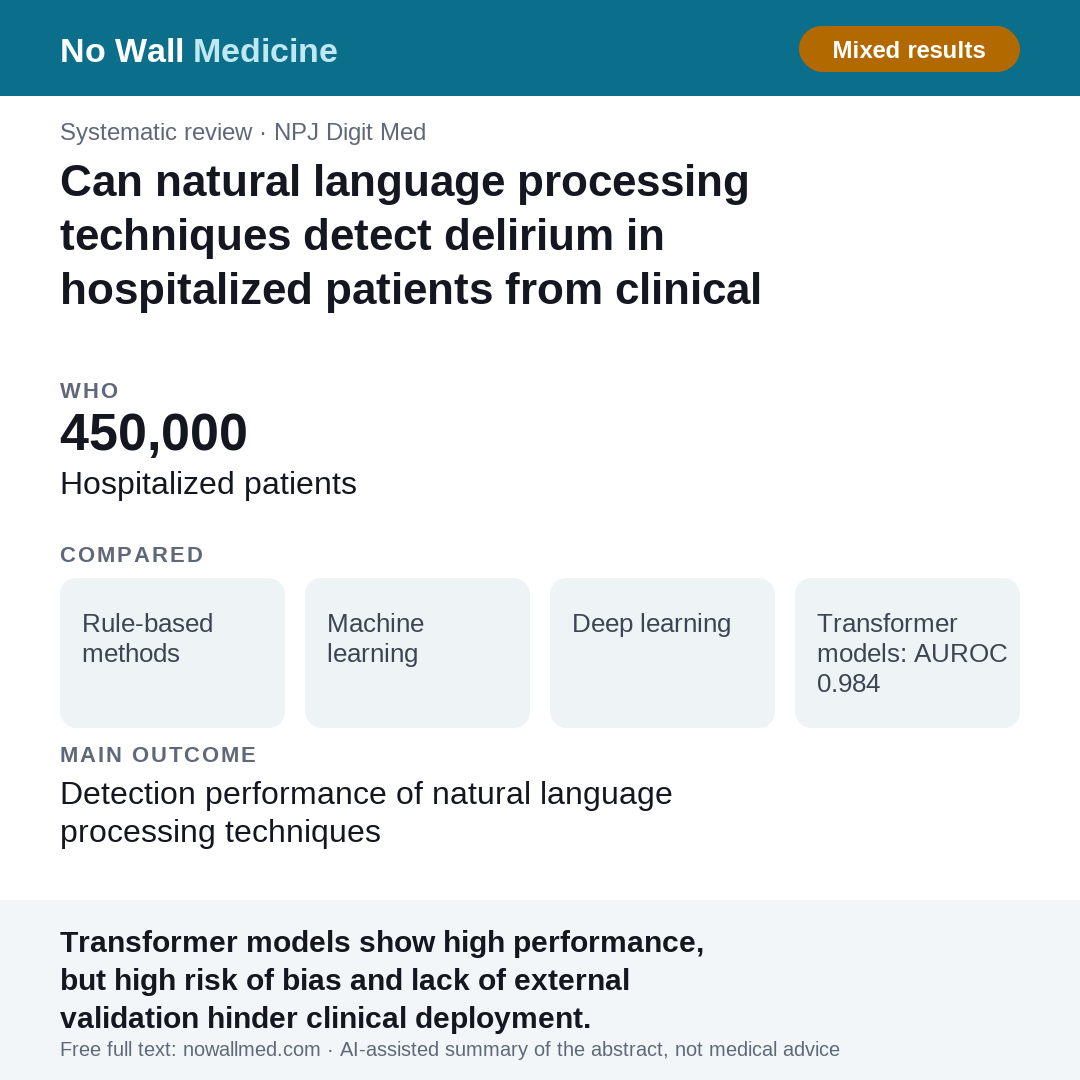
Clinical question: Can natural language processing techniques detect delirium in hospitalized patients from clinical notes?
Why it matters: Traditional methods for detecting delirium in hospitalized patients have detection rates as low as 20-30%.
Key points
- Researchers reviewed 13 studies involving over 450,000 patients to evaluate natural language processing, which is computer technology that understands human text, for detecting delirium.
- Sensitivity for detection ranged from 28.5% to 99.1%, while transformer models achieved the highest performance with an Area Under the Receiver Operating Characteristic curve of 0.984.
- The review found that 61.5% of studies had a high risk of bias due to inadequate validation practices.
Limitation the authors note: The authors noted that 61.5% of studies showed high risk of bias, only one study conducted external validation, and none evaluated prospective implementation or patient outcomes.
Headline and key points written with AI from the paper’s abstract, with every number checked against it. Read the paper before relying on them.
Cite this article
Shankar R, Kannan J, Tan YH, Xu Q. Natural language processing techniques to detect delirium in hospitalized patients from clinical notes: a systematic review. NPJ Digit Med. 2025. doi:10.1038/s41746-025-02051-w
Spotted a mistake? Suggest a correction