Near-infrared autofluorescence increases parathyroid gland identification during thyroidectomy and bilateral exploration surgery
Near-Infrared Autofluorescence for Parathyroid Detection During Endocrine Neck Surgery: A Randomized Clinical Trial
Multicenter randomized clinical trialBenefit found
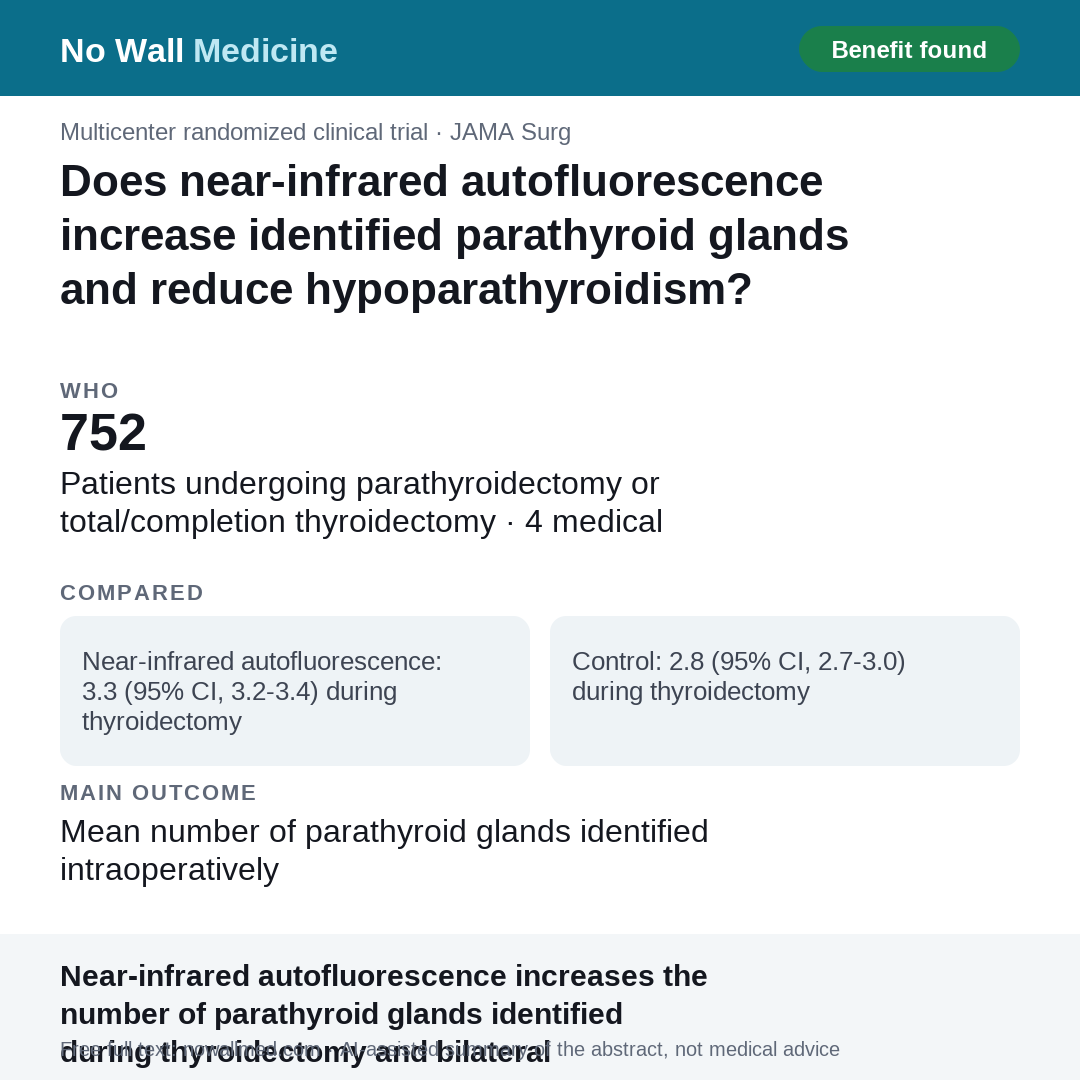
Does near-infrared autofluorescence increase identified parathyroid glands and reduce hypoparathyroidism?
Who
752
Patients undergoing parathyroidectomy or total/completion thyroidectomy · 4 medical centers in the United States
Compared
Near-infrared autofluorescence: 3.3 (95% CI, 3.2-3.4) during thyroidectomy
Control: 2.8 (95% CI, 2.7-3.0) during thyroidectomy
Main outcome
Mean number of parathyroid glands identified intraoperatively
Result: not specified for all subgroups
Bottom line: Near-infrared autofluorescence increases the number of parathyroid glands identified during thyroidectomy and bilateral exploration parathyroidectomy.
JAMA Surg · 2025-07-16Download image
Clinical question: Does near-infrared autofluorescence increase identified parathyroid glands and reduce hypoparathyroidism?
Why it matters: Accurate identification and preservation of parathyroid glands is necessary to prevent hypoparathyroidism during thyroid and parathyroid surgeries.
Key points
- Researchers conducted a multicenter randomized trial of 752 patients to compare fiber-based near-infrared autofluorescence (NIRAF) with conventional surgery techniques.
- During thyroidectomy, the mean number of parathyroid glands identified was 3.3 with NIRAF compared to 2.8 with traditional surgery.
- In bilateral exploration parathyroidectomy, the mean number of glands identified was 3.5 with NIRAF versus 3.2 with control methods.
Headline and key points written with AI from the paper’s abstract, with every number checked against it. Read the paper before relying on them.
Was this summary helpful?
Subject terms
Cite this article
Cousart AG, Kiernan CM, Willmon PA, Thomas G, Wang TS, Gauger PG. Near-Infrared Autofluorescence for Parathyroid Detection During Endocrine Neck Surgery: A Randomized Clinical Trial. JAMA Surg. 2025. doi:10.1001/jamasurg.2025.2233
Spotted a mistake? Suggest a correction
Top studies every Monday
The week’s key trials and guidelines in your specialties, plus any topics you follow. By email, free.
Get the weekly digest