Clinical trial criteria suggest needs-based triggers for palliative care referrals in older adults
Needs-based triggers for timely referral to palliative care for older adults severely affected by noncancer conditions: a systematic review and narrative synthesis
Systematic narrative review of randomized controlled trialsBenefit found
What are the eligibility criteria for timely palliative care referral in older adults with noncancer conditions?
Who
Older adults with noncancer conditions
Compared
26Diagnostic criteria (96%)
15Medical history-based criteria (56%)
14Physical and psychological symptom criteria (52%)
Main outcome
Eligibility criteria for palliative care involvement
Bottom line: Palliative care referral for older adults with noncancer conditions should be based on symptoms, functional status, and quality of life.
Limitation: Further research is needed to examine how needs-based triggers can be operationalized in clinical settings.
BMC Palliat Care · 2023-03-09Download image
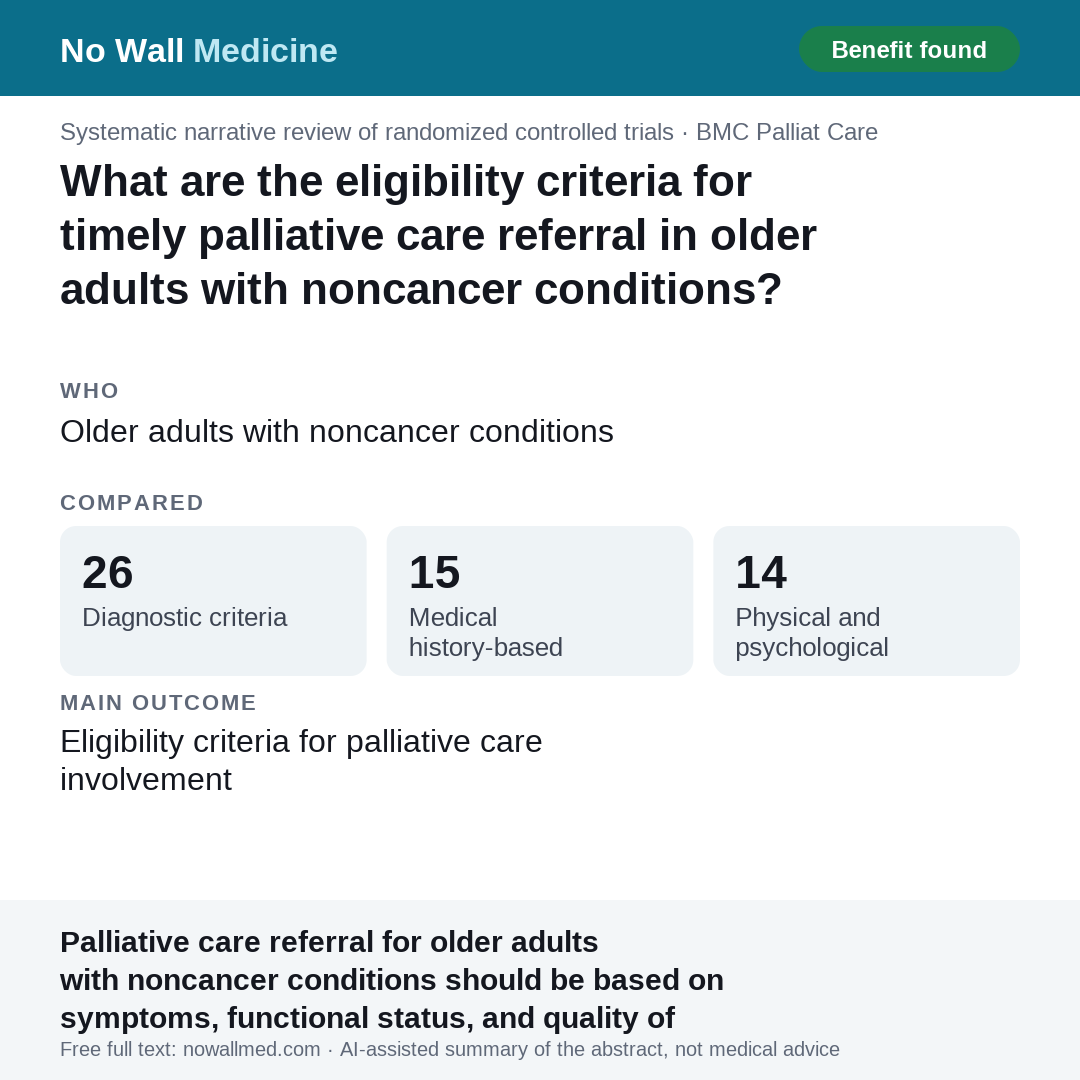
Clinical question: What are the eligibility criteria for timely palliative care referral in older adults with noncancer conditions?
Why it matters: Older adults with noncancer conditions often lack standardized referral criteria because their disease progression is difficult to predict.
Key points
- Researchers reviewed 27 randomized controlled trials from 9,584 papers to identify eligibility criteria for palliative care in older adults with noncancer conditions.
- The most common eligibility criteria were diagnostic criteria (n = 26, 96%), followed by medical history-based criteria (n = 15, 56%) and symptom criteria (n = 14, 52%).
- Identified criteria fell into three categories: needs-based, time-based, and medical history-based.
Headline and key points written with AI from the paper’s abstract, with every number checked against it. Read the paper before relying on them.
Was this summary helpful?
Subject terms
Cite this article
Kawashima A, Evans CJ. Needs-based triggers for timely referral to palliative care for older adults severely affected by noncancer conditions: a systematic review and narrative synthesis. BMC Palliat Care. 2023. doi:10.1186/s12904-023-01131-6
Spotted a mistake? Suggest a correction
Top studies every Monday
The week’s key trials and guidelines in your specialties, plus any topics you follow. By email, free.
Get the weekly digest