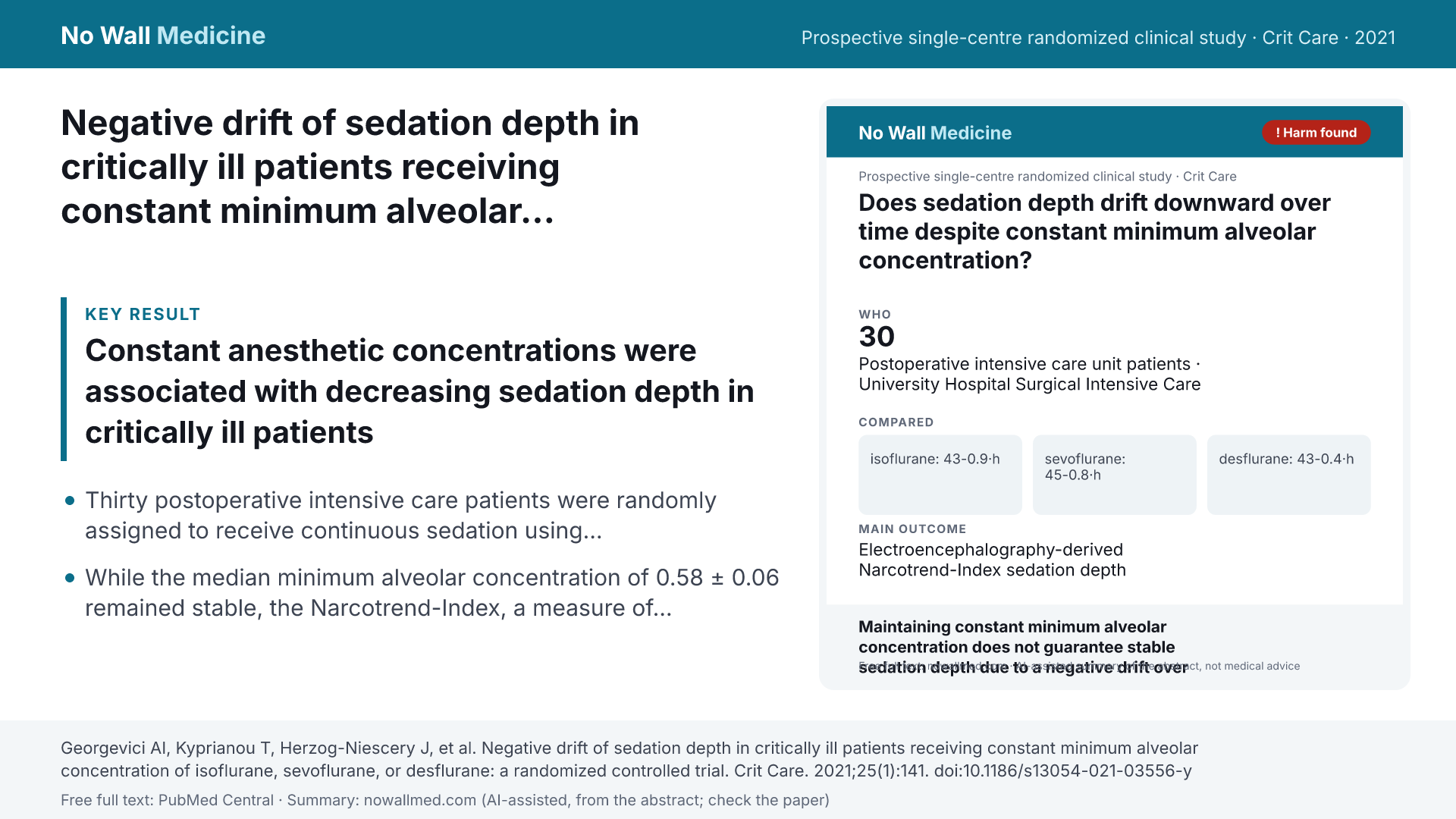
Constant anesthetic concentrations were associated with decreasing sedation depth in critically ill patients
Negative drift of sedation depth in critically ill patients receiving constant minimum alveolar concentration of isoflurane, sevoflurane, or desflurane: a randomized controlled trial
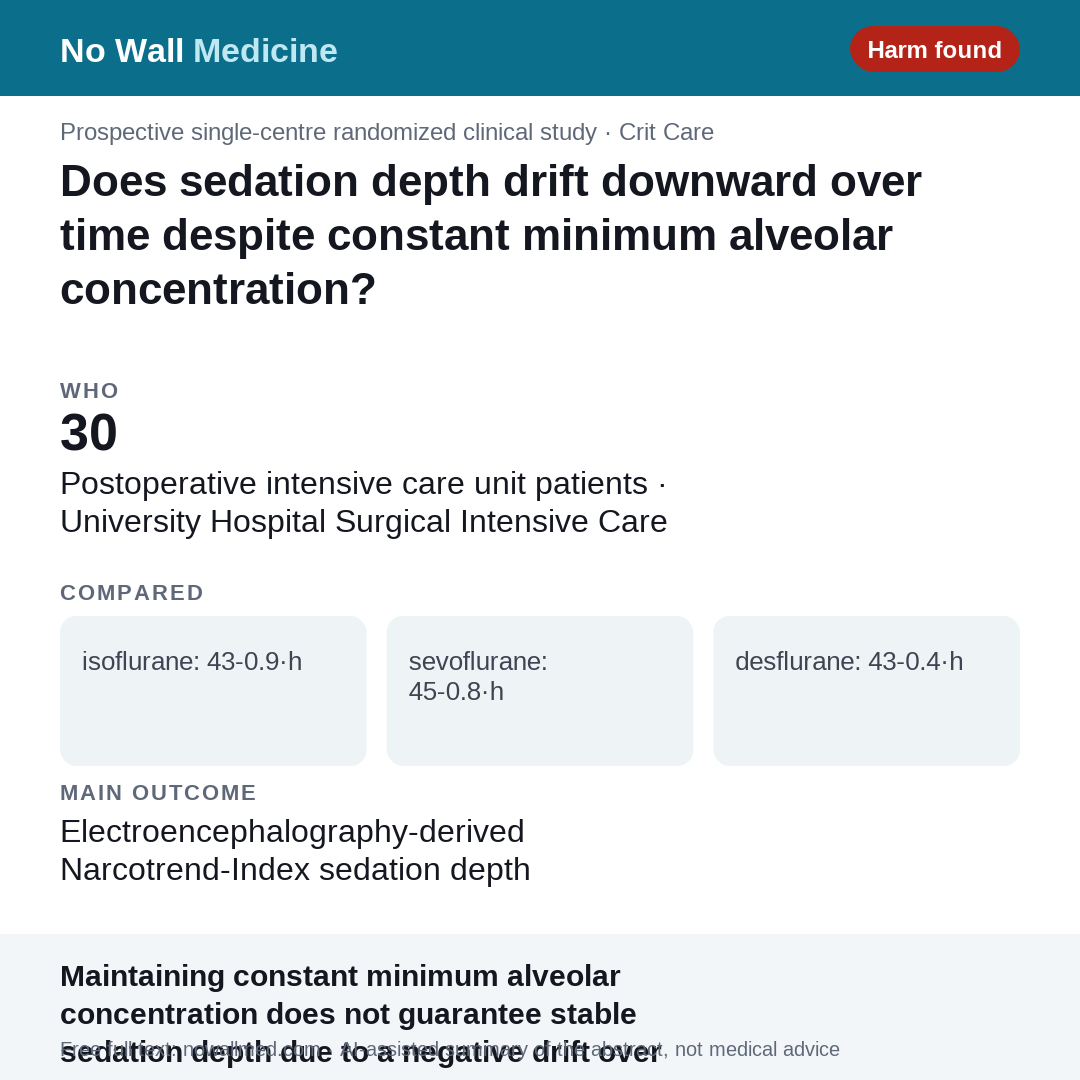
Prospective single-centre randomized clinical studyHarm found
Does sedation depth drift downward over time despite constant minimum alveolar concentration?
Who
30
Postoperative intensive care unit patients · University Hospital Surgical Intensive Care Unit
Compared
isoflurane: 43-0.9·h
sevoflurane: 45-0.8·h
desflurane: 43-0.4·h
Main outcome
Electroencephalography-derived Narcotrend-Index sedation depth
Bottom line: Maintaining constant minimum alveolar concentration does not guarantee stable sedation depth due to a negative drift over time.
Limitation: Differences across different volatile anaesthetics regarding time-dependent negative drift requires further exploration.
Crit Care · 2021-04-13Download image
Clinical question: Does sedation depth drift downward over time despite constant minimum alveolar concentration?
Why it matters: It is unknown if maintaining a constant minimum alveolar concentration of inhaled anesthetics reliably controls sedation depth in critically ill patients over time.
Key points
- Thirty postoperative intensive care patients were randomly assigned to receive continuous sedation using isoflurane, sevoflurane, or desflurane.
- While the median minimum alveolar concentration of 0.58 ± 0.06 remained stable, the Narcotrend-Index, a measure of sedation depth via brain wave monitoring, showed a negative correlation with sedation duration.
- The rate of sedation depth decline was lower in the desflurane group compared to the isoflurane and sevoflurane groups.
Limitation the authors note: This was a prospective single-centre randomized clinical study.
Headline and key points written with AI from the paper’s abstract, with every number checked against it. Read the paper before relying on them.
Was this summary helpful?
Abstract
Background
Intensive care unit (ICU) physicians have extended the minimum alveolar concentration (MAC) to deliver and monitor long-term volatile sedation in critically ill patients. There is limited evidence of MAC's reliability in controlling sedation depth in this setting. We hypothesized that sedation depth, measured by the electroencephalography (EEG)-derived Narcotrend-Index (burst-suppression N_Index 0-awake N_Index 100), might drift downward over time despite constant MAC values. Methods
This prospective single-centre randomized clinical study was conducted at a University Hospital Surgical Intensive Care Unit and included consecutive, postoperative ICU patients fulfilling the inclusion criteria. Patients were randomly assigned to receive uninterrupted inhalational sedation with isoflurane, sevoflurane, or desflurane. The end-expiratory concentration of the anaesthetics and the EEG-derived index were measured continuously in time-stamped pairs. Sedation depth was also monitored using Richmond-Agitation-Sedation-Scale (RASS). The paired t-test and linear models (bootstrapped or multilevel) have been employed to analyze MAC, N_Index and RASS across the three groups. Results
Thirty patients were recruited (female/male: 10/20, age 64 ± 11, Simplified Acute Physiology Score II 30 ± 10). In the first 24 h, 21.208 pairs of data points (N_Index and MAC) were recorded. The median MAC of 0.58 ± 0.06 remained stable over the sedation time in all three groups. The t-test indicated in the isoflurane and sevoflurane groups a significant drop in RASS and EEG-derived N_Index in the first versus last two sedation hours. We applied a multilevel linear model on the entire longitudinal data, nested per patient, which produced the formula N_Index = 43 - 0.7·h (R2 = 0.76), showing a strong negative correlation between sedation's duration and the N_Index. Bootstrapped linear models applied for each sedation group produced: N_Index of 43-0.9, 45-0.8, and 43-0.4·h for isoflurane, sevoflurane, and desflurane, respectively. The regression coefficient for desflurane was almost half of those for isoflurane and sevoflurane, indicating a less pronounced time-effect in this group. Conclusions
Maintaining constant MAC does not guarantee stable sedation depth. Thus, the patients necessitate frequent clinical assessments or, when unfeasible, continuous EEG monitoring. The differences across different volatile anaesthetics regarding their time-dependent negative drift requires further exploration. Trial registration
NCT03860129.
Abstract reproduced under the article’s CC BY licence.
Subject terms
Cite this article
Georgevici AI, Kyprianou T, Herzog-Niescery J, et al. Negative drift of sedation depth in critically ill patients receiving constant minimum alveolar concentration of isoflurane, sevoflurane, or desflurane: a randomized controlled trial. Crit Care. 2021. doi:10.1186/s13054-021-03556-y
Spotted a mistake? Suggest a correction