Rates of study dropout during placebo treatment vary across nine major psychiatric disorders
Negative Effects During Placebo Treatment: A Systematic Review and Meta-Analysis
Systematic review and meta-analysisMixed results
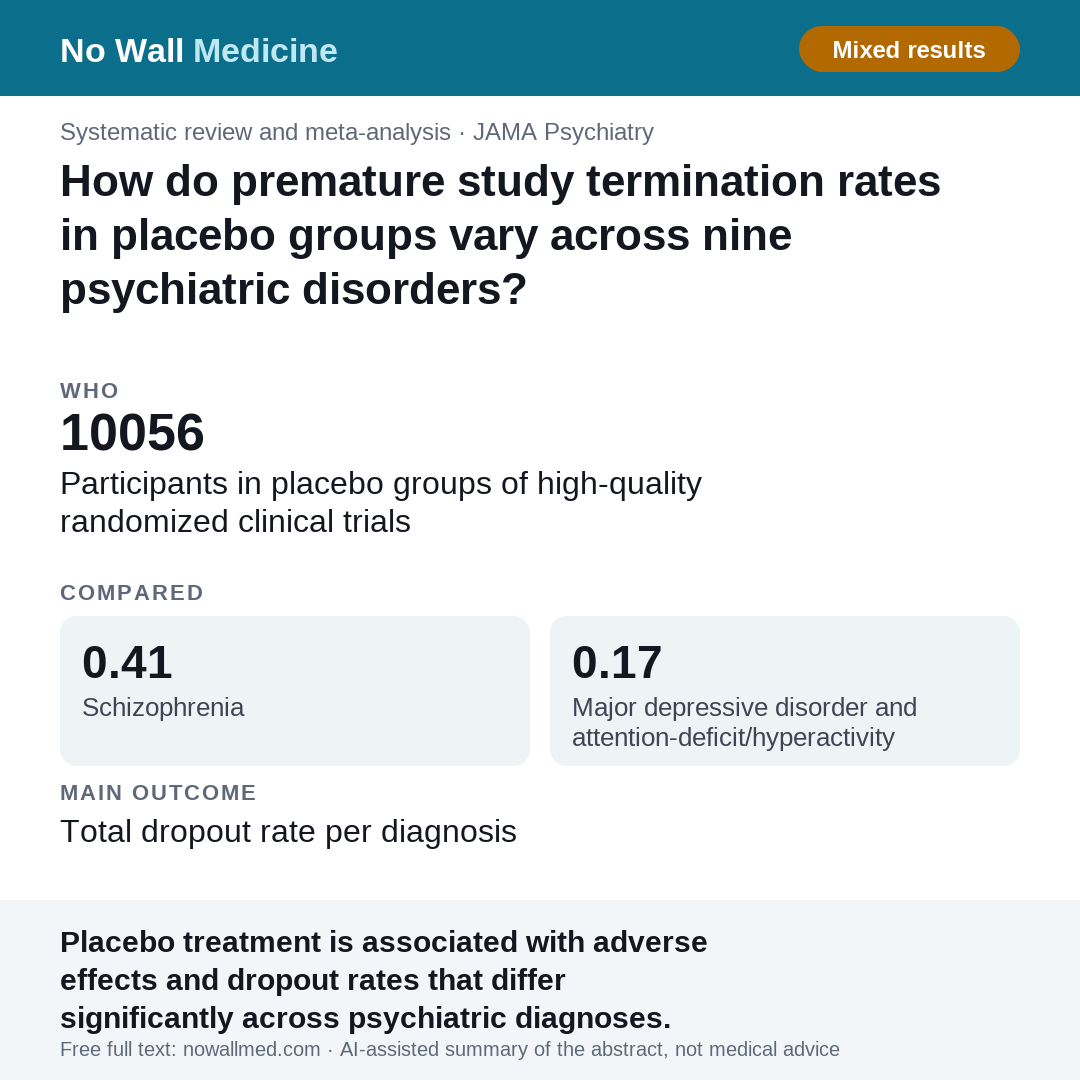
How do premature study termination rates in placebo groups vary across nine psychiatric disorders?
Who
10056
Participants in placebo groups of high-quality randomized clinical trials
Compared
0.41Schizophrenia (95% CI, 0.35-0.48)
0.17Major depressive disorder and attention-deficit/hyperactivity disorder (95% CI, 0.11-0.25)
Main outcome
Total dropout rate per diagnosis
Bottom line: Placebo treatment is associated with adverse effects and dropout rates that differ significantly across psychiatric diagnoses.
JAMA Psychiatry · 2025-04-16Download image
Clinical question: How do premature study termination rates in placebo groups vary across nine psychiatric disorders?
Why it matters: Comprehensive comparisons of negative effects, known as nocebo effects, are lacking across different psychiatric diagnoses.
Key points
- Researchers analyzed 90 high-quality randomized clinical trials involving 10,056 participants to compare placebo dropout rates across nine psychiatric diagnoses.
- Total dropout rates differed by diagnosis, with schizophrenia showing the highest rate at 0.41 while major depressive disorder and ADHD showed the lowest at 0.17.
- The most common negative effect was dropping out due to lack of effect, which was highest in schizophrenia and mania.
Headline and key points written with AI from the paper’s abstract, with every number checked against it. Read the paper before relying on them.
Was this summary helpful?
Subject terms
Cite this article
Bschor T, Unger J, Nagel L, Schwarzer G, Baethge C. Negative Effects During Placebo Treatment: A Systematic Review and Meta-Analysis. JAMA Psychiatry. 2025. doi:10.1001/jamapsychiatry.2025.0336
Spotted a mistake? Suggest a correction
Top studies every Monday
The week’s key trials and guidelines in your specialties, plus any topics you follow. By email, free.
Get the weekly digest